Connect with us


BUSINESS

Polaris Bank, Eventful Lift 3 Firms With Business Expansion Grants At The Fashion Souk

Published

on

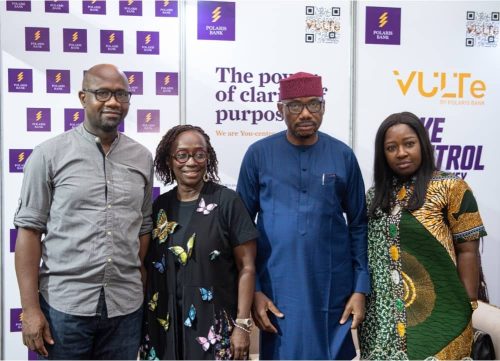
Polaris Bank and Eventful Limited have reinforced their support for Nigeria’s Small & Medium Enterprises (SMEs) sector with three firms empowered at the just-concluded 5th Lagos Fashion Souk to further grow their businesses.

While handing the cheques to the winners,  who were successful in a business pitch, Polaris Bank’s Managing Director/CEO, Mr. Innocent C. Ike, disclosed that the most important factor required by existing and budding entrepreneurs is to get investors interested in their businesses is the entrepreneurial spirit.

Aside from the business pitch winners, special prizes were also given to the Most Original Store and Best Decorated Store at the Fashion Souk. The winners were given equipment grants by Polaris Bank to further expand their businesses.

The overall winner of the pitch, Mrs. Oluwatosin Ogunbanjo, who runs a leather bag and shoe company, Avenue 7, got N750,000 and first runner-up, Victoria Udoh, a painting on Fabric Company, Vudoh was given N500,000 while the second runner-up, Tunde Issa, a Tailor and Founder of the male clothing line company, RoyalKlassicKoutoure, went home with N250,000.

The hugely attended one-day Fashion Souk/business fair which was held at the prestigious Harbour Point facility in Victoria Island, Lagos, on Sunday, provided a platform for more than 150 SMEs in Nigeria’s fashion industry to showcase their creativity, product lines, and economic potentials. Some of the SMEs categories at the fair included: manufacturers, retailers, leather, and jewelry/accessories.

The objective of sponsoring the Fashion Souk according to Polaris Bank was a reinforcement of its support to SMEs as the catalyst for propelling the growth of the Nigerian economy. 

Shedding more light on how fundamental entrepreneurial spirit is for business success, the Polaris Bank CEO said he has a habit of telling entrepreneurs that what makes the difference, “Is the creative idea that an entrepreneur has and the ability to sit down and put it together diligently in a well-articulated manner.”

He added that “Creative ideas are the only way to attract funding from banks and individuals who will like to invest in the idea because they will see clearly that it is viable. He said the only way an entrepreneur can achieve that is by sitting down and putting his thoughts together and by making sure he crosses all the T’s and dots all the I’s.”

According to the Polaris Bank CEO, “When such a business proposal is presented to any investor Bank, it will be very convincing and such an entrepreneur will not get a ‘no’ for an answer.”

Earlier in her address too, Chairman of Eventful/Convener of the Event, Mrs. Yewande Zaccheus, appreciated Polaris Bank for consistently supporting SMEs in the country over the years, remarking that the Bank is not only talking but actually putting its money where its mouth is and urged the Bank to sustain the Partnership for a sustainable Fashion Souk.

The highlight of the Fashion Souk was the product launch that SMEs could leverage the Bank’s loan products like Polaris Business Loan, Invoice Discounting facility, and LPO financing among others were pitched with the participating SMEs.

The Bank has developed SME-friendly products to cater to the needs of SMEs based on sector/industry-specific, ranging from SMEs in the Health sector, Education, Manufacturing, General business, Agriculture, Export, Creative Industry, etc.” 

Polaris Bank also provides business advisory at no cost while SMEs are encouraged to send in their business proposal for review via- smebusiness@polarisbanklimited.com

Aside from Polaris Bank, the fashion fair also featured product launches by other top participating Fashion companies like Arami, Tara, Mobos, and Zaron; as well as runways by Clatural, Aaboux/Cornocupia, Woora, and Dyelab, among others.

Nigeria’s fashion sub-sector has huge and untapped potentials capable of reducing the rate of unemployment in the country. According to statistics by the Fashion Association Designers of Nigeria (FADAN), Nigeria’s fashion industry is valued at $10 billion. Africa Development Bank (AfDB) also projects the global fashion industry’s worth to be over $2.5 trillion with Africa’s share estimated at less than 1% of that value in 2020, putting Africa’s entire textile/clothing market at more than $31 billion.

BUSINESS

UBA Foundation Deepens Pan-African Impact, Delivers Continent-Wide Aid To Vulnerable Communities, Others.


Published

on

As part of its Food Bank and Giving Back drive, the bank impacted over 100,000 individuals in the communities with essential items and cash gifts, between November 2025 and January 2026, to alleviate the financial strain associated with the end of the year and beginning of the new year, underscoring the bank and Foundation’s unwavering commitment to fostering hope, and resilience among individuals living within the communities where it operates.

In Nigeria for instance, UBA Foundation’s outreach extended to beneficiaries across all the regions of the country, impacting homes, and IDP camps including the Daughter of Mercy Mother of Mary Orphanage Home in Abia; the Trinitarian Foundation for Orphans and the Helpless in Ebonyi; The Destitute Home Okobaba in Lagos; Oyiza Orphanage and Foster Foundation in Oyo; Itsoghena Orphanage Home in Edo; Enoima Children Home in Akwa Ibom; Yekope Orphanage in Kogi; IDP Camps in Niger and Borno; UMCN Orphanage Home in Taraba; Kebbi Children’s Home; and the Orphanage Home in Dutse, Jigawa.

In Africa, UBA Foundation’s humanitarian efforts and nutritional support were also replicated in the Benin Republic, Burkina Faso, Cameroon, Chad, Congo Brazzaville, Congo DRC, Côte d’Ivoire, Gabon, Ghana, Guinea, Kenya, Liberia, Mali, Mozambique, Senegal, Sierra Leone, Tanzania, Uganda, and Zambia, where several hundreds of thousands were also impacted.

The Managing Director/CEO, UBA Foundation, Bola Atta, who visited some of the orphanages including the Destitute Home Okobaba, Lagos where she distributed non-perishable food items and school materials to adults and students alike, emphasised the foundation’s belief in impacting lives all-year round, to create lasting effect and touch the lives of people in all areas, regardless of location and economic barriers.

She said, “At UBA Foundation, we believe that true development begins with compassion and action. Through our various Food Bank and Giving Back initiatives, we are not only providing nourishment and essential support but also restoring hope and creating pathways for children and families to learn, grow, and thrive. This is our commitment to Africa: to show up consistently, act responsibly, and leave no community behind.”

Explaining further, she said, “Our various interventions aim to support people by equipping them not only with the right tools but also with the essential nourishment required for cognitive development and physical well-being.”

The foundation has a long-standing tradition of philanthropy, with numerous initiatives across Africa, including the National Essay Competition, The Read Africa Project, Tree Planting for Sustainability, Health Outreaches, Each1 Teach 1, Kindness Connect, Food Bank, and others, aimed at empowering the underprivileged and poverty alleviation.

UBA Foundation, the CSR arm of the UBA Group, is committed to the socio-economic betterment of the communities in which the bank operates, focusing on development in the areas of education, environment, economic empowerment, and special projects.

Continue Reading

BUSINESS

Turkey Requests Inclusion In Nigeria’s E-Visa System To Ease Business Travel

Published

on

Turkey has asked Nigeria to include its citizens in the country’s electronic visa (e-visa) system to simplify visa processing and strengthen bilateral ties.

Mehmet Poroy, the Turkish ambassador, made the request when he met Olubunmi Tunji-Ojo, Nigeria’s minister of interior, in Abuja on Tuesday.

In a statement issued on Tuesday, Mary Ali, the ministry’s head of press and public relations, said Mehmet sought Turkey’s inclusion in the system to ease business travel for Turkish investors.

According to Ali, the ambassador explained that the absence of a Nigerian visa office in Istanbul poses logistical challenges for Turkish applicants, who must travel to Ankara to complete visa processes.

“Tunji-Ojo assured that denying visas to genuine Nigerian or Turkish businesspeople is not in the interest of either country,” the statement reads.

“He emphasised the Ministry’s commitment to transparency, dialogue, and continuous improvement in visa administration, while reaffirming Nigeria’s openness to legitimate investors and international business partners.”

The ministry’s spokesperson said the minister and the ambassador also discussed faster visa processing for Nigerian business travellers to Turkey, concerns over visa clarity for Turkish investors visiting Nigeria, and verification of documents, including marriage certificates.

She said Tunji-Ojo clarified that all marriage certificates issued under Nigerian law are constitutionally valid and should not require additional verification.

Both sides reaffirmed commitments to transparent, practical visa policies, openness to legitimate investors, and broader diplomatic cooperation.

In November, Poroy said Ankara authorised its embassy in Abuja to issue visas directly to Nigerian business travellers without seeking clearance from Turkey.

He said the step was a major boost for economic cooperation between both countries.

Continue Reading

BUSINESS

World Bank Raises Nigeria’s 2026 Economic Growth Rate Projection To 4.4%

Published

on

The World Bank has increased its projection for Nigeria’s economic growth rate for 2026 to 4.4 percent from the 3.7 percent forecasted in June 2025.

World Bank announced the increase in its 2026 ‘Global Economic Prospects’ report on Tuesday.

The global financial institution also upgraded Nigeria’s economic growth rate for 2027 to 4.4 percent from 3.8 percent.

In addition, the Bretton Woods institution estimated that Nigeria’s economy grew by 4.2 percent in 2025, compared to the 3.6 percent forecasted in June last year.

Also, the World Bank increased its 2026 global economic growth rate projection from 2.4 percent to 2.6 percent.

In the report, the financial institution also estimated a 2.7 percent economic growth rate for the 2025 period compared to the 2.3 percent forecasted in June last year.

According to the report, the 2027 global economic growth rate is projected at 2.7 percent, compared to the 2.6 percent forecasted in June 2025.

World Bank said the global economy is proving more resilient than anticipated despite persistent trade tensions and policy uncertainty.

However, the bank noted that while global growth remains stable, it is concentrated in advanced economies and is unlikely to reduce extreme poverty, with the 2020s on track to be the weakest decade since the 1960s.

“The resilience reflects better-than-expected growth — especially in the United States, which accounts for about two-thirds of the upward revision to the forecast in 2026,” the World Bank said.

The institution stated that global growth is expected to slow in 2026 as trade-related boosts fade, but easing financial conditions and fiscal expansion are anticipated to mitigate the impact.

It added that inflation is projected to edge down to 2.6 percent in 2026, with growth expected to pick up in 2027 as trade and policy uncertainty ease.

Indermit Gill, the World Bank Group’s chief economist, said with each passing year, the global economy has become less capable of generating growth while appearing more resilient to policy uncertainty.

“But economic dynamism and resilience cannot diverge for long without fracturing public finance and credit markets,” Gill said.

“Over the coming years, the world economy is set to grow slower than it did in the troubled 1990s, while carrying record levels of public and private debt.

“To avert stagnation and joblessness, governments in emerging and advanced economies must aggressively liberalise private investment and trade, rein in public consumption, and invest in new technologies and education.”

Continue Reading


Join Us On Facebook

Most Popular


Warning: Undefined array key "slug" in /home/porsch10/public_html/wp-includes/class-wp-theme-json.php on line 2117

Warning: Undefined array key "slug" in /home/porsch10/public_html/wp-includes/class-wp-theme-json.php on line 2117

Warning: Undefined array key "slug" in /home/porsch10/public_html/wp-includes/class-wp-theme-json.php on line 2117