



Connect with us


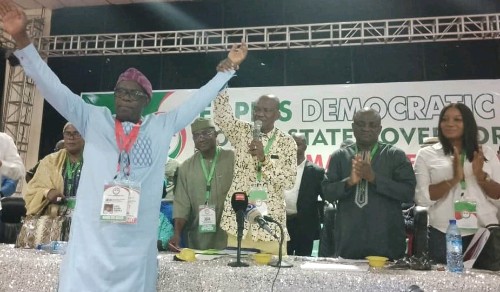
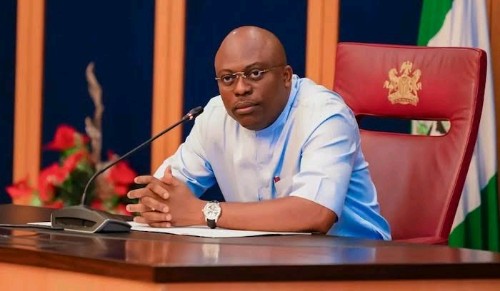
Ayodele Fayose the Governor of Ekiti State is not thinking of apologising to anybody for adopting his deputy, Kolapo Olusola, as the Peoples Democratic Party’s governorship candidate for the 2018 governorship election.

Speaking at a declaration of ambition (tagged ‘baby declaration’) by Olusola in Ado Ekiti on Tuesday, Fayose also told the former Minister of Works, Prince Dayo Adeyeye, and other aggrieved PDP aspirants that they were free to leave the PDP for other parties.

Adeyeye, a former Nigerian High Commissioner to Canada, Dare Bejide; a former Commissioner for Justice, Owoseni Ajayi; and a Senator representing Ekiti-South, Mrs. Abiodun Olujimi, had kicked against the adoption of Olusola by Fayose as his candidate, labelling it arrogant and anti-democratic.

But Fayose at the rally said, “The PDP has taken a position; I say we have taken a position and we have no apologies for that and the position is that Olusola should take over after me as the governor of Ekiti.

“It doesn’t matter to us how many people that are abusing us by our action. They are even free to join our adversaries, but we will defeat them as God liveth.”

The governor said the declaration was a show of strength to warn the APC, adding, “We are here, we have what it takes to win an election. They say they want to rig election; that will not happen here in Ekiti; they should look elsewhere.

“They must know that politics is not played in the other room; it is played in the living room. We are going to play politics of the living room and not the other room.

POLITICS

Emergency Plenary: National Assembly Moves To Shift Presidential Poll To Feb13

Published

on

The National Assembly announced on Sunday that it would reconvene its plenary session on Tuesday, February 17, 2026, cutting short its recess amid indications that lawmakers may review the date set for the 2027 presidential election.

Findings by our correspondent showed that the National Assembly may shift the presidential poll to February 13, 2027.

In a notice signed by the Clerk to the National Assembly, Kamoru Ogunlana, senators and members of the House of Representatives were directed to resume sitting at 11 am and adjust their schedules accordingly, as “very crucial decisions” are expected to be taken during the session.

“I am directed to inform all Distinguished Senators and Honourable Members of the National Assembly that the Senate and House of Representatives shall reconvene plenary session at 11:00 am on Tuesday, 17th February 2026, respectively,” the notice read.

“Consequently, all Distinguished Senators and Honourable Members are kindly requested to take note and reschedule their engagements accordingly to enable them attend the session, as very crucial decisions shall be taken by each Chamber during the session,” Ogunlana added.

However, sources within the National Assembly, speaking to newsmen on condition of anonymity, revealed that the public notice masks a more pressing agenda.

“It is more of an extraordinary plenary session to review the 2027 presidential election date as stipulated in the Electoral Act amendment.

That is why our recess has been cut short through the announcement made by the Clerk of the National Assembly,” a senator confided.

“The ultimate aim is to give legislative backing to INEC’s request to address the concerns raised regarding the 2027 election slated to hold during Ramadan,” the lawmaker added.

Another Senate insider told The PUNCH: “If all goes according to plan, the presidential poll date may be brought forward to February 13 from the previously announced February 20 by INEC.”

Similarly, a Senator said: “This session is crucial. It is about more than dates—it is about ensuring that every Nigerian, regardless of faith, has a fair opportunity to participate in the electoral process. The decisions we take here could define the credibility of the 2027 elections.”

The development comes barely a week after the Senate, bowing to public pressure, approved the electronic transmission of election results to the Independent National Electoral Commission’s Result Viewing Portal, while retaining manual collation as a backup in areas where technology may fail.

The emergency reconsideration arose from a disputed clause in the Electoral Act (Repeal and Re-enactment) Amendment Bill, 2026, which had triggered days of nationwide protests and intense criticism from opposition figures, civil society groups, and youth movements.

Despite approving the electronic transmission system, the Senate stopped short of making it compulsory and rejected calls for real-time uploads of results—a key demand of protesters who had accused lawmakers of undermining electoral integrity ahead of the 2027 general elections.

Under the revised provision, presiding officers at polling units must electronically transmit results to the IReV portal after voting concludes and documentation is completed. Where electronic transmission is not possible due to network challenges, the manual result sheet, Form EC8A, will serve as the primary basis for collation and declaration.

Senate President Godswill Akpabio, while putting the motion to a voice vote, urged senators who opposed the amendment to formally challenge it on the floor.

With plenary set to resume, lawmakers are expected to continue deliberations on pending bills, committee reports, and other legislative matters, including further work on the Electoral Act amendment and related reforms ahead of the 2027 polls.

Meanwhile, the Joint National Assembly Conference Committee, constituted to reconcile differences in the Electoral Amendment Bill passed separately by the Senate and the House of Representatives, is expected to meet on Monday. The harmonised bill will subsequently be transmitted to President Bola Tinubu for assent.

It was learned that the joint panel, comprising members from both chambers, has been given a one-week window to resolve contentious provisions in the bill.

Earlier, it was reported that INEC acknowledged public concerns over the timing of the 2027 general elections, which coincides with the holy month of Ramadan, a period of fasting and spiritual reflection for millions of Nigerian Muslims.

The commission indicated that it may seek legislative intervention if necessary.

Continue Reading

POLITICS

Governor Dauda Lawal Wins New Telegraph Governor of the Year Award for Remarkable Development Initiatives

Published

on

In a significant recognition of his leadership and developmental agenda, Dr. Dauda Lawal, the Executive Governor of Zamfara State, has been awarded the prestigious New Telegraph Governor of the Year Award for Projects. This accolade comes just a day after he received the Governor of the Year award from Leadership Newspaper in Abuja.

The gala ceremony took place at the renowned Oriental Hotel, Lekki, Lagos, on Friday, February 13, 2026, showcasing the governor’s exceptional contributions to the state.

The award was presented to Governor Lawal by Aremo Olusegun Osoba, former Governor of Ogun State and a prominent chieftain of the All Progressives Congress (APC), alongside His Excellency Senator Orji Uzor Kalu, Publisher of New Telegraph and former Governor of Abia State. Both leaders expressed their admiration for Governor Lawal’s substantial investments in crucial sectors such as education, road construction, agricultural development, security enhancement, and capacity building. These initiatives have played a vital role in transforming Zamfara into a flourishing hub of infrastructural renewal and socio-economic growth.

During the award dinner, event organizers emphasized that Governor Lawal’s selection was based on his impressive track record of creating impactful projects and driving sustainable development within the state. The governor’s commitment to transparency, fiscal prudence, and exceptional budget performance has set a new standard for governance in Zamfara.

In his acceptance speech, Governor Lawal reflected on his campaign promises aimed at rescuing the state from years of infrastructural neglect. He noted that visible transformations are taking place, with Zamfara steadily evolving into a well-structured and efficient entity. He highlighted his administration’s focus on revamping the civil service to enhance efficiency and integrating technology to improve governance.

Governor Lawal also reassured the attendees that his administration is steadfastly on course to complete all ongoing projects, meeting and exceeding established standards. He underscored his unwavering commitment to the overall development of Zamfara, vowing to continue elevating the state from its previous struggles to a vibrant and sustainable community committed to the welfare of its citizens.

As a testament to his belief in collaborative governance, he dedicated the award to the resilient and supportive people of Zamfara. He expressed deep gratitude for their trust and encouragement, emphasizing that their faith in his leadership fuels his drive toward ensuring a prosperous future for the state.

Continue Reading

BIG STORY

African Leaders Should Be Under 50, I Sometimes Had Just 2 Hours Of Sleep As President —- Jonathan

Published

on

Former President Goodluck Jonathan has called for a generational shift in African leadership, urging countries across the continent to deliberately promote younger leaders between the ages of 25 and 50, who he said are more physically and mentally equipped for the rigours of modern governance.

Jonathan made the call on Thursday in Abuja at the International Memorial Lecture and Leadership Conference marking the 50th anniversary of the assassination of former Head of State, General Murtala Ramat Muhammed.

Reflecting on the demands of leadership, the former president recalled that while in office, he sometimes had no more than two hours of sleep in 24 hours, stressing that advanced age can limit the capacity to cope with the pressures of governance.

“Why do we begin to think that you must be a hundred years old before you can rule your country?” Jonathan asked.

He noted that leadership requires unusual stamina and resilience, arguing that younger leaders are better positioned to withstand the pressure.

“If they need to stay awake for 24 hours, they can stay awake for 24 hours. When I was in office, some days I did not sleep up to two hours. If you subject an older person to that kind of stress, the person will spend 50 per cent of the time in hospital,” he said.

Jonathan aligned his position with the spirit of Nigeria’s “Not Too Young To Run” movement, which seeks to lower age barriers for elective offices and encourage youth participation in politics.

“I have to reinforce the Not Too Young To Run movement. We have to bring some of these age limits down. If we are looking for people who can run nations in Africa, we should look within the 25 to 50 age bracket. That is when you can be very vibrant, physically strong and mentally sound,” he said.

He also questioned the practice of some public office holders spending extended periods outside their states or countries.

“In a country like the United States, some governors do not leave their states for four years. But here, some of our governors spend 50 per cent of their time outside. So who runs the state? Why will we not have security problems? Coming of age must transcend many things. First and foremost, we must have the discipline to manage ourselves,” he added.

Reflecting on the legacy of General Murtala Muhammed, Jonathan said the late leader demonstrated that age was not a barrier to decisive and visionary leadership. Muhammed became Head of State at 38 and, despite ruling for only 200 days, left a lasting impact.

“General Murtala Muhammed assumed office at the very young age of 38. Despite a tenure of only 200 days, his achievements were profound because he was driven by a clear, unyielding vision.

“His leadership sent a clear message: leadership was to serve the national interest, not personal ambition,” Jonathan said.

He also referenced other Nigerian leaders who assumed office at relatively young ages, including General Yakubu Gowon, who became Head of State at 32 and later introduced the National Youth Service Corps, which remains in existence to this day.

“A young man of 32 managed to pull the country through the civil war. So why do we now think leadership must only come at old age?” he asked.

However, Jonathan cautioned that youth alone is insufficient without discipline, patriotism and strong institutions. While praising Muhammad’s decisiveness, he stressed that democracy depends more on institutions than on individuals.

“Democracy requires vision rather than decree. It requires persuasion instead of command. It depends on institutions, not individuals. Above all, it requires respect for the rule of law and the willingness to submit power to the will of the people,” he said.

He urged African leaders to view governance as stewardship rather than entitlement and encouraged young people to see leadership as service.

“Young people must see leadership as service, not entitlement. Leaders must see governance as stewardship, not a right,” he said.

“I sometimes remember when I contested as a deputy governorship candidate. You had to be 40 years old before you could even be a senator, a deputy governor or a governor, not to talk about president. Yet the Head of State we are celebrating today assumed office at 38,” he said.

Calling on Nigerians and Africans to draw lessons from history, Jonathan said leadership should be measured by impact rather than duration in office.

“As we mark 50 years of General Murtala Muhammed’s legacy, let us remember that leadership is not measured by how long you govern; it is measured by the courage to act decisively when the nation needs direction and by the impact you make on society,” he added.

He emphasised that while military leaders govern by command and authority, democracy demands a different approach anchored on strong institutions, credible electoral bodies, an independent judiciary, well-trained security agencies and accountable governance systems.

“While General Murtala Muhammed symbolised decisive leadership, our democratic future depends on strong institutions. Democracy requires vision rather than decree. It requires persuasion instead of command. It depends on institutions, not individuals. Democracy also demands restraint and respect for the rule of law,” Jonathan said.

Continue Reading

Most Popular


Warning: Undefined array key "slug" in /home/porsch10/public_html/wp-includes/class-wp-theme-json.php on line 2117

Warning: Undefined array key "slug" in /home/porsch10/public_html/wp-includes/class-wp-theme-json.php on line 2117

Warning: Undefined array key "slug" in /home/porsch10/public_html/wp-includes/class-wp-theme-json.php on line 2117