Connect with us


BIG STORY

Naira Redesign: CBN Directs Banks To Open Saturdays To Ease Old Notes Recovery

Published

on

The Central Bank of Nigeria has instructed commercial banks in the country to work on Saturdays till January 31, 2023, to enable customers return existing naira notes.


The CBN had announced plans to redesign the N200, N500, and N1,000 banknotes, and release the new notes by December 15, 2022.


Speaking at the CBN fair in Ilorin, Kwara State capital, on Thursday, the CBN Director, Corporate Communications Department, Osita Nwasinobi, said that the new and existing notes shall remain legal tender until January 31, 2023, when the existing notes shall cease to be legal tender.


The CBN fair has as its theme, “Promoting financial stability and economic development.”


Represented by acting director, Corporate Communications, CBN, Akpama Uket, the director said that

Deposit Money Banks have been directed to immediately start returning the existing currencies to the CBN.


Naira redesign will curb corruption, terrorism financing – Sani

“They have also been instructed to receive the existing banknotes beyond the threshold stipulated by the Cashless Policy without charges to customers.


“Consequently, you must return all the current N200, N500, and N1,000

banknotes to your bank before the expiration of the deadline,” he said.


Meanwhile, the CBN warned Nigerians of the consequences of mishandling naira notes, saying, “Let me also reiterate the need to handle the naira with care. The naira remains a symbol of our national pride. Treat it with utmost dignity.


“Do not spray, squeeze or counterfeit the naira, as default goes with consequences.”

BIG STORY

FG Officially Declares Kidnappers, Bandits As Terrorists

Published

on

The Federal Government has officially designated kidnappers and violent armed groups as terrorists, marking a major escalation in Nigeria’s response to abductions, attacks on farmers, and community violence.

The announcement was made on Monday by Information Minister Mohammed Idris during the end-of-year press briefing in Abuja.

This move signals a shift from treating mass kidnappings and rural attacks as ordinary crimes to confronting them under full counterterrorism measures.

“Henceforth, any armed group or individual that kidnaps our children, attacks our farmers, and terrorises our communities is officially classified and will be dealt with as a terrorist,” Idris said.

“Now, the era of ambiguous nomenclature is over. If you terrorize our people, whether you are a group or you are an individual, you are a terrorist and will be classified as such. There is no name hiding under this again,” the minister said.

He added that the policy would strengthen intelligence sharing and operational coordination across security agencies, allowing for faster and more decisive action.

The minister highlighted that improved inter-agency collaboration has already produced results, noting that in 2025, two of the most internationally wanted criminals were captured through coordinated operations.

In a bid to secure vulnerable rural areas, Idris also announced the deployment of trained and equipped forest guards, saying that these personnel will combine surveillance, local intelligence, and rapid-response capabilities to secure forests and remote locations often used as hideouts by criminal groups.

By classifying kidnappers as terrorists, the government is signaling zero tolerance for abductions and rural violence, while expanding the powers of security forces.

The forest guard initiative is expected to disrupt criminal supply routes, dismantle camps, and provide reassurance to farming communities affected by insecurity.

He noted the arrest of the ISWAP head residing in Nigeria, described as one of the most wanted terrorists on the African continent, who had a substantial bounty placed on him by the United States.

“The most internationally wanted criminals, the ISWAP head residing in Nigeria, has been captured through the coordination of all the security agencies and those also in the intelligence community.

“Don’t forget that Abu Barra was captured a few months ago, and he was also presented to the public by the National Security Advisor and other security chiefs.

“This is one of the most wanted terrorists on the African continent, and he was captured through the coordination of our security forces.

“Remember also, this was someone who had a large sum of money put on his head by even the Americans to capture him and bring him to justice.

“As we speak today, this gentleman, together with his chief of staff, are undergoing and having their day in court, and he is going to get justice that befits them,” he said.

Continue Reading

BIG STORY

Nigerian, Four Pakistanis Charged In US For ‘$41m Insider Trading, Market Fraud Scheme’

Published

on

Six individuals, including a Nigerian, have been charged by the United States Federal Bureau of Investigation (FBI) for alleged involvement in “insider trading and market manipulation on a massive scale”.

The individuals were identified as Izunna Okonkwo, a Nigerian, and four Pakistanis — Muhammad Saad Shoukat, Muhammad Arham Shoukat, Muhammad Shahwaiz Shoukat, and Daniyal Khan.

Gyunho Justin Kim was charged in a separate complaint.

In a statement published on the website of the US Department of Justice, the FBI said the suspects participated in “a years-long scheme to trade securities based on material non-public information (MNPI)”.

The FBI said the suspects were charged to court in a case that stemmed from “three overlapping securities fraud schemes that occurred at various points from June 2020 through February 2024”.

The FBI said Kim worked at an investment bank that was involved in multiple mergers and acquisitions of publicly traded healthcare and biopharmaceutical companies, adding that he allegedly obtained MNPI about many pending deals.

Kim was said to have illegally shared the MNPI with Muhammad Saad Shoukat, who traded with the information, and shared same with others.

“Saad Shoukat also tipped off others — including Arham Shoukat, Shahwaiz Shoukat, Khan, and Okonkwo — who similarly traded and profited from the MNPI,” the FBI said.

“Overall, Saad Shoukat and his co-conspirators received illicit profits from the insider trading scheme totalling at least $41 million.

“Saad Shoukat, Arham Shoukat, and others actively manipulated the stock price of Olema, a publicly traded company. Olema focused on developing breast cancer treatment through a drug called OP-1250.

“From the spring of 2021, Saad Shoukat and Arham Shoukat began investing in Olema stock and encouraged others to invest in it.

“After buying substantial stock in Olema, Saad Shoukat, Arham Shoukat, and others accessed confidential information showing that OP-1250 was less effective than Saad Shoukat and Arham Shoukat had hoped.

“Saad Shoukat, Arham Shoukat, and others then falsified the OP-1250 data the co-conspirators had illegally accessed, and publicly disseminated it in a manner that made it look like the data was real and came from Olema.

“The release of the false data — which inflated the drug’s efficacy — temporarily caused Olema’s stock price to increase, during which Saad Shoukat, Arham Shoukat, and others profited and avoided losses by selling large numbers of shares in Olema stock.

“Saad Shoukat, his brothers, and others also manipulated the stock price of Opiant, another publicly traded company. Opiant was developing an opioid overdose treatment.

“Kim provided MNPI to Saad Shoukat about a company seeking to acquire Opiant. Based on that MNPI, Saad Shoukat and others bought Opiant stock. But that potential acquisition stalled, and Saad Shoukat and others were stuck with their stock purchases.

“In response, in or around April 2022, Saad Shoukat, his brothers, and others — using a fake Opiant website and fake Opiant email addresses that appeared legitimate — caused the publication of a fake press release announcing a purported merger and acquisition involving Opiant and another company.

“The fake press release drove up Opiant’s stock approximately 29%. Saad Shoukat, his brothers, and others profited by selling off shares during that spike, causing substantial losses to victim investors.”

If convicted, the suspects risk more than 20 years’ imprisonment.

Continue Reading

BIG STORY

Only Oyo Throne Can Confer Yorubaland Titles —– Alaafin

Published

on

The Alaafin of Oyo, Oba Abimbola Akeem Owoade I, has stated that he is the only traditional ruler with the authority to confer chieftaincy titles bearing the name “Yorubaland.”

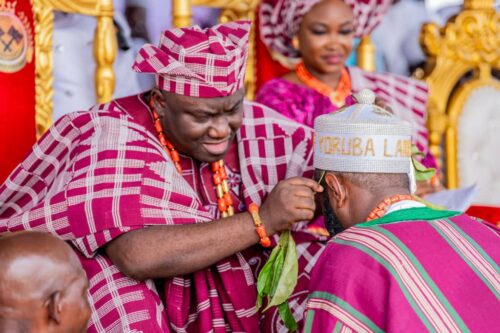
The monarch made the assertion on Sunday at the Aganju Forecourt of the Oyo Palace during the installation of former Zamfara State Governor, Senator Abdul-Aziz Yari, as Obaloyin of Yorubaland, and Seyi Tinubu as Okanlomo of Yorubaland.

Owoade said chieftaincy in Yoruba tradition is neither ornamental nor granted as a favour, but a serious responsibility rooted in history, authority and service.

According to him, the Oyo throne has historically functioned as a central coordinating authority for the Yoruba people, a role that was recognised during the colonial era and sustained in post-independence governance.

He explained that titles carrying the name “Yorubaland” are collective in nature, representing the entire Yoruba nation rather than any single town or kingdom.

The monarch, therefore, stated that any ‘Yorubaland’ title must be conferred by an authority whose jurisdiction historically spans the whole region.

The Alaafin noted that this position has been validated by colonial records, post-independence councils, scholarly works and judicial pronouncements, including decisions of the Supreme Court of Nigeria.

Describing the newly installed titles as positions of trust, Oba Owoade said they demand courage, loyalty and selfless service to the Yoruba people, adding that such honours are intended to strengthen unity and respect for tradition across Yorubaland.

He urged the new titleholders to discharge their duties with humility and ensure that their roles promote dignity, cohesion and the collective good of the Yoruba people.

He said, “We are gathered here today for a purpose that goes beyond celebration. We are here to witness history and to place responsibility where tradition has long placed it. Chieftaincy, in our culture, is not an act of favour. It is not decoration. It is a duty, conferred only when history, authority, and responsibility align.

“From the earliest organisation of the Yoruba people, authority was never vague. Our forebears understood structure. This understanding gave Yorubaland stability long before modern governance arrived.

“The throne of Oyo emerged in that history as a coordinating authority, by responsibility. When colonial administration came, it did not invent this reality; it encountered it and recorded it. By 1914, Oyo Province had become the largest province in Southern Nigeria, covering 14,381 square miles. It was bounded in the north by Ilorin and Kontagora, in the east by Ondo and Ijebu, in the south by Ijebu and Abeokuta, and in the west by French Dahomey. This reflected recognised leadership over a wide and diverse space.

“This history explains why certain chieftaincy titles are different in nature. Titles that bear the name ‘Yorubaland’ are not local titles. They are collective titles. They speak not for one town or one kingdom, but for the Yoruba people as a whole. Such titles must therefore proceed from an authority whose reach, by history and by law, extends across Yorubaland.

“Today, I do not speak to provoke debate. I speak to state order. Among the Yoruba, authority has never been a matter of assumption or convenience. It has always been a matter of history, structure, and law. Thrones were not created equal in function, even though all are sacred in dignity.

“From the earliest organisation of Yorubaland, the Alaafin of Oyo occupied a central and coordinating authority—an authority that extended beyond the walls of Oyo and into the collective political life of the Yoruba people. This was not self-declared. It was recognised, enforced, and sustained across generations. Colonial records acknowledged it. Post-independence councils preserved it. Scholars documented it.

“And finally, the Supreme Court of Nigeria affirmed it. The law is clear. History is settled. Chieftaincy titles that bear the name Yorubaland—titles whose meaning, influence, and obligation are not confined to a single town or kingdom—fall under a singular, established authority. That authority is the throne of Oyo.”

Continue Reading


Join Us On Facebook

Most Popular


Warning: Undefined array key "slug" in /home/porsch10/public_html/wp-includes/class-wp-theme-json.php on line 2117

Warning: Undefined array key "slug" in /home/porsch10/public_html/wp-includes/class-wp-theme-json.php on line 2117

Warning: Undefined array key "slug" in /home/porsch10/public_html/wp-includes/class-wp-theme-json.php on line 2117