Connect with us


The Lagos State Government has sacked five officials of the Lagos State Traffic Management Authority, LASTMA, for various forms of offenses ranging from extortion, harassment and violation of Lagos State Public Service Rules.

General Manager, LASTMA, Olawale Musa disclosed this on Thursday, saying that the agency recommended five of the unruly officials for dismissal and demote 14 others, adding that 15 others were issued letters of warning, while three were exonerated after careful investigation.

“The affected officers appeared in the month of April before the Personal Management Board (discipline) to defend and make presentation on various actions that bothered on indiscipline against them,” the agency said. Besides, Musa condemned incessant attacks of traffic officials by motorists, especially commercial drivers, saying the officials were on the roads to ensure motorists and commuters get to their destinations without stress and discomfort.

“It was disheartening, callous and barbaric seeing a LASTMA official, Olanrewaju Yusuf stabbed on duty at Onipanu last week Wednesday while performing a lawful duty, by a driver of commercial yellow bus with registration number EPE 714 XP for picking passengers at undesignated place and conductor hanging at the door. I like to use this medium to call on motorists to always report erring officials to the agency and not adopt self help as anybody caught attacking officials of the agency would face full wrath of the law,” Musa said.

He also appealed to motorists plying routes where major construction works were ongoing to bear with the state government and comply with traffic directive, saying concerted efforts have been put in place to deliver the projects on schedule. Musa, who spoke after monitoring flow of traffic along Lagos-Abeokuta and Apapa- Oshodi Expressway, said the road projects across the State were being implemented by the State Government to ultimately achieve free flow of traffic within the metropolis, and thereby boost economy and commerce.

The State Government is currently working on major road projects including Lagos – Abeokuta Expressway, Oshodi- Apapa Expressway, Murtala Muhammed International Airport Road, Agege Pen Cinema, among other massive roads reconstruction across the State. Musa said necessary engineering research and traffic count had been done before the construction of Bus Rapid Transit (BRT) corridor on the Lagos-Abeokuta Expressway, just as he dispelled insinuation that the project would make the road to be smaller in length. “Let me appeal to motorists plying the routes where construction activities are ongoing to bear with us and comply with instruction by traffic personnel on the roads.

The projects will ultimately contribute to free flow of traffic as well as boost economy and commerce. “Also, the construction of the BRT corridor along the Lagos-Abeokuta Expressway will not narrow the road size as being anticipated by some motorists, but it would rather enhance the road capacity to accommodate more vehicles and improve free flow of traffic at completion,” Musa said.

Specifically, the LASTMA boss appealed to members of the public using roads under construction to exercise patience in the meantime, adding that the projects, upon completion, would make traffic congestion being experienced on the roads to become a thing of the past. While assuring that motorists and commuters would soon heave a sigh of relief, Musa urged them to continue to obey traffic rules and regulations and cooperate with the LASTMA officials who, according to him, are on the road to ensure free flow of traffic.

He commended motorists for their patience and perseverance since the commencement of the projects, and appealed to them to bear with the government as the road construction works and diversions were designed to ensure the safety of motorists and free flow of traffic. “All the measures put in place to control traffic are in the interest of public and the State Government is doing its best to ensure that the projects are completed within the stipulated period,” he said.

BIG STORY

Airstrikes Show Nigeria, US Resolve To Counter Terrorism — Defence HQ

Published

on

The Armed Forces of Nigeria has said the recent airstrikes in the North West demonstrate the Federal Government’s unwavering resolve to confront terrorism, carried out in collaboration with the United States.

The Director of Defence Information, Maj.-Gen. Samaila Uba, disclosed this in a statement issued on Friday in Abuja, saying the operation followed credible intelligence and was aimed at degrading the operational capabilities of the terrorists while minimising collateral damage.

According to him, the strikes were conducted with the approval of appropriate authorities as part of sustained efforts to rid the country of terrorists and other criminal elements threatening national security.

“The Armed Forces of Nigeria, in conjunction with the United States of America, has successfully conducted precision strike operations against identified foreign ISIS-linked elements operating in parts of North West Nigeria,” Uba said.

He added, “The strikes followed credible intelligence and careful operational planning aimed at degrading the operational capabilities of the terrorists while minimising collateral damage.”

Uba said the operation underscored the resolve of the Federal Government, working with strategic international partners, to confront transnational terrorism and prevent foreign fighters from establishing or expanding footholds within Nigeria.

“This action clearly demonstrates the unwavering resolve of the Federal Government of Nigeria, in collaboration with strategic international partners, to confront transnational terrorism and prevent foreign fighters from gaining any foothold within our borders,” he said.

The defence spokesman reaffirmed the commitment of the Armed Forces to the protection of lives and property across the country.

“The Armed Forces of Nigeria remains fully committed to protecting the lives and property of Nigerians and will continue to support joint, inter-agency and international efforts aimed at restoring lasting peace and security across the country,” Uba said.

Earlier on Friday, the Ministry of Foreign Affairs confirmed that Nigeria remains engaged in structured security and intelligence cooperation with international partners, including the United States, in addressing terrorism and violent extremism.

In a statement signed by the ministry’s spokesperson, Kimiebi Imomotimi Ebienfa, the ministry said the collaboration involves intelligence sharing, strategic coordination, and other forms of support in line with international law, mutual respect for sovereignty, and shared security commitments.

The ministry stressed that Nigeria’s counter-terrorism efforts are guided by the need to protect civilian lives, safeguard national unity, and uphold the rights of all citizens, irrespective of faith or ethnicity, adding that terrorist violence against any religious or ethnic group remains an affront to Nigeria’s values and international peace.

The Foreign Affairs Ministry’s statement followed comments by United States President Donald Trump, who said on Thursday that U.S. forces had carried out deadly strikes against Islamic State terrorists in Northwestern Nigeria.

In a separate social media post, United States Defence Secretary Pete Hegseth said Washington acted with the cooperation of the Nigerian government, expressing gratitude for Nigeria’s support during the operation.

The airstrikes came a day after a bomb attack on a mosque in Maiduguri, Borno State, which killed five people and injured dozens in what authorities suspect was a suicide bombing, highlighting ongoing security challenges in parts of the country.


Continue Reading

BIG STORY

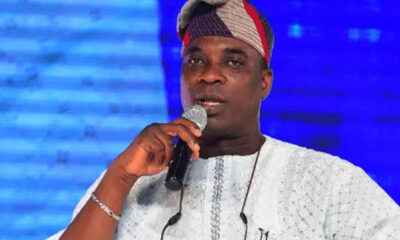
KWAM1 Loses Bid To Block Awujale Selection Process

Published

on

The Ogun State High Court, sitting in Ijebu-Ode, on Monday refused to grant an interim injunction aimed at restraining Governor Dapo Abiodun and five others from proceeding with the selection and installation of the next Awujale of Ijebuland.

Ayinde, represented in court by Wahab Shittu (SAN), had sought the injunction pending the hearing of his substantive suit challenging the selection process.

But Justice A. A. Omoniyi dismissed the application, holding that the interim injunction lacked merit and that there were no strong grounds to justify its grant.

He subsequently ordered the expedited hearing of the substantive matter, fixing 14 January 2026 for proceedings.

KWAM1 had declared his interest in the vacant Awujale stool, claiming lineage from the Jadiara Royal House of the wider Fusengbuwa Ruling House.

However, the Fusengbuwa ruling house rejected his claim, stating that he is not from the royal house.

To challenge what he perceived as injustice, Ayinde filed a suit against the Fusengbuwa ruling house, Governor Abiodun, the Chairman of Ijebu-Ode Local Government, Dare Alebiosu, and three others.

The other respondents include the Commissioner for Local Government and Chieftaincy Affairs, Ganiyu Hamzat; Secretary of Ijebu-Ode Local Government, Oke Adebanjo; and the Chairman of the Awujale Interregnum Administrative Council, Dr Olorogun Sunny Kuku.

The suit, HC3/238/2025, was filed ex parte, citing Order 38 Rules 4 and Order 39 Rule 1 of the High Court of Ogun State (Civil Procedure) Rules 2024, Section 36 of the 1999 Constitution, and the court’s inherent jurisdiction

A copy of the court document dated 16 December 2025 was obtained by our correspondent.

Ayinde urged the court to restrain all respondents from further action on the Awujale selection process to protect his interest and preserve the res from being dissipated or interfered with.

He prayed the court to restrain the respondents, “their agents, or anyone acting on their behalf, from taking any steps in the installation process of the next Awujale of Ijebuland pending the hearing and determination of the substantive suit.”

The musician said he is an aspirant to the Awujale stool, “and the injunction is necessary to secure his interest and preserve the res from being dissipated or interfered with by the respondents.”

With the interim injunction denied, attention now turns to the substantive hearing scheduled for 14 January 2026, which will determine the fate of KWAM1’s claim to the Awujale stool.

Continue Reading

NEWS

Nigerians Are Not Having It: PayPal’s Quiet Comeback Bid Meets Fierce Resistance

Published

on

PayPal is trying to slip back into Africa, and Nigerians are not here for it. Not one bit. The company recently hinted at a 2026 return through partnerships with local fintech players, framing it as some grand expansion into the continent. But across social media, especially on X, the reaction has been swift and brutal: calls for a full boycott, threads digging up old wounds, and a flat-out refusal to welcome the payment giant back. Many see this move as opportunistic, almost insulting, after years of being shut out while the rest of the world used PayPal freely.

The bad blood goes way back. Since the mid-2000s, PayPal has placed heavy restrictions on Nigeria and a handful of other African countries.

Officially, it was about high fraud risks, chargebacks, and stolen cards. In practice, it meant Nigerians could open accounts and send money out, but receiving payments or withdrawing to local banks? Forget it.

For almost two decades, freelancers, remote workers, small business owners, and everyday hustlers were locked out of a huge chunk of the global digital economy. The stories are painful and personal. A graphic designer lost major international clients because the only payment option was PayPal.

A software developer watched job offers vanish the moment “Nigeria” appeared on his profile. Countless young people trying to earn dollars through surveys, micro-tasks, or gigs on platforms like Upwork and Fiverr hit the same wall. Many resorted to desperate workarounds: using VPNs to fake locations, borrowing relatives’ accounts abroad, or paying hefty fees to middlemen. It wasn’t just inconvenient; it felt discriminatory. “Why us?” became the constant question. And that’s the part that still stings.

Fraud happens everywhere. Scams aren’t exclusive to Nigeria. Yet PayPal seemed to single out Africa’s biggest country, slapping on restrictions that didn’t fully apply to nations with similar or worse records. While PayPal rolled out services in over 190 markets, including tiny countries few people think about, Nigeria stayed on the outside looking in. That lingering sense of unfair treatment has never gone away.

But here’s the thing: Nigerians didn’t just sit and complain. They built alternatives. When PayPal turned its back, local and regional fintechs stepped up. Flutterwave, Paystack (before the Stripe acquisition), Payoneer, Grey, Cleva, Raenest, and others created solutions tailored to the reality on the ground. Virtual dollar accounts, easy cross-border transfers, seamless integrations for freelancers.

Today, Nigeria’s fintech scene is one of the most vibrant in the world, moving billions annually. People found ways to get paid, save in dollars, and run businesses globally without ever needing PayPal. Now the company wants back in, quietly, through backdoor partnerships rather than a direct apology or full restoration of services.

The plan, teased as “PayPal World,” would link local wallets to its network without requiring traditional PayPal accounts. It sounds convenient on paper, but to many Nigerians, it feels like too little, way too late. “We survived without you,” is the common refrain. “We built our own thing. Why should we let you profit now?”

On X, the sentiment is raw. One designer wrote in all caps: “PLEASE BOYCOTT PAYPAL IF YOU HAVE THE CHANCE.” Another threatened to sue any local fintech that integrates with them, demanding compensation for years of frozen funds and lost income. The anger isn’t manufactured; it’s built on real scars from a time when opportunities slipped away simply because of a postcode.

Some analysts point out the irony in PayPal’s timing. The company has struggled lately, with its stock taking heavy hits while competitors eat its lunch. Africa’s young, tech-savvy population looks like the next big growth market.

To many Nigerians, this doesn’t feel like goodwill. It feels like fear of missing out. A few voices argue it could bring more options and competition, which isn’t a bad thing. But right now, those voices are drowned out by the overwhelming chorus of “no thanks.”

Nigerians endured the exclusion, adapted, and thrived in spite of it. They built bridges PayPal refused to cross. So when the company finally shows up at the door, years later, acting like nothing happened? The response is clear: the door stays closed.

Ojelabi, a journalist and publisher of Freelanews.com, writes from Lagos

Continue Reading

Most Popular


Warning: Undefined array key "slug" in /home/porsch10/public_html/wp-includes/class-wp-theme-json.php on line 2117

Warning: Undefined array key "slug" in /home/porsch10/public_html/wp-includes/class-wp-theme-json.php on line 2117

Warning: Undefined array key "slug" in /home/porsch10/public_html/wp-includes/class-wp-theme-json.php on line 2117