Connect with us


BIG STORY

History: London Museum Transfers Ownership Of Looted Benin Artifacts To Nigeria [PHOTOS]

Published

on

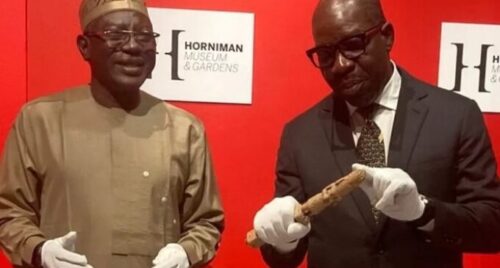
The Horniman Museum, based in south-east London, the United Kingdom, has kick-started the process of returning looted Benin bronzes to Nigeria.

NAN reports that the ownership of 72 artifacts forcefully taken from Benin in 1897 was handed over to the Nigerian government on Monday.

The museum was quoted as saying the gesture is a “moral and appropriate” response to the request for repatriation by Nigeria’s National Commission for Museums and Monuments (NCMM).

Godwin Obaseki, Edo state governor, Nick Merriman, chief executive of the Horniman Museum and Gardens, and Abba Tijani, NCMM director-general, were present at the handover ceremony.

Merriman, who said the Horniman had been an “excellent example” of leadership, stated that “journalists who ask me about the Benin return always want to ask me about the British Museum.

“I would rather talk about what an excellent example the Horniman is rather than answer questions about the British Museum.”

NAN reports that an agreement between the NCMM and the Horniman will allow most of the artifacts to stay in Britain on loan, with the second phase of physical repatriations to follow in due course.

The NCMM director-general added that about 5,000 Benin bronzes are currently “scattered” around the world.

BIG STORY

ICPC To Arraign Ozekhome Monday Over UK Property As Immigration Provides More Forgery Evidence

Published

on

The arraignment of a Senior Advocate of Nigeria, Chief Mike Ozekhome for alleged felony and forgery is to hold on Monday.

Ozekhome is implicated in the forgery controversy over a property in the UK traced to a former Minister of the Federal Capital Territory, late Gen. Jeremiah Useni.

The High Court of Justice of the Federal Capital Territory yesterday notified the Independent Corrupt Practices and Other Related Offences Commission (ICPC) that the trial is fixed for Court 4.

Ozekhome may either be taken into custody preparatory to the trial or asked to report as early as possible on Monday.

But the Nigeria Immigration Service (NIS) yesterday presented more evidence of the forgery of its passport to ICPC, which may increase the charges against Ozekhome from three to eight.

The ICPC said it is empowered to put Ozekhome on trial by virtue of Section 13 of the commission’s Act.

According to the notice from the court, FRN v. Chief Mike Ozekhome, parties are to be heard on Monday “if the business of the court permits or otherwise on some adjournment day of which you will receive no further notice.

“The parties are warned that at the hearing, they are required to bring forward all the evidence by witnesses or by documents which each of them desires to rely on in support of his own case or in contradiction of that of his opponent…”

Meanwhile, ICPC yesterday insisted that it can put Ozekhome on trial

A top source in the commission, who spoke with our correspondent, said that although Ozekhome is not a public officer, he has a case to answer by virtue of Section 13 of the ICPC Act 2000.

The source said: “We have been getting representations that allegations against Ozekhome are within the mandate of the Economic and Financial Crimes Commission (EFCC) because he is not a public officer. In fact, Ozekhome, in his statement to us, said he had interacted with EFCC on the same subject matter.

“This assumption is based on the ignorance of the law. We have full legal backing to prosecute the man by virtue of Section 13 of the ICPC Act.

“Section 13 of the Corrupt Practices and Other Related Offences Act, 2000 (ICPC Act) in Nigeria addresses the offence of Fraudulent Receipt of Property.

“Section 13 criminalizes receiving property obtained through a felony or misdemeanor, either within or outside Nigeria, while knowing it was acquired illegally.

“Forgery is a Fundamental peg of this case. It is a criminal matter, and it has nothing to do with whether you are a public officer or not. We will meet in court to defend our action.”

Responding to a question, the source said: “We have just received more evidence on passport forgery from the Nigeria Immigration Service (NIS). We may amend the charges against Ozekhome from three to about eight.

“It is an interesting case drawing international attention. “


Continue Reading

BIG STORY

Fashola: Newly Appointed Ambassadors Must Understand Nigeria’s Policies To Attract Investment

Published

on

Babatunde Fashola, former governor of Lagos and ex-minister of power, works, and housing, says that newly appointed Nigerian ambassadors must possess a deep knowledge of the country’s policies to attract foreign investment effectively.

Fashola spoke in Abuja on Tuesday while delivering the keynote address at the Nigeria Reputation Summit 2026, organized by the Nigeria Reputation Management Group, an initiative of the Nigerian Institute of Public Relations (NIPR).

The summit was themed ‘Better Nigeria, better reputation’.

Fashola recounted an official visit to an African country during his time as a minister, where Nigeria’s ambassador lacked knowledge of the country’s policy position in the sector under discussion.

“We have ambassadors, and I’m going to make my recommendation based on my own experience; over dinner, preparatory to my meeting, I shared the purpose of my visit, which was a ministry-related sector issue, and ultimately, it turned out that the ambassador had no clue what Nigeria’s position on those matters were,” he said.

The former minister said the recent appointment of ambassadors provides an opportunity for structured and continuous engagement to equip them with current information on Nigeria’s fiscal policies, tax laws, investment incentives, oil and gas reforms, solid minerals, and the business environment.

“Our ambassadors must have handy knowledge and information to really represent us; how long does it take to register a business in Nigeria? They must know that,” he said.

He described such capacity-building as urgent and ongoing, urging the minister of information and national orientation to work with the ministry of foreign affairs to commence coordinated briefings for Nigeria’s diplomatic corps.

Fashola also criticised what he described as a misplaced approach to economic diplomacy, where ambassadors invite Nigerian ministers to visit their host countries rather than attract investors to Nigeria.

“Very often, I would get letters from ambassadors asking us to come and visit the countries where they were posted, and unfortunately, most of those letters ended up in my shredder; if there was a problem of development at all, it was here, not there,” he said.

He said Nigeria’s ambassadors should focus on persuading potential investors to visit the country and experience its market and opportunities firsthand.

“Our ambassadors must invite people to come and visit Nigeria, not the other way around,” he said.

Mohammed Idris, minister of information and national orientation, called on Nigerians, professionals, institutions, and the private sector to take shared responsibility for building and protecting the country’s reputation.

Idris described the unveiling of Nigeria’s first national reputation perception index by the NIPR as an important step in understanding how the country is perceived locally and internationally.

“The report is not a verdict on Nigeria; it is a mirror, and as a responsible nation, we must have the courage to look into that mirror and act,” he said.

He acknowledged that while the report placed Nigeria in a low-trust category, progress had been recorded under President Bola Tinubu’s administration.

“We are not where we used to be; while perception often lags behind reality, real progress is being made, and it must be communicated clearly, consistently and honestly,” the minister said.

Ike Neliaku, NIPR president, told journalists after the event that reputation management is fundamental to national development.

“Reputation is so key, it’s so fundamental, it’s so important that we must do everything to guide and guard the reputation of the Federal Republic of Nigeria,” he said.

“When reputation first becomes your mantra, before you speak or act, you weigh carefully whether it is adding to or taking from Nigeria’s reputation bank.”

The summit brought together public relations professionals, policymakers, and private sector leaders to discuss strategies for improving Nigeria’s global standing through credible governance, strategic communication, and effective diplomacy.

Continue Reading

BIG STORY

Alleged Terror Financing: Malami Faces Long Detention As DSS Intensifies Investigation

Published

on

Former Attorney General of the Federation, Abubakar Malami (SAN), might spend a longer time in the custody of the Department of State Services, according to reports.

Multiple security sources reported that Malami faces prolonged detention, as the DSS is already working to obtain a court order to keep him in custody until the investigations are concluded.

Malami’s latest ordeal began on Monday when DSS operatives took him into custody shortly after he perfected his bail and was released from the Kuje Correctional Centre in Abuja. His arrest came barely minutes after he stepped out of the facility, where he had been detained since early December over allegations brought against him by the Economic and Financial Crimes Commission. Security sources indicate that the DSS is seeking a court order to prolong his detention, citing the sensitive and complex nature of the investigations, which are expected to take months.

The former AGF had initially been arrested by the EFCC following allegations that he conspired with his wife, Asabe, and their son to conceal proceeds of unlawful activities valued at about N8.7bn. According to the anti-graft agency, the alleged offences involved the use of multiple corporate entities, bank accounts, and high-value real estate transactions in Abuja and other parts of the country.

The trio was arraigned on December 29, 2025, before a Federal High Court in Abuja on 16 counts bordering on money laundering and conspiracy. They all pleaded not guilty to the charges.

Before their arraignment, Malami had been unable to meet the bail conditions earlier granted to him, leading to his continued detention from December 8. On December 18, a Federal Capital Territory High Court presided over by Justice Babangida Hassan upheld his detention, ruling that it was lawful under the circumstances. It was not until January 7 that Justice Emeka Nwite of the Federal High Court granted Malami, his wife and son bail in the sum of N500m each, with stringent conditions.

In the charges preferred against them, the EFCC alleged that the defendants conspired to conceal proceeds of unlawful activities through multiple corporate entities, bank accounts and high-value real estate transactions in Abuja and other parts of the country to the tune of N8.7bn. They pleaded not guilty to the 16 charges.

However, Justice Emeka Nwite of the Federal High Court in Abuja on January 7 granted Malami, his wife and son bail in the sum of N500 million each.

Justice Nwite ordered that each defendant produce two sureties with verifiable landed property within Asokoro, Maitama or Gwarimpa areas of Abuja.

The court also directed that the title documents of the properties be deposited with the court for verification by the Deputy Chief Registrar, while the sureties were to depose to affidavits of means.

Twelve days after he was granted bail, Malami perfected his bail and was leaving the correctional centre when the DSS picked him up.

Report says the ex-AGF might not be released anytime soon, as investigations may take months.

According to sources familiar with the matter, Malami is being grilled over his handling of the list of Nigerian terror financiers released by the United Arab Emirates.

A source familiar with the matter told The PUNCH, “The investigation is likely going to take a long time. This is why we are working to get a court order on Wednesday (today) to detain him further.

“There are several issues he is being questioned on. One of them is the handling of the terrorism financiers list released by the UAE in 2021 and some terror financiers during his term as the AGF. So, this investigation will take a very long time. I am not sure he will be released anytime soon.”

In 2021, authorities in the United Arab Emirates named six Nigerians with ties to the insurgent group, Boko Haram, as terrorist financiers.

The UAE Cabinet issued Resolution No. 83 of 2021, designating a total of 38 individuals and 15 entities on its approved list of persons and organisations supporting Boko Haram and other terrorist causes.

The individuals listed by the UAE authorities included Abdurrahaman Ado Musa, Salihu Yusuf Adamu, Bashir Ali Yusuf, Muhammed Ibrahim Isa, Ibrahim Ali Alhassan and Surajo Abubakar Muhammad. At the time, the release of the list sparked widespread controversy within Nigeria, raising questions about how suspected terror financiers were able to operate within the country and whether Nigerian authorities had acted decisively on intelligence shared by foreign governments.

Ironically, Malami had, during his tenure as Attorney General, repeatedly vowed that the government would not shield any individual linked to terrorism or its financing. He publicly maintained that no matter how highly placed, anyone found culpable would be prosecuted in line with the law. Investigators are said to be revisiting those declarations in the light of the allegations now levelled against him.

Political analysts note that Malami’s case reflects a broader pattern of post-tenure scrutiny of former top officials, particularly those who wielded enormous influence during the Muhammadu Buhari administration. As AGF and Minister of Justice from 2015 to 2023, Malami was involved in several high-profile cases, including asset recoveries, prosecutions of corruption suspects, and controversial legal opinions that often generated public debate.

Another source said Malami is also being questioned over an arms cache allegedly found in his Kebbi home, as well as terrorism and terrorism financing petitions against him.

“He will also be probed on the arms cache found in his Kebbi home. Beyond this, there are several petitions against him bordering on alleged terrorism financing. Terrorism and terrorism financing are serious offences globally. You’ll recall that when Abubakar Malami, SAN, was the Attorney General of the Federation and Minister of Justice, he vowed that the government of the day would not shield any person or persons linked to terrorism or terrorism financing.

“No responsible government would, in the same vein, fold its hands or turn a blind eye to weighty allegations of terrorism financing levelled against any individual, no matter how highly placed, in this case, Malami, SAN.

“In the course of investigations, we have what is called inter-agency cooperation. It is not uncommon for one security agency to hand over a person under investigation to another sister security agency. In Nigeria, the DSS is the sole security agency tasked with the responsibility of investigating such allegations. It’ll be best to allow them do their job,” the source said.


Continue Reading


Join Us On Facebook

Most Popular


Warning: Undefined array key "slug" in /home/porsch10/public_html/wp-includes/class-wp-theme-json.php on line 2117

Warning: Undefined array key "slug" in /home/porsch10/public_html/wp-includes/class-wp-theme-json.php on line 2117

Warning: Undefined array key "slug" in /home/porsch10/public_html/wp-includes/class-wp-theme-json.php on line 2117