Connect with us


BIG STORY

Foreign Airlines’ Blocked Funds In Nigeria Hit $743m — IATA

Published

on

The International Air Transport Association (IATA) says foreign airlines’ revenue blocked from repatriation by the Nigerian government has increased to $743 million from $662m in January 2023.

The association disclosed this on Tuesday in a letter addressed to Hadi Sirika, minister of aviation, and signed by Samson Fatokun, the association’s area manager West and Central Africa.

The air transport group and the global airline community wrote to the federal government, seeking a special invention for the resolution of airlines’ blocked funds in the country.

“For over a year, Nigeria has been the country with the highest amount of airline-blocked funds in the world. Please find attached the comparative table of airlines’ blocked funds by country,” the letter reads.

“Moreover, as of January 2023, airlines’ blocked funds in Nigeria have increased to $743,721,092 from $662m in January 2023 and $549m in December 2022.”

Since the amount increased from $450 million in May 2022, to $464 million in July the same year, the trapped funds have been linked to some of the challenges in Nigeria’s aviation sector with far-reaching effects.

In attempts to recover its revenue last year, Emirates Airlines suspended flight operations to Nigeria, but later resumed passenger scheduled flights in December 2022.

In a similar move, British Airways (BA) closed inventory on Nigeria in the global distribution system (GDS) — an act that prevented local travel agencies from making bookings from their portals.

Following several meetings by the authorities aimed at addressing the impasse, the Central Bank of Nigeria (CBN) released the sum of $265 million to foreign airlines operating in the country to settle outstanding ticket sales.

But the problem is yet to be fully resolved.

Susan Akporiaye, national president, of the National Association of Nigeria Travel Agencies (NANTA) asked the federal government to proffer solutions to the challenges of airfare profiteering in the aviation sector.

She said the face-off with foreign airlines has affected travel agents’ businesses in several ways as the airlines blame the hike in airfare on their trapped funds.

Negative Effects On Investment

Speaking in the letter on Tuesday, IATA said the increasing backlog of international airlines’ blocked funds in Nigeria sends a strong message against foreign direct investment (FDI) in Nigeria.

“Potential investors are reading from the plight of the airlines that they would not be able to repatriate their funds from Nigeria, even at this moment when Nigeria is expecting investments in the concession of some of its prominent airports,” the group said.

“Foreign airlines fly into Nigeria within the legal framework of the bilateral air service agreement (BASA) signed between their countries and the Federal Republic of Nigeria. It is agreed in those BASAs that Nigeria will facilitate repatriation of the funds of the other party’s airline. Nigeria flaunts this contractual obligation by not facilitating enough the repatriation of airlines’ funds.”

Reduced Connectivity, Job Loss And High-Ticket Prices

According to the association, to mitigate the increasing backlog of their funds in Nigeria and its impact on their cash flow, some airlines have had to reduce the number of their frequencies, or the number of seats made available for sale in the Nigerian market.

This mitigation measure, IATA explains, reduces person and cargo access to Nigeria.

“E-commerce that relies on aviation for speedy delivery will be impacted in Nigeria. Moreover, going by the law of demand and supply, the reduction of airline inventories in the Nigerian market will lead to ticket fare increase which will further burden average Nigerians and take air travel away from the reach many Nigerians,” it said.

“The downstream sector [of] the aviation industry (travel agencies, freight forwarders, ground handling companies) relies heavily on airlines capacity to grow or remain in business. Should the airlines be compelled to further reduce their capacity, those businesses would be negatively impacted, leading to job losses. The negative indirect impact will also affect ground transportation (taxi, car hire), hotels and restaurants output.”

IATA, therefore, appealed to Sirika to ensure that the airlines’ blocked funds “are  totally cleared before your administration leaves office”.

BIG STORY

‘Excessive’ Security For Seyi Tinubu: How It Is Understood —–Folorunsho Tahir Hamsat

Published

on

The appropriateness or otherwise of security protection for a president’s family can be a subject of public debate. This debate is centred on the complex challenge of ensuring the safety of people connected to the presidency while being mindful of public accountability and the effective use of government resources.

This writer will focus solely on the provision of security for the president’s family, as understood, in layman’s terms. Recently, at a public function, President Tinubu’s son, Seyi,’s excessive security escort was criticized by Nobel laureate, Professor Wole Soyinka. The respected leader had argued that such resources were needed elsewhere.

From my study, it is standard international practice for a country’s president’s immediate family, including the children, to receive significant security protection. This is due to the high profile of the president and the potential national security risks that could arise from threats and various forms of harm to the president’s family members.

Nigeria is currently confronted by multiple security challenges like kidnapping and banditry, with the primary threat coming from the Islamic State of West Africa (ISWA) and Boko Haram. On that score, threatening or harming a president’s son, daughter, or wife could be used to blackmail the president and compromise his ability to perform state duties, thereby creating a national crisis. Thus, the goal of ‘excessively’ protecting the president’s family is to ensure the stability and continuity of the president’s function and, by extension, the nation, by mitigating high-level threats to the First Family.

I am not familiar with the local laws on the protection of private individuals, but, based on my research, in developed countries whose model of democracy Nigeria especially practices, such as the US, the provision of security by agencies like the DSS to the president’s immediate family is a federal law, not a discretionary choice.

The president’s family members often attend public schools or travel, requiring extensive, pre-planned security measures and an advance team to ensure their safety in such environments. Even the US law specifies that children of former presidents receive protection until they are 16 years old, unless declined.

In other climes, a sitting president can issue an executive order to extend protection to members of his family, including individuals not automatically covered by law. I will support this argument with two empirical evidence. Just before departing the White House, finally in January 2025, after the expiration of his constitutional two terms as president of the United States, Joe Biden extended protection for his adult children through the next seven months via an executive order.

That presidential order was critiqued by his successor, Donald Trump, and subsequently revoked by him. However, Trump himself did the same for his four adult children and two of their spouses before his first term ended in 2021, when they were given six months of additional protection beyond their stay in the government house. Thus, my interpretation of this subject is that, if it’s not unusual for a president before he leaves office to authorize an extended period of protection for their immediate family members, giving them full-time protection while holding the power is justified and not inappropriate.


-Tahir Hamsat is a Lagos-based journalist. He can be reached via 08051000485

Continue Reading

BIG STORY

JUST IN: Accord Party Clears Adeleke As Sole Aspirant For Osun Guber Primary

Published

on

Barely 16 hours after Governor Ademola Adeleke officially joined the Accord Party, the party’s national leadership has cleared him to participate in its gubernatorial primary.

The Nation recalled that Adeleke, on Tuesday evening, defected to the Accord Party alongside his deputy, Kola Adewusi, and other top aides.

In a statement, Elder Ibe Thankgod, Chairman of the Accord Party Screening Committee, confirmed that Adeleke had been screened ahead of Wednesday’s primary.

He noted that the governor met all the necessary requirements for nomination and participation, adding that the committee had cleared him as the sole aspirant for the party’s governorship ticket and completed all required documentation with relevant bodies.

The statement added that the committee presented Adeleke with a certificate of clearance and described him as a worthy gubernatorial aspirant.

Adeleke expressed gratitude to the screening committee and party leadership, affirming his readiness for the primary and the 2026 general elections.

“I am ready for the primary and I am ready for the general elections. We are winning by God’s grace,” he said.

Continue Reading

BIG STORY

Backlash Over My Interaction With Adeleke At Ooni’s Event ‘Needless Controversy’ — Remi Tinubu

Published

on

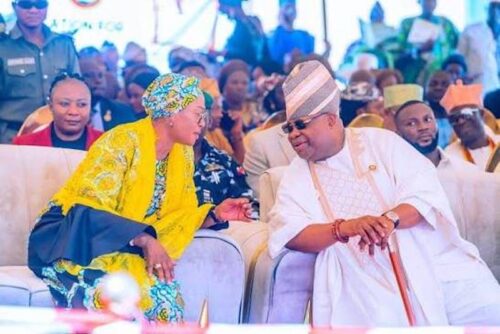
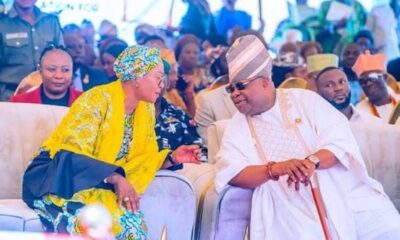
Nigeria’s First Lady, Senator Oluremi Tinubu, has dismissed public backlash over her interaction with Osun State Governor, Ademola Adeleke, calling the reactions a “needless controversy.”

In a statement posted on her Facebook page on Tuesday, Mrs Tinubu said critics often magnify minor issues and create distractions around leadership. She wrote:

“Those entrusted with leadership understand their duties and how to steer the affairs of society.

“More often, it is the followers and critics who scrutinize every step, amplify minor missteps, and turn them into needless controversy. Ọṣun lè tèǹtẹ̀ – Osun is ahead.”

The comments followed a video clip from the 10th coronation anniversary of the Ooni of Ife, Oba Adeyeye Ogunwusi, which showed Adeleke pausing after breaking into a short song during his speech.

Mrs Tinubu walked to the podium, gestured to him, and whispered to him — a moment that quickly went viral and drew sharp reactions online.

The First Lady’s statement marks her first public response since the video circulated.

The episode has since divided opinion.

Senior Special Assistant to the Governor on the Bureau of Social Services, Akintunde Bello, said the First Lady should be cautioned, insisting that her gesture toward an elected governor was inappropriate.

Similarly, African Democratic Congress chieftain Dele Momodu criticised the act, describing it as bullying and alleging that Mrs Tinubu had “openly disgraced and embarrassed Adeleke before a global audience.”

Some, however, believe that Mrs Tinubu’s action was justified.

Dayo Fashola, an aide to a former Osun State Governor Adegboyega Oyetola, on her verified Facebook page, said the interaction between the duo was lighthearted.

“What transpired between Oluremi Tinubu and Adeleke was light‑hearted and isn’t as serious as people are making it seem,” Fashola wrote.

Similarly, Facebook user Oyetunji Ayoade defended the First Lady, writing, “The highest respect the First Lady can give to Osun people is to stand up and inform him by herself, and she did.”

Neither Governor Adeleke nor the Presidency has issued further comments, even as the incident continues to dominate social media discussions.

Continue Reading


Join Us On Facebook

Most Popular


Warning: Undefined array key "slug" in /home/porsch10/public_html/wp-includes/class-wp-theme-json.php on line 2117

Warning: Undefined array key "slug" in /home/porsch10/public_html/wp-includes/class-wp-theme-json.php on line 2117

Warning: Undefined array key "slug" in /home/porsch10/public_html/wp-includes/class-wp-theme-json.php on line 2117