Connect with us


BIG STORY

Federal Government Plans Tax Overhaul To Access $750m World Bank Loan

Published

on

The Federal Government is pushing ahead with critical tax reforms to meet the requirements for a $750 million loan from the World Bank.

This loan is part of a broader $2.25 billion package approved by the World Bank to support Nigeria’s economic stability and vulnerable populations.

The disbursement of the $750 million loan is contingent on specific fiscal and governance conditions under the Accelerating Resource Mobilisation Reforms programme.

The ARMOR programme includes three main result areas: implementing tax and excise reforms to increase Value-Added Tax collections and excise rates on health and environmentally friendly products; strengthening tax and customs administrations to enhance VAT compliance and audit effectiveness; and safeguarding oil and gas revenues by increasing transparency and net revenue contributions.

The agreement document between Nigeria and the World Bank read in part, “The bank agrees to lend to the borrower the amount of $750,000,000 as such amount may be converted from time to time through a currency conversion (“Loan”), to assist in financing the programme described in Part 1 of Schedule 1 to this Agreement (“Programme”) and the project described in Part 2 of Schedule 1 to this Agreement (“Project”, and together with the Programme, hereinafter jointly referred to as the “Operation”).

“The borrower may withdraw the proceeds of the loan in accordance with Section IV of Schedule 2 to this Agreement. All withdrawals from the loan account shall be deposited by the Bank into an account specified by the Borrower and acceptable to the bank.”

According to the Disbursement Linked Indicators set out in the loan agreement, the loan will only be released upon achieving measurable progress in key areas.

These include raising VAT collection through improved regulations, increasing excise taxes on health and environmental products, and boosting corporate tax compliance through enhanced digital infrastructure.

Central to the ARMOR programme is the government’s plan to increase VAT rates and expand taxpayer compliance.

Some of the loan targets include increasing VAT collections to 1.8 per cent of non-oil Gross Domestic Product, unlocking $105m of the loan.

Also, there is a target to register 660,000 VAT filers, which will release $30m from the loan.

An e-invoicing system for VAT traders, once launched, will trigger $20m, with an additional $45m upon 30 percent trader adoption.

In an effort to boost VAT revenue, the Federal Government is considering a bill proposing an increase in the VAT from 7.5 per cent to 10 percent by 2025.

VAT refers to a consumption tax on goods and services levied at each stage of the supply chain where value is added.

In the executive bill seen by PUNCH Online, the legislature also intends to increase the VAT to 12.5 percent by 2026 through 2029.

“VAT shall be charged on the value of all taxable supplies at the following rates (a) 2025 year of assessment 10 per cent; (b) 2026, 2027 2028, and 2029 years of assessment 12.5 percent (c) 2030 year of assessment and thereafter 15 per cent,” the document reads.

Also, a copy of the Stakeholder Engagement Plan for Nigeria – Accelerating Resource Mobilisation Reforms programme dated March 2024 showed that the government is required to reintroduce the excises on telecom services, EMT levy on electronic money transfers through the Nigerian Banking System among other taxes.

It was also gathered that one of the tax bills at the National Assembly included this excise tax.

The Federal Government has proposed a five per cent excise duty on telecommunications services, gaming, and betting activities as part of a new bill to overhaul Nigeria’s tax framework.

The bill, titled “A Bill for an Act to Repeal Certain Acts on Taxation and Consolidate the Legal Frameworks relating to Taxation and Enact the Nigeria Tax Act to Provide for Taxation of Income, Transactions, and Instruments, and Related Matters,” was dated October 4, 2024.

An analysis of the proposed legislation showed that it seeks to introduce excise duties on services such as telecoms, gaming, gambling, lotteries, and betting provided in Nigeria.

Also, the program outlines specific allocations for technical assistance, with $5m each going to the Federal Inland Revenue Service and the Nigeria Customs Service to support their capacity to implement these new measures effectively.

This includes the development of systems for better data sharing, risk-based audits, and compliance processes, as well as substantial investments in program management and capacity building.

There will also be $10m for project management, tax policy capacity-building and other expenses.

In total, the amount makes the $20m investment financing before the release of $730m in line with fiscal targets met.

The FIRS will receive $5m to develop and implement critical initiatives aimed at enhancing its operations and revenue collection capabilities.

This funding will support the development and implementation of a robust third-party data sharing platform, along with administrative control programs to streamline operations and enhance efficiency.

Also, the FIRS will develop a VAT lottery system and an e-invoicing system, both of which rely heavily on advanced software and extensive communication planning. These systems are designed to boost VAT collections and improve compliance among taxpayers.

The funding will facilitate the creation of a risk-based audit assessment program for VAT and Corporate Income Tax, aimed at enhancing the effectiveness and efficiency of audit processes within the agency.

Similarly, the NCS will receive $5m to enhance its administrative processes and improve compliance.

This funding will be used to design and implement new administrative processes, including the establishment of sanctions for non-compliance with excise rules.

The NCS will also develop centralised control room systems equipped with backup and disaster recovery capabilities, ensuring operational continuity and resilience in case of emergencies.

Moreover, the funding will support capacity-building initiatives, enabling the NCS to effectively manage and implement these new systems and processes, ultimately leading to improved compliance and operational efficiency.

The loan also focuses on customs reforms to improve trade compliance and increase revenue.

Directing 15 percent of cargo through the Green Channel will unlock $35m, while a compliant trader programme under the Authorized Economic Operator framework is linked to $15m.

Other loan-linked targets include reducing tax expenditures by eliminating corporate bond interest exemptions and rationalising the Pioneer Status Industry Tax Incentive scheme by the end of 2024, each unlocking $10m.

Also, excise taxes on health-related products and environmentally harmful goods will increase. A presidential order to introduce these excises will trigger $10m, with an additional $30m if revenue from green taxes reaches 0.2 percent of non-oil GDP.

The Federal Government recently inaugurated a Joint Committee of staff of the Nigerian Investment Promotion Commission and FIRS to review the current guidelines for the administration of the PSI, validate the cost of the incentive to Nigeria, and recommend changes to the qualification and administration.

The Taiwo Oyedele-led Presidential Committee on Fiscal Policy and Tax Reforms plans to replace the abused pioneer status with priority sector incentives, rewarding companies based on their investments in the economy.

Also, in one of the executive bills, the Federal Government plans to introduce an Economic Development Incentive Certificate as a tax incentive for companies investing in capital projects.

As outlined in the bill, firms seeking the certificate must submit their applications through the Nigerian Investment Promotion Commission, accompanied by a non-refundable fee of 0.1 per cent of the capital expenditure, capped at N5m.

The NIPC will review and recommend the applications to the Minister for approval, after which the Minister may forward the recommendation to the President.

A part of the bill read, “The application shall be accompanied by a non-refundable fee of 0.1% of the qualifying capital expenditure incurred or to be incurred, subject to a maximum of N5,000,000.00 and no further fee shall be payable in respect of such application.

“The NIPC shall recommend the application to the Minister, for approval or otherwise, including the projected tax expenditure impact report in its recommendation.”

The tax bill noted that approval from the President is mandatory before the certificate is issued.

Once granted, the NIPC is required to submit an annual report detailing the sectors and companies that benefited from the scheme to the Minister, who must present the report to the President and the National Economic Council within 30 days.

BIG STORY

Police To Resume Nationwide Tinted Glass Permit Enforcement January 2, 2026

Published

on

The Nigeria Police Force has announced that it will resume the nationwide enforcement of the tinted glass permit policy from January 2, 2026, citing growing security concerns linked to the misuse of unauthorized tinted vehicle glass.

The announcement was contained in a statement issued on Monday by the Force Public Relations Officer, Chief Superintendent of Police Benjamin Hundeyin.

The police said the decision followed a review of emerging security threats and the need to enhance public safety, pending the final determination of a related matter currently before the court.

The Force clarified that there was no court order restraining it from enforcing the law regulating the use of tinted glass on vehicles.

It explained that enforcement was earlier suspended in the interest of transparency and public convenience, to allow motorists sufficient time to regularize their documentation and complete the permit application process without pressure.

According to the statement, recent security trends have revealed a rise in criminal activities carried out with the aid of vehicles fitted with unauthorized tinted glass.

Such vehicles, the police noted, have been used by criminals to conceal their identities while committing offences including armed robbery, kidnapping and other violent crimes.

In view of these developments, the police said the resumption of enforcement had become necessary and urgent as a proactive step to safeguard lives and property across the country.

“Recent trends, however, reveal a disturbing rise in criminal activities perpetrated with the aid of vehicles fitted with unauthorized tinted glass.

“Some individuals and organized criminal groups have exploited this gap to conceal their identities and facilitate crimes ranging from armed robbery to kidnapping and other violent crimes.

“In view of this, the Nigeria Police Force has found it both necessary and urgent to resume full enforcement as a proactive measure to safeguard our communities. Consequently, enforcement of Tinted Glass Permit will resume on 2nd January, 2026,” the statement read.


Continue Reading

BIG STORY

Buhari Believed Aso Rock Gossip I Planned Killing Him, Began Locking His Room —— Aisha

Published

on

Former First Lady, Aisha Buhari, has narrated how her husband, the late President Muhammadu Buhari “began locking his room” following gossip in Aso Rock that she (Aisha) planned to kill him.

The ex-First Lady also said the health crisis that forced Buhari, to take 154 days of medical leave in 2017 began with a broken feeding routine and mismanaged nutrition.

She argued that Buhari’s illness was not a mysterious ailment or poisoning.

Her account of the health crisis appeared in a new 600-page biography, ’From Soldier to Statesman: The Legacy of Muhammadu Buhari’, authored by Dr. Charles Omole, launched at the State House on Monday.

It read, “According to Aisha Buhari, her husband’s 2017 health crisis did not originate as a mysterious ailment or a covert plot. It started, she says, with the loss of a routine; ‘my nutrition,’ she describes it, a pattern of meals and supplements she had long overseen in Kaduna before they moved into Aso Villa.”

The former First Lady convened a meeting with close staff, including the physician, Suhayb Rafindadi; the CSO, Bashir Abubakar; the housekeeper, and the SSS DG to explain the plan.

She said, “Daily, cups and bowls with tailored vitamin powders and oils, a touch of protein here, a change to cereals there.”

“When the Presidency’s machinery took over our private lives, she explained the plan: daily, at specific hours, cups and bowls with tailored vitamin powders and oil, a touch of protein here, a change to cereals there. Elderly bodies require gentle, consistent support,” Omole narrated.

However, the routine frayed.

“Then came the gossip and the fearmongering. They said I wanted to kill him,” the book quotes her as saying.

“My husband believed them for a week or so,” she said, revealing that the President began locking his room, changed small habits, and crucially, “meals were delayed or missed; the supplements were stopped.”

“For a year, he did not have lunch. They mismanaged his meals,” she added.

The deterioration culminated in Buhari’s two extended medical trips to the United Kingdom, totalling 154 days in 2017, during which he ceded authority to Vice President Yemi Osinbajo.

Upon return, he admitted to being “never so ill” and having received blood transfusions.

Buhari’s absences “sparked rumours, speculation, and even conspiracy theories,” Omole wrote.

Mrs Buhari debunked stories of plots to poison her husband.

Her contention, Omole noted, is that “loss of a routine, ‘my nutrition,’ was the genesis of the crisis.”

In London, doctors prescribed an even stronger regimen of supplements, he explained.

Initially, Buhari “was frightened and not taking them as prescribed. So she took charge of his welfare, slipping hospital-issued supplements into his juice and oats,” it read.

The former First Lady described the turnaround as swift, noting, “After just three days, he threw away the stick he was walking with. After a week, he was receiving relatives.”

“‘That,’ she says, ‘was the genesis, and also the reversal of his sickness,’” the book stated.

According to Omole, critics said Buhari’s reliance on UK hospitals exposed the failure of Nigeria’s health system.

A “more compassionate perspective,” he wrote, recognises that a man in his 70s may require specialised care “not readily available in Nigeria” after “decades of underinvestment.”

He also noted Buhari’s habit of handing power to his deputy during absences, which, he said, ensured “institutional propriety, even during personal health crises.”

The book also revealed a climate of mistrust around the Presidency.

Mrs Buhari alleged surveillance, the bugging of the President’s office with listening devices and playback of private conversations, saying, fear and conscience “contributed to taking his life.”

She refuted the long-held rumour that Buhari had a body double, popularly known as “Jibril of Sudan,” as absurd, arguing that poor strategic communication in government allowed simple, banal developments to metastasise into conspiracies.

Continue Reading

BIG STORY

Dangote Releases Details of ‘$5m Spent By NMDPRA CEO’ On His Children’s Secondary School Education In Switzerland [PHOTO]

Published

on

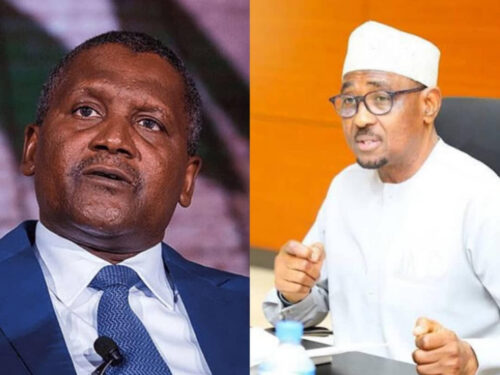
Aliko Dangote, chairman of the Dangote Group, says Farouk Ahmed, chief executive officer (CEO) of the Nigerian Midstream and Downstream Petroleum Regulatory Authority (NMDPRA), spent about $5 million on the secondary school education of his children in Switzerland.

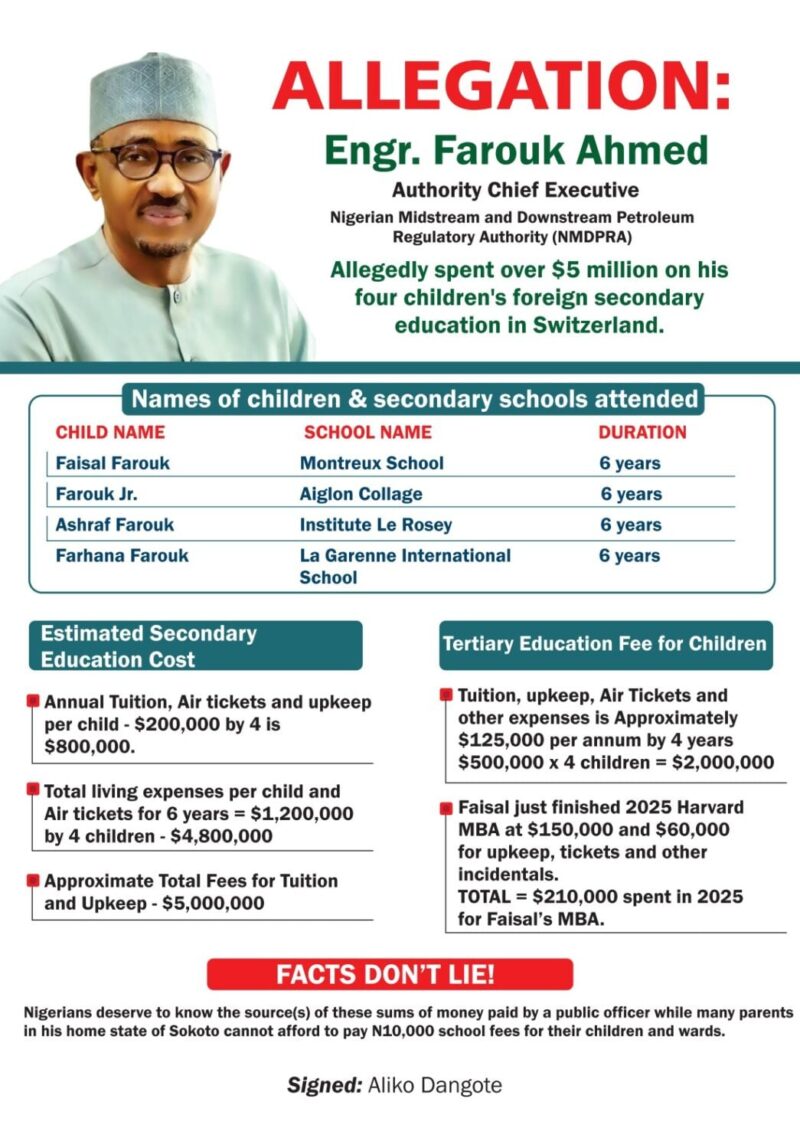
In a paid newspaper advert on Tuesday, the billionaire said Ahmed paid the said amount for four of his children, covering a period of six years.

On Monday, Dangote had alleged that Ahmed Farouk “paid $5 million” to a Swiss secondary school for his children’s education, describing the act as “economic sabotage and corruption”.

Releasing details of his allegations, in the newspaper advert, Dangote listed the four children as Faisal Farouk, Farouk Jr., Ashraf Farouk, and Farhana Farouk.

According to the billionaire entrepreneur, the secondary schools the children attended for a duration of six years were Montreux School, Aiglon College, Institut Le Rosey, and La Garenne International School.

Dangoted also presented estimated annual tuition, living expenses, air travel, and upkeep, which were multiplied across four children and several years of study.

He said the annual cost of tuition, airfare, and upkeep per child was $200,000, which totals $800,000 per year for his four children.

The businessman further explained that the total living expenses and air tickets per child over six years was $1.2 million, amounting to $4.8 million for all four children.

Overall, Dangote estimated that the combined cost of tuition and upkeep for all the children reached $5 million.

He also listed the tertiary education expenses for Ahmed’s children, noting that tuition, upkeep, airfare, and other costs average approximately $125,000 per year over a four-year period.

According to the billionaire, this adds up to $500,000 for four years per child, totaling $2 million for all of them.

“Faisal just finished the 2025 Harvard MBA at $150,000 and $60,000 for upkeep, tickets and other incidentals. Total =$210,000 spent in 2025 for Faisal’s MBA,” he added.

Dangote said Nigerians deserve to know the source of the money “paid by a public officer while many parents in his home state of Sokoto cannot afford to pay N10,000 school fees for their children and wards”.

 

Continue Reading


Join Us On Facebook

Most Popular


Warning: Undefined array key "slug" in /home/porsch10/public_html/wp-includes/class-wp-theme-json.php on line 2117

Warning: Undefined array key "slug" in /home/porsch10/public_html/wp-includes/class-wp-theme-json.php on line 2117

Warning: Undefined array key "slug" in /home/porsch10/public_html/wp-includes/class-wp-theme-json.php on line 2117