




BIG STORY
Book Preview: Making Movies The Nollywood Way By Seun Oloketuyi


- /home/porsch10/public_html/wp-content/plugins/mvp-social-buttons/mvp-social-buttons.php on line 27
https://porscheclassy.com/wp-content/uploads/2023/09/resize1694068175798-500x600.jpg&description=Book Preview: Making Movies The Nollywood Way By Seun Oloketuyi', 'pinterestShare', 'width=750,height=350'); return false;" title="Pin This Post">
- Share
- Tweet /home/porsch10/public_html/wp-content/plugins/mvp-social-buttons/mvp-social-buttons.php on line 69
https://porscheclassy.com/wp-content/uploads/2023/09/resize1694068175798-500x600.jpg&description=Book Preview: Making Movies The Nollywood Way By Seun Oloketuyi', 'pinterestShare', 'width=750,height=350'); return false;" title="Pin This Post">
- Affidavit of Greatness: Nigerian filmmakers surrender “trade secrets”
Previewed By: Femi Akintunde-Johnson
Title of Book: Making Movies The Nollywood Way
Genre: Nonfiction/Mini Autobiographies
Type: Coffee-table book
Published: 07 September, 2023
Pages: 117 (Content only)
THIS book is not for cynics who disdain the promises of humble beginnings; nor is it for self-conceited revisionists who associate mediocrity with any home-groomed artistic expression.
A student of life, a fan of our movies, or an enthusiast of business potential desirous of understanding the chaotic complexities of producing and promoting films in Nigeria will be enormously excited about the book. And young professionals who are not immune to learning and unlearning the brasstacks and peculiarities of Nigerian filmic anthropology will certainly have a go-to companion in ‘Making Movies the Nollywood Way’.
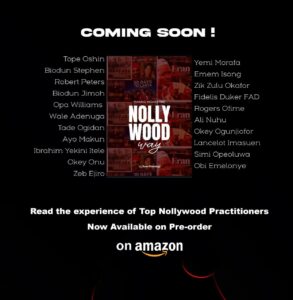
The book is colourfully arranged, peppered with action pictures and portraits of each entry subject. Spatially designed in the manner of attractive coffee-table books, ‘Making Movies the Nollywood Way’ is a collection of the thoughts, styles, production etiquettes, and some sort of “trade secrets” of 21 delicately selected ‘caucus’ of Nigeria’s better known and highly regarded filmmakers.
Smartly compiled by media entrepreneur and budgeoning filmmaker, Olúwaṣeun Oloketuyi, the 117-page book devotes between four and ten pages to 11 veterans of this immensely challenging and technically exhausting profession, namely: Ọpa Williams, Wale Adenuga, Tade Ogidan, Zeb Ejiro, Emem Isong, Zik-Zulu Okafor, Fidelis Duker, Okey Ogunjiofor, Lancelot Imasuen, and a pair of younger veterans: Simi Opeoluwa and Obi Emelonye.
The other set of entries are some of the most exciting and riveting operatives who have matured behind the camera, and delivered outlandishly beyond their numerical experience within the last 10 to 20 years of the Nollywood phenomenon. These are the final ten ‘technocrats’: Tope Oshin, Biodun Stephen, Robert Peters, Biodun Jimoh, Ayo Makun, Ibrahim Yekini, Okey Onu, Yemi Morafa, Rogers Ofime, and Ali Nuhu (old hand in acting).
A little more on our classification of ‘veteranship’ and the latter generation. Some of the eleven individuals tagged as veterans made forays into the make-believe world even before the “epochal” 1992 that the industry has grown to settle on as the launch date of Nigeria’s Nollywood, while the rest flowered within the first decade of Nollywood.
Back to the book: all the contributors to this documentary of Nollywood’s how-to-do survival kit delivered their responses in their own words – some colourful, few business-like or plaintive, and a couple just a little hastily – as they were given similar eight questions to field. The eight parameters that highlight the uniformity of experiences in some cases, and diversities of operations in others, are as follows: Background. First film. The filming process. Filmmaking in Nigeria. Nollywood timing. Funding and budgeting. Location scouting and other challenges. Key ingredients for success and marketability of films in Nollywood. A day on set.
Let us quickly note this heartwarming point before we turn off the road: fidelity to interviewees’ statements have often been the albatross on the necks of books that seek to aggregate verbatim the thoughts of sundry people in a one-off historical document. In ‘Making Movies the Nollywood Way’, reading is not only bumpy-less, you’re easily transported to the world each filmmaker chooses to unveil – a testament to editorial astuteness.
The reader would be thoroughly entertained and informed with some of the filmmakers who bent backwards to reveal the nuances of how they overcame some atrocious challenges and man-made obstacles erected against the creative expression in a land desirous of great works of art but at loggerheads with its critical process. Some of the filmmakers are thorough as they take us through the tortuous paths of film making in Nigeria, like Fidelis Duker (page 75); and one other in more expressive story of self discovery amidst horrific impediments is rendered effusively by Okey Ogunjiofor (pps 93-94).
To underscore the quantum leap the industry has witnessed in the last 30 years is to read the statements of these filmmakers who now consider ₦10m spend as a low-budget project – a sum hitherto seen as a robust outlay for a local blockbuster. Nowadays, according to the filmmakers, fairly big-budget films are not merely imagined, but spoken of as an astonishing modern reality in our clime… and guess the starting cost – ₦100m!
Many speak fairly confidently of achieving returns on investment without a glint of anxiety on account of the quality of their works, the delicate understanding of the taste and tendencies of movie watchers, and the numerous platforms now available to exhibit their talents and business acumen. Of course, it is yet another reminder of how Nigerian politicians have squandered our potential, and trifled with our macro economy, throughout the past three decades.
One of the drawbacks of this interesting book is the limited number of female filmmakers – only three featured out of 21 – especially when you imagine what could have been even more engaging, considering the quality of submissions by Isong, Oshin and Stephen, which are quite educative, and inspirational in the context of their glass-ceiling breaking efforts in an industry subconsciously patrilineal.
Another distraction is the numerous quotes that emblazon the first page of each filmmaker’s submission. Curiously, the multiple quotes have multiple captions as íf the readers are likely to forget that the same person made all the quotes if we are not reminded ‘numerously’ – some as many as 15 or 19 times! A better way to go is what was mistakenly done (apparently) with Opeoluwa’s chapter (page 105)… Of course, it is thereafter soiled with multiple tags of “lessons” under multiple quotes!
To those who may wonder why only 21 people were selected in a field teeming with hundreds of talented and remarkable individuals – one can only vouch a proxy defence here – the answer is pretty simple: in matters creative, the shorter, the better. And in any case, this book can serve as the first of a series – as other volumes can have more entries and even more parameters of engagement. One thing is certain though, in spite of the universality of their challenges and the Nigerian experience: their individual expressions, attitudes, idiosyncrasies, beliefs and reactions make the compilation a treasure-trove of unimaginable contribution to understanding and immortalising the critical underpinnings of Nollywood.
Furthermore, those distractions pale into insignificance, or petty nitpicking, when we consider the overarching impact of this coffee-table page turner. As one who has passed this stage a number of times, and has a fair idea of how the Nollywood evolved, one can easily hazard that if you wish to leave a copy of ‘Making Movies the Nollywood Way’ as an attractive exhibition in your cute reception area, be prepared to buy in bulk. The book will not only grow on you, it will go off with your visitors… inadvertently!
(Akintunde-Johnson is the author of Reflections: Anthology of Thoughts on Nigerian Movie Industry; Fame: Untold Stories of its Rise & Fall, and other books)



















-

 BIG STORY3 days ago
Lagos Couple Stages Self-Kidnap To Raise Funds For Husband’s US Return Ticket, Arrested With N10m Ransom
-

 NEWS4 days ago
Reimagining Urban Spaces: The Forward-Thinking Public-Private Collaboration in Obalende’s Transformation By Babajide Fadoju
-

 NEWS4 days ago
Adron Homes Unveils “Love for Love” Valentine Promo with Exciting Discounts, Luxury Gifts, and Travel Rewards
-

 BIG STORY4 days ago
Police Arrest Six For ‘Hacking Telecoms Firm To Divert N7.7bn Airtime’, Recover 400 Laptops, 1000 Mobile Phones
-

 BUSINESS2 days ago
FIRST HOLDCO PLC – TAKING THE BULL BY THE HORN WITH A RECORD IMPAIRMENT CHARGE; GROWS GROSS EARNINGS TO N3.4 TRILLION FOR THE UNAUDITED FULL YEAR ENDED DECEMBER 31, 2025.
-

 NEWS4 days ago
Sanwo-Olu’s Tough Actions, Soft Power By Tunji Bamishigbin
-

 ENTERTAINMENT7 hours ago
Burna Boy, Davido, Wizkid, Ayra Starr Lose At 2026 Grammy Awards
-

 BIG STORY3 days ago
Resident Doctors Give Federal Government Four Weeks To Meet Demands