Connect with us


BIG STORY

Tinubu Flags Off Abuja-Kaduna Road Reconstruction Project

Published

on

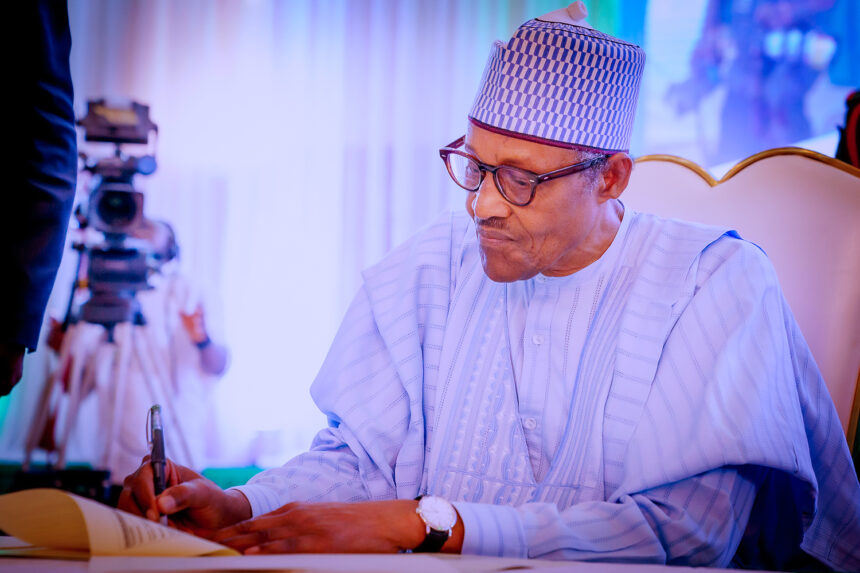
President Bola Tinubu has flagged off the reconstruction of the Abuja-Kaduna-Zaria-Kano federal highway, a road vital to the socio-economic life of Northern Nigeria.

Speaking at the event on behalf of the president, Governor Uba Sani of Kaduna State described the road as a major artery linking the Federal Capital Territory to over 12 states across the North-central, North-west, and North-east geopolitical zones.

At the event which took place at Jere in Kagarko Local Government Area on Sunday, Mr. Sani noted that the road had suffered neglect for several years, costing lives and hurting economic growth.

The governor described the road as the busiest in the North and second busiest in Nigeria, after the Lagos-Ibadan expressway, lamenting that the people watched helplessly as its condition worsened over the years.

“The reconstruction of this road will undoubtedly bring much-needed relief and development to our communities. It will create job opportunities and boost security, transforming the socio-economic and political landscape of our region,” he added.

According to him, one of the reasons that the contractor gave for not completing the project, apart from funding, was the insecurity that was prevailing along the Kaduna-Abuja road at that time.

He commended the National Security Adviser, Nuhu Ribadu, for stabilising the security situation along the route through effective coordination of security agencies and the implementation of the Kaduna Peace Model.

The governor also disclosed that the president has directed all stakeholders to expedite work on other major federal road projects, including the long-delayed Eastern and Western Bypasses in Kaduna.

Speaking at the event, the Minister of Works, David Umahi, assured Nigerians that the 700 kilometre road would be completed within 14 months with concrete-reinforced pavement.

According to him, the road’s standard will be like the Lagos-Calabar coastal highway. He said the president has added 11 kilometres to the 280 kilometres at the Kano section, extending it to the Aminu Kano International Airport.

He revealed that after terminating the contract with Julius Berger, the project had been re-awarded to a new firm with a proven track record, which has been ‘’tested and proven to be competent to do the job. I have no regrets awarding them this job”

Mr Umahi also disclosed that the president also said that the reconstructed highway will have solar-powered lighting and Closed-Circuit TV surveillance, ‘’throughout the stretch.’’

The minister further said President Tinubu has awarded the completion of sections 1 and 3, a total of 118 kilometres, for a total sum of N252 billion, and that 30 per cent of the amount has been paid to the contracting firm

He commended Governor Sani for his relentless efforts to ensure the project took off, describing him as “a smart governor who has united the people of Kaduna behind the President and the APC.”

BIG STORY

Police To Resume Nationwide Tinted Glass Permit Enforcement January 2, 2026

Published

on

The Nigeria Police Force has announced that it will resume the nationwide enforcement of the tinted glass permit policy from January 2, 2026, citing growing security concerns linked to the misuse of unauthorized tinted vehicle glass.

The announcement was contained in a statement issued on Monday by the Force Public Relations Officer, Chief Superintendent of Police Benjamin Hundeyin.

The police said the decision followed a review of emerging security threats and the need to enhance public safety, pending the final determination of a related matter currently before the court.

The Force clarified that there was no court order restraining it from enforcing the law regulating the use of tinted glass on vehicles.

It explained that enforcement was earlier suspended in the interest of transparency and public convenience, to allow motorists sufficient time to regularize their documentation and complete the permit application process without pressure.

According to the statement, recent security trends have revealed a rise in criminal activities carried out with the aid of vehicles fitted with unauthorized tinted glass.

Such vehicles, the police noted, have been used by criminals to conceal their identities while committing offences including armed robbery, kidnapping and other violent crimes.

In view of these developments, the police said the resumption of enforcement had become necessary and urgent as a proactive step to safeguard lives and property across the country.

“Recent trends, however, reveal a disturbing rise in criminal activities perpetrated with the aid of vehicles fitted with unauthorized tinted glass.

“Some individuals and organized criminal groups have exploited this gap to conceal their identities and facilitate crimes ranging from armed robbery to kidnapping and other violent crimes.

“In view of this, the Nigeria Police Force has found it both necessary and urgent to resume full enforcement as a proactive measure to safeguard our communities. Consequently, enforcement of Tinted Glass Permit will resume on 2nd January, 2026,” the statement read.


Continue Reading

BIG STORY

Buhari Believed Aso Rock Gossip I Planned Killing Him, Began Locking His Room —— Aisha

Published

on

Former First Lady, Aisha Buhari, has narrated how her husband, the late President Muhammadu Buhari “began locking his room” following gossip in Aso Rock that she (Aisha) planned to kill him.

The ex-First Lady also said the health crisis that forced Buhari, to take 154 days of medical leave in 2017 began with a broken feeding routine and mismanaged nutrition.

She argued that Buhari’s illness was not a mysterious ailment or poisoning.

Her account of the health crisis appeared in a new 600-page biography, ’From Soldier to Statesman: The Legacy of Muhammadu Buhari’, authored by Dr. Charles Omole, launched at the State House on Monday.

It read, “According to Aisha Buhari, her husband’s 2017 health crisis did not originate as a mysterious ailment or a covert plot. It started, she says, with the loss of a routine; ‘my nutrition,’ she describes it, a pattern of meals and supplements she had long overseen in Kaduna before they moved into Aso Villa.”

The former First Lady convened a meeting with close staff, including the physician, Suhayb Rafindadi; the CSO, Bashir Abubakar; the housekeeper, and the SSS DG to explain the plan.

She said, “Daily, cups and bowls with tailored vitamin powders and oils, a touch of protein here, a change to cereals there.”

“When the Presidency’s machinery took over our private lives, she explained the plan: daily, at specific hours, cups and bowls with tailored vitamin powders and oil, a touch of protein here, a change to cereals there. Elderly bodies require gentle, consistent support,” Omole narrated.

However, the routine frayed.

“Then came the gossip and the fearmongering. They said I wanted to kill him,” the book quotes her as saying.

“My husband believed them for a week or so,” she said, revealing that the President began locking his room, changed small habits, and crucially, “meals were delayed or missed; the supplements were stopped.”

“For a year, he did not have lunch. They mismanaged his meals,” she added.

The deterioration culminated in Buhari’s two extended medical trips to the United Kingdom, totalling 154 days in 2017, during which he ceded authority to Vice President Yemi Osinbajo.

Upon return, he admitted to being “never so ill” and having received blood transfusions.

Buhari’s absences “sparked rumours, speculation, and even conspiracy theories,” Omole wrote.

Mrs Buhari debunked stories of plots to poison her husband.

Her contention, Omole noted, is that “loss of a routine, ‘my nutrition,’ was the genesis of the crisis.”

In London, doctors prescribed an even stronger regimen of supplements, he explained.

Initially, Buhari “was frightened and not taking them as prescribed. So she took charge of his welfare, slipping hospital-issued supplements into his juice and oats,” it read.

The former First Lady described the turnaround as swift, noting, “After just three days, he threw away the stick he was walking with. After a week, he was receiving relatives.”

“‘That,’ she says, ‘was the genesis, and also the reversal of his sickness,’” the book stated.

According to Omole, critics said Buhari’s reliance on UK hospitals exposed the failure of Nigeria’s health system.

A “more compassionate perspective,” he wrote, recognises that a man in his 70s may require specialised care “not readily available in Nigeria” after “decades of underinvestment.”

He also noted Buhari’s habit of handing power to his deputy during absences, which, he said, ensured “institutional propriety, even during personal health crises.”

The book also revealed a climate of mistrust around the Presidency.

Mrs Buhari alleged surveillance, the bugging of the President’s office with listening devices and playback of private conversations, saying, fear and conscience “contributed to taking his life.”

She refuted the long-held rumour that Buhari had a body double, popularly known as “Jibril of Sudan,” as absurd, arguing that poor strategic communication in government allowed simple, banal developments to metastasise into conspiracies.

Continue Reading

BIG STORY

Dangote Releases Details of ‘$5m Spent By NMDPRA CEO’ On His Children’s Secondary School Education In Switzerland [PHOTO]

Published

on

Aliko Dangote, chairman of the Dangote Group, says Farouk Ahmed, chief executive officer (CEO) of the Nigerian Midstream and Downstream Petroleum Regulatory Authority (NMDPRA), spent about $5 million on the secondary school education of his children in Switzerland.

In a paid newspaper advert on Tuesday, the billionaire said Ahmed paid the said amount for four of his children, covering a period of six years.

On Monday, Dangote had alleged that Ahmed Farouk “paid $5 million” to a Swiss secondary school for his children’s education, describing the act as “economic sabotage and corruption”.

Releasing details of his allegations, in the newspaper advert, Dangote listed the four children as Faisal Farouk, Farouk Jr., Ashraf Farouk, and Farhana Farouk.

According to the billionaire entrepreneur, the secondary schools the children attended for a duration of six years were Montreux School, Aiglon College, Institut Le Rosey, and La Garenne International School.

Dangoted also presented estimated annual tuition, living expenses, air travel, and upkeep, which were multiplied across four children and several years of study.

He said the annual cost of tuition, airfare, and upkeep per child was $200,000, which totals $800,000 per year for his four children.

The businessman further explained that the total living expenses and air tickets per child over six years was $1.2 million, amounting to $4.8 million for all four children.

Overall, Dangote estimated that the combined cost of tuition and upkeep for all the children reached $5 million.

He also listed the tertiary education expenses for Ahmed’s children, noting that tuition, upkeep, airfare, and other costs average approximately $125,000 per year over a four-year period.

According to the billionaire, this adds up to $500,000 for four years per child, totaling $2 million for all of them.

“Faisal just finished the 2025 Harvard MBA at $150,000 and $60,000 for upkeep, tickets and other incidentals. Total =$210,000 spent in 2025 for Faisal’s MBA,” he added.

Dangote said Nigerians deserve to know the source of the money “paid by a public officer while many parents in his home state of Sokoto cannot afford to pay N10,000 school fees for their children and wards”.


Continue Reading


Join Us On Facebook

Most Popular


Warning: Undefined array key "slug" in /home/porsch10/public_html/wp-includes/class-wp-theme-json.php on line 2117

Warning: Undefined array key "slug" in /home/porsch10/public_html/wp-includes/class-wp-theme-json.php on line 2117

Warning: Undefined array key "slug" in /home/porsch10/public_html/wp-includes/class-wp-theme-json.php on line 2117