Connect with us


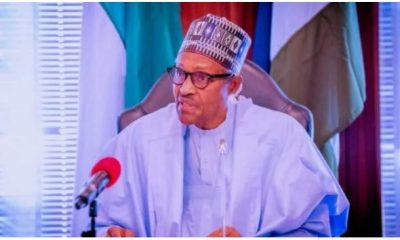
Senator Shehu Sani has revealed that mass killings being reportedly carried out by herdsmen in the country were sponsored by some governors. President Muhammadu Buhari on Wednesday when he visited the Archbishop of Canterbury, alleged that former Libya President Muammar Gaddafi trained the killer herdsmen.

However, the Senator representing Kaduna Central in a series of tweets on his handle, alleged that governors operating the policy of conditional cash transfer should be held responsible for herdsmen killings. He thus called on the Federal Government to treat such governors as risk.

“The roots of Herdsmen mass murder and kidnappings in other parts of Nigeria is in the policy of ‘Paying Fulani Herdsmen’ by some Governors. They appeased a monster with public funds and now the monster is going door to door;Sahel,Savanna and mangrove forests,” the lawmaker tweeted.

“Any Governor of a state operating the policy of Conditional Cash transfer to Killer Herdsmen is their patron. And he must be seen and treated as a national security risk.”


ANY GOVERNOR OF A STATE OPERATING THE POLICY OF CONDITIONAL CASH TRANSFER TO KILLER HERDSMEN IS THEIR PATRON.AND HE MUST BE SEEN AND TREATED AS A NATIONAL SECURITY RISK.

— SENATOR SHEHU SANI (@SHEHUSANI)
APRIL 12, 2018

THE ROOTS OF HERDSMEN MASS MURDER AND KIDNAPPINGS IN OTHER PARTS OF NIGERIA IS IN THE POLICY OF ‘PAYING FULANI HERDSMEN’ BY SOME GOVERNORS.THEY APPEASED A MONSTER WITH PUBLIC FUNDS AND NOW THE MONSTER IS GOING DOOR TO DOOR;SAHEL,SAVANNA AND MANGROVE FORESTS.

— SENATOR SHEHU SANI (@SHEHUSANI)
APRIL 12, 2018

BIG STORY

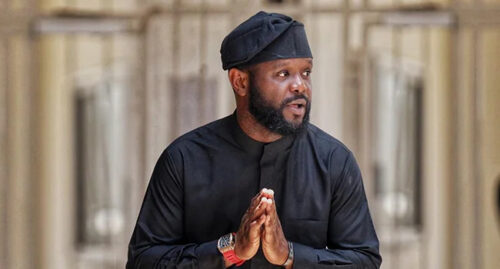
KWAM1 Loses Bid To Block Awujale Selection Process

Published

on

The Ogun State High Court, sitting in Ijebu-Ode, on Monday refused to grant an interim injunction aimed at restraining Governor Dapo Abiodun and five others from proceeding with the selection and installation of the next Awujale of Ijebuland.

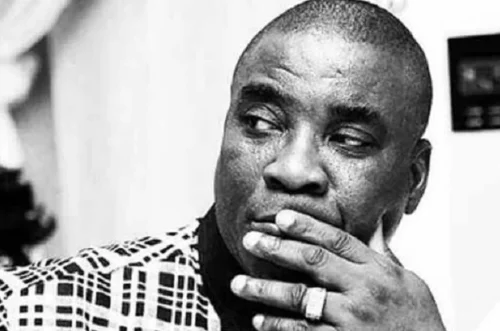
Ayinde, represented in court by Wahab Shittu (SAN), had sought the injunction pending the hearing of his substantive suit challenging the selection process.

But Justice A. A. Omoniyi dismissed the application, holding that the interim injunction lacked merit and that there were no strong grounds to justify its grant.

He subsequently ordered the expedited hearing of the substantive matter, fixing 14 January 2026 for proceedings.

KWAM1 had declared his interest in the vacant Awujale stool, claiming lineage from the Jadiara Royal House of the wider Fusengbuwa Ruling House.

However, the Fusengbuwa ruling house rejected his claim, stating that he is not from the royal house.

To challenge what he perceived as injustice, Ayinde filed a suit against the Fusengbuwa ruling house, Governor Abiodun, the Chairman of Ijebu-Ode Local Government, Dare Alebiosu, and three others.

The other respondents include the Commissioner for Local Government and Chieftaincy Affairs, Ganiyu Hamzat; Secretary of Ijebu-Ode Local Government, Oke Adebanjo; and the Chairman of the Awujale Interregnum Administrative Council, Dr Olorogun Sunny Kuku.

The suit, HC3/238/2025, was filed ex parte, citing Order 38 Rules 4 and Order 39 Rule 1 of the High Court of Ogun State (Civil Procedure) Rules 2024, Section 36 of the 1999 Constitution, and the court’s inherent jurisdiction

A copy of the court document dated 16 December 2025 was obtained by our correspondent.

Ayinde urged the court to restrain all respondents from further action on the Awujale selection process to protect his interest and preserve the res from being dissipated or interfered with.

He prayed the court to restrain the respondents, “their agents, or anyone acting on their behalf, from taking any steps in the installation process of the next Awujale of Ijebuland pending the hearing and determination of the substantive suit.”

The musician said he is an aspirant to the Awujale stool, “and the injunction is necessary to secure his interest and preserve the res from being dissipated or interfered with by the respondents.”

With the interim injunction denied, attention now turns to the substantive hearing scheduled for 14 January 2026, which will determine the fate of KWAM1’s claim to the Awujale stool.

Continue Reading

NEWS

Nigerians Are Not Having It: PayPal’s Quiet Comeback Bid Meets Fierce Resistance

Published

on

PayPal is trying to slip back into Africa, and Nigerians are not here for it. Not one bit. The company recently hinted at a 2026 return through partnerships with local fintech players, framing it as some grand expansion into the continent. But across social media, especially on X, the reaction has been swift and brutal: calls for a full boycott, threads digging up old wounds, and a flat-out refusal to welcome the payment giant back. Many see this move as opportunistic, almost insulting, after years of being shut out while the rest of the world used PayPal freely.

The bad blood goes way back. Since the mid-2000s, PayPal has placed heavy restrictions on Nigeria and a handful of other African countries.

Officially, it was about high fraud risks, chargebacks, and stolen cards. In practice, it meant Nigerians could open accounts and send money out, but receiving payments or withdrawing to local banks? Forget it.

For almost two decades, freelancers, remote workers, small business owners, and everyday hustlers were locked out of a huge chunk of the global digital economy. The stories are painful and personal. A graphic designer lost major international clients because the only payment option was PayPal.

A software developer watched job offers vanish the moment “Nigeria” appeared on his profile. Countless young people trying to earn dollars through surveys, micro-tasks, or gigs on platforms like Upwork and Fiverr hit the same wall. Many resorted to desperate workarounds: using VPNs to fake locations, borrowing relatives’ accounts abroad, or paying hefty fees to middlemen. It wasn’t just inconvenient; it felt discriminatory. “Why us?” became the constant question. And that’s the part that still stings.

Fraud happens everywhere. Scams aren’t exclusive to Nigeria. Yet PayPal seemed to single out Africa’s biggest country, slapping on restrictions that didn’t fully apply to nations with similar or worse records. While PayPal rolled out services in over 190 markets, including tiny countries few people think about, Nigeria stayed on the outside looking in. That lingering sense of unfair treatment has never gone away.

But here’s the thing: Nigerians didn’t just sit and complain. They built alternatives. When PayPal turned its back, local and regional fintechs stepped up. Flutterwave, Paystack (before the Stripe acquisition), Payoneer, Grey, Cleva, Raenest, and others created solutions tailored to the reality on the ground. Virtual dollar accounts, easy cross-border transfers, seamless integrations for freelancers.

Today, Nigeria’s fintech scene is one of the most vibrant in the world, moving billions annually. People found ways to get paid, save in dollars, and run businesses globally without ever needing PayPal. Now the company wants back in, quietly, through backdoor partnerships rather than a direct apology or full restoration of services.

The plan, teased as “PayPal World,” would link local wallets to its network without requiring traditional PayPal accounts. It sounds convenient on paper, but to many Nigerians, it feels like too little, way too late. “We survived without you,” is the common refrain. “We built our own thing. Why should we let you profit now?”

On X, the sentiment is raw. One designer wrote in all caps: “PLEASE BOYCOTT PAYPAL IF YOU HAVE THE CHANCE.” Another threatened to sue any local fintech that integrates with them, demanding compensation for years of frozen funds and lost income. The anger isn’t manufactured; it’s built on real scars from a time when opportunities slipped away simply because of a postcode.

Some analysts point out the irony in PayPal’s timing. The company has struggled lately, with its stock taking heavy hits while competitors eat its lunch. Africa’s young, tech-savvy population looks like the next big growth market.

To many Nigerians, this doesn’t feel like goodwill. It feels like fear of missing out. A few voices argue it could bring more options and competition, which isn’t a bad thing. But right now, those voices are drowned out by the overwhelming chorus of “no thanks.”

Nigerians endured the exclusion, adapted, and thrived in spite of it. They built bridges PayPal refused to cross. So when the company finally shows up at the door, years later, acting like nothing happened? The response is clear: the door stays closed.

Ojelabi, a journalist and publisher of Freelanews.com, writes from Lagos

Continue Reading

BIG STORY

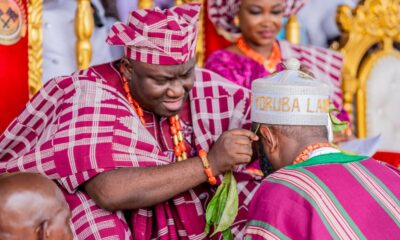
Alaafin To Install Seyi Tinubu As ‘Okanlomo of Yorubaland’ Saturday

Published

on

The Alaafin of Oyo, Oba Abimbola Owoade, is set to install Seyi, the son of President Bola Tinubu, as the “Okanlomo of Yorubaland” on Saturday.

The monarch on the same occasion will also install Senator Abdul’Aziz Yari representing Zamfara West as the “Obaloyin of Yorubaland”.

The chieftaincy installation of the duo was contained in a flyer that was obtained on social media platforms on Wednesday.

In the flyer, the monarch and his wife, Ayaba Abiwumi Owoade, invited the general public to the event and implored them to save the date, as it was scheduled to take place on Saturday, December 21, 2025.

“Okanlomo of Yorubaland” is a prestigious Yoruba title meaning “the one dear to the hearts of all Yoruba people” or “beloved child,” signifying deep affection and importance to the race.

Confirming the chieftaincy installation to our correspondent in a telephone conversation on Wednesday, the Alaafin’s media aide, Bode Durojaiye, said it is true and that the event will hold as planned.

He affirmed that the press statement for the said event would be made available to journalists any time soon.

“Yes, it is true. The Alaafin of Oyo wants to install Seyi Tinubu as the Okanlomo of Yorubaland and Senator Abdul’Aziz Yari as the Obaloyin of Yorubaland.

“The press statement on the said event would be made available today or anytime soon,” he said.

This was coming a few months after Alaafin’s counterpart, the Ooni of Ife, Oba Enitan Ogunwusi, bestowed the title of “Okanlomo of Oodua” on an Ibadan-born philanthropist and the Bada Olubadan designate, Dotun Sanusi.

This title sparked supremacy controversy between the two respected monarchs of Yorubaland, but was quelled by the region’s stakeholders.

Recently, the Ooni also conferred the First Lady, Remi Tinubu, with the prestigious chieftaincy title of Yeye Asiwaju Gbogbo Ile Oodua.

Arriving at the Ooni’s palace around 1 pm amid fanfare and heightened security, Mrs Tinubu was received by the monarch and his chiefs.

The installation ceremony, held at the Palace Square, coincided with celebrations marking Oba Ogunwusi’s 10th coronation anniversary.

The event drew a gathering of traditional rulers and dignitaries from across Yorubaland, including the Olu of Warri, Ogiame Atuwatse III; the Sultan of Sokoto; and the Soun of Ogbomoso, alongside cultural leaders and other notable personalities.

The title Yeye Asiwaju Gbogbo Ile Oodua carries historical significance, having been previously held by the late Hannah Idowu Dideolu Awolowo, wife of the revered statesman Chief Obafemi Awolowo.

The title Yeye Asiwaju Gbogbo Ile Oodua carries historical significance, having been previously held by the late Hannah Idowu Dideolu Awolowo, wife of the revered statesman Chief Obafemi Awolowo.

It is a recognition of leadership, influence, and contributions to society, particularly within the Yoruba cultural sphere.

Continue Reading

Most Popular


Warning: Undefined array key "slug" in /home/porsch10/public_html/wp-includes/class-wp-theme-json.php on line 2117

Warning: Undefined array key "slug" in /home/porsch10/public_html/wp-includes/class-wp-theme-json.php on line 2117

Warning: Undefined array key "slug" in /home/porsch10/public_html/wp-includes/class-wp-theme-json.php on line 2117