Connect with us


BIG STORY

Presidential Tribunal: PDP, Labour Party To Adopt Final Written Addresses On Tuesday

Published

on

The Presidential Election Petition Court, sitting in Abuja, is preparing to rule on three petitions attempting to overturn President Bola Tinubu’s victory.

As a preliminary to setting the judgment date, the five-member panel led by Justice Haruna Tsammani has directed the parties to appear before it tomorrow to adopt their last briefs of argument.

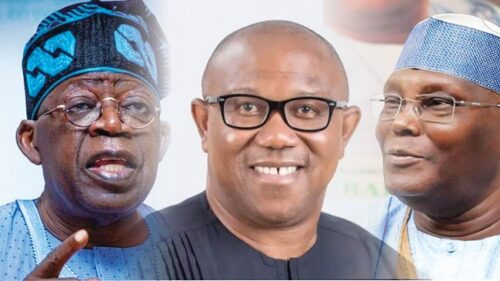
In a notice sent to the parties, the court invited them to adopt their written address in relation to the petition filed against President Tinubu by the former Vice President and candidate of the Peoples Democratic Party, PDP, as well as the petition filed by Mr. Peter Obi, candidate of the Labour Party, LP.

Recall that the Independent National Electoral Commission, INEC, announced on March 1 that Tinubu of the ruling All Progressives Congress, APC, had won the presidential election held on February 25, beating out 17 other contestants.

It was announced that Tinubu received 8,794,726 votes, defeating the two major rivals, Alhaji Atiku of the PDP, who received 6,984,520 votes, and Mr. Obi of the LP, who received 6,101,533 votes.

However, displeased with the outcome of the election, both Atiku and Obi petitioned the court to declare it null and void. In separate petitions, the couple claimed victory in the presidential election while questioning Tinubu’s ability to run. Aside from asking the court to declare that President Tinubu did not receive the majority of legitimate votes cast in the election, the petitioners also want INEC to remove the Certificate of Return that was granted to him.

Alternatively, they are asking the court to order a new presidential election, with President Tinubu barred from running because he was not qualified from the start.

It was earlier reported that the Electoral Act 2022 made it mandatory for candidates that were aggrieved by the outcome of the election, to within 21 days after the result was declared by INEC, file a petition before the court which shall deliver its judgment in writing within 180 days.

The court had on July 5, concluded its hearing of both Atiku and Obi’s petitions
While Obi closed his case after he called 13 witnesses that testified and tendered several documentary exhibits, Atiku, produced 27 witnesses and equally tendered exhibits before the court. On their part, both INEC and President Tinubu wrapped up their defense in both cases with one witness each, while the APC failed to produce any witness before the court.

However, all the Respondents in their respective written addresses, urged the court to dismiss all the petitions for want of merit. They argued that the petitioners were unable to discharge the burden of proof placed on them by the law. According to the Respondents, whereas the petitioners raised allegations that had elements of crime in them, they, however, failed to prove them beyond reasonable doubt as required by the law.

President Tinubu urged the court to hold that he was validly returned as winner of the election, by the INEC.

Specifically, Atiku, in the joint petition he filed with his party, marked: CA/PEPC/05/2023, maintained that the declaration of Tinubu as the winner of the presidential election was “invalid by reason of non-compliance with the provisions of the Electoral Act, 2022”, insisting that he “was not duly elected by a majority of lawful votes cast at the election”. He told the court that Tinubu, who was cited as the 2nd Respondent, “was at the time of the election not qualified to contest.”

In a further process he filed through his team of lawyers led by Chief Chris Uche, SAN, Atiku told the court that the President-elect had “demonstrated inconsistency as to his actual date of birth, secondary schools he attended (Government College Ibadan); his State of origin, gender, actual name; certificates evidencing Universities attended (Chicago State University).”

“The purported degree Certificate of the 2nd Respondent allegedly acquired at the Chicago State University did not belong to him but to a female (F) described as “F” in the Certificate bearing the name Bola Tinubu.

“The 2nd Respondent did not disclose to the 1st Respondent (INEC) his voluntary acquisition of the citizenship of the Republic of Guinea with Guinean Passport No. D00001551, in addition to his Nigerian citizenship. The 2nd Respondent is hereby given notice to produce the original copies of his said two passports,” Atiku added.

He argued that the APC candidate did not meet the constitutional threshold and “is constitutionally disabled from contesting for the office of President of the Federal Republic of Nigeria”.

Likewise, Obi and LP, in their own petition marked: CA/PEPC/03/2023, argued that as at the time Tinubu’s running mate, Senator Kashim Shettima, became the Vice Presidential candidate, he was still the nominated candidate of the APC for the Borno Central Senatorial election.

They equally challenged Tinubu’s eligibility to contest the presidential election, alleging that he was previously indicted and fined the sum of $460,000.00 by the United States District Court, Northern District of Illinois, Eastern Division, in Case No: 93C 4483, for an offense involving dishonesty and drug trafficking on the ground that the election was invalid by reason of corrupt practices and non-compliance with the provision of Electoral Act, 2022, the petitioners argued that INEC acted in breach of its own Regulations and Guidelines.

The petitioners contended that the electoral body was in the course of the conduct of the presidential poll, mandatorily required to prescribe and deploy technological devices for the accreditation, verification, continuation, and authentication of voters and their particulars as contained in its Regulations.

Consequently, they prayed the court to not only hold that Tinubu was not qualified to contest the election but to also declare that all the votes recorded for him were wasted votes owing to his non-qualification/disqualification.

“That it is determined that on the basis of the remaining votes (after discountenancing the votes credited to the 2nd Respondent) the 1st Petitioner (Obi) scored a majority of the lawful votes cast at the election and had not less than 25% of the votes cast in at least 2/3 of the States of the Federation, and the Federal Capital Territory, Abuja, and satisfied the constitutional requirements to be declared the winner of the 25th February 2023 presidential election.

“That it be determined that the 2nd Respondent having failed to score one-quarter of the votes cast at the presidential election in the Federal Capital Territory, Abuja was not entitled to be declared and returned as the winner of the presidential election held on 25th February 2023.

In the alternative, the petitioners want an order canceling the election and compelling INEC to conduct a fresh election at which Tinubu, Shettima, and the APC, listed as 2nd, 3rd, and 4th Respondents, respectively, shall not participate.

They urged the court to declare that since Tinubu was not duly elected by a majority of the lawful votes cast in the election, therefore, his return as the winner of the presidential election, was unlawful, unconstitutional, and of no effect whatsoever.

In a further alternative prayer in the petition dated March 20, which Obi filed through a team of lawyers led by Dr. Livy Uzoukwu, SAN, and Awa Kalu, SAN, he wants the tribunal to hold that the presidential election was void on the ground that it was not conducted substantially in accordance with the provisions of the Electoral Act 2022, and the 1999 Constitution, as amended.

Likewise, an order, “canceling the presidential election conducted on 25th February 2023 and mandating the 1st Respondent to conduct a fresh election for the President, the Federal Republic of Nigeria.”

Though five petitions were initially filed to nullify Tinubu’s election, however, the Action Alliance, AA, on May 8, withdrew its case, even as the Action Peoples Party, APP, followed suit two days later by also discontinuing further proceedings on its own petition.

The Allied Peoples Movement, APM, which refused to withdraw its own petition, had on July 14, adopted its final written address, even as the court reserved its judgment on the petition.

The APM, in its petition marked: CA/PEPC/04/2023, argued that the withdrawal of Mr. Ibrahim Masari who was initially nominated as the Vice-Presidential candidate of the All Progressives Congress, APC, invalidated Tinubu’s candidacy in view of Section 131(c) and 142 of the 1999 Constitution, as amended.

The party argued that there was a gap of about three weeks between the period that Masari, who was listed as the 5th Respondent in the petition, expressed intention to withdraw, the actual withdrawal of his purported nomination, and the time Tinubu purportedly replaced him with Senator Kashim Shettima.

It further argued that Tinubu’s candidature had elapsed at the time he nominated Shettima as Masari’s replacement.


BIG STORY

Power Interrupted: Wike And The Naval Officer’s Quiet Defiance — By Babajide E. Ikuyajolu

Published

on

Public Work or Defiance?

In a country where power often speaks louder than law, the recent confrontation between FCT Minister Nyesom Wike and a Naval officer did more than spark an argument. It stirred something deeper about how Nigerians now see authority.

The video showed what many described as an altercation: Wike visibly angry, the naval officer standing firm, refusing to yield. In a different setting, it might have been a routine exchange of hierarchy. But Nigeria is no longer a place where power goes unquestioned, and that made the moment explode into fascination and quiet applause.

Between Law and Ego

Inside military circles, there is a colloquial expression called “Two Fighting”. It is not a written law, but a saying, used when a senior officer assaults a junior one without legal justification or outside military boundaries. It captures a simple truth whispered in the barracks: rank may command obedience, but it should never erase dignity.

Yet, this was not two fighting. This was a civilian political authority confronting a uniformed officer, a delicate space between governance and discipline, between civil power and uniformed restraint.

By law, Ministers direct policies, not soldiers. The Armed Forces Act makes clear that obedience belongs within a defined chain of command. So while Wike may have carried political weight, the officer’s calm refusal stood on the firmer ground of legality, and perhaps morality too.

Still, power has its own dialect, and sometimes ego translates it louder than law.

The Street’s Verdict

If the law spoke in nuance, the people spoke in certainty. Nigerians did not see a minister enforcing order. They saw a man in power trying to impose himself, and a naval officer who refused to bow.

Across motor parks, offices, and social media timelines, one thing was constant: Admiration. Not necessarily for defiance, but for composure. The officer’s restraint felt like a collective release, the kind that says, “At least someone stood up today.”

It was not rebellion they saw. It was representation. For once, someone in uniform seemed to mirror the quiet dignity Nigerians wish their leaders would show.

The Weight of Punishment

Yet, within the military, hierarchy remains sacred. Technically, the officer could face disciplinary action, not for fighting, but for the embarrassment the episode brought.

But here is where the lines blur again: when a man in uniform is punished for restraint, the public does not see discipline. They see injustice. And in a country already brimming with silent anger, such a message can ripple far beyond the barracks.

Because military men are Nigerians too. Their uniforms may set them apart, but their frustrations are rooted in the same soil. When one of them is made a scapegoat for showing composure, the people watching from the sidelines feel it personally. Their silence starts to sound like protest waiting for a trigger.

Sometimes it takes very little for collective irritation to turn into open defiance, not from hate, but from exhaustion.

The Balance We Need

Moments like this test more than authority; they test perception. They force a country to ask if power can coexist with fairness.

What the situation needs is not punishment or spectacle, but Arbitration, the kind that listens before it judges. Because the more openly government can resolve such tensions, the more quietly the people begin to believe again.

Arbitration here is not just about a verdict; it is about trust. It is the government telling its citizens, “We can be firm without being cruel.” That message alone can hold back the tide of cynicism rising in the hearts of those who have stopped expecting justice to ever look familiar.

Beneath the Outburst

This incident was never about a fence, a title, or a patch of land. It was about something far more human, the way Nigerians now relate to those who hold authority over them.

They are not anti-leadership. They are simply weary of the kind that confuses service with status.

That is why Wike’s anger did not register as zeal for order, but as the old sound of entitlement. And why the naval officer’s restraint felt like a glimpse of the Nigeria people still hope for, a place where discipline and dignity do not cancel each other out.

The Echo

Maybe this was not about who was right or wrong. Maybe it was about what happens when power finally meets a kind of calm it cannot command.

Because in that brief standoff, Nigerians did not just see an officer.

They saw themselves, standing tall, unarmed, but finally unwilling to move.

Continue Reading

BIG STORY

JUST IN: Federal Government Suspends Implementation Of 15% PMS, Diesel Import Duty

Published

on

The Nigerian Midstream and Downstream Petroleum Regulatory Authority (NMDPRA) has announced that the previously proposed 15 per cent ad-valorem import duty on Premium Motor Spirit (PMS) and Automotive Gas Oil (diesel) will no longer be implemented.

George Ene-Ita, Director of the Public Affairs Department at NMDPRA, issued the update on Wednesday, urging the public to avoid panic buying of petroleum products.

The import tariff had been approved by President Bola Tinubu on October 29, following a submission from the Executive Chairman of the Federal Inland Revenue Service, Zacch Adedeji. The proposal sought to apply a 15 per cent duty on the cost, insurance, and freight (CIF) value of imported petrol and diesel, aiming to align import costs with domestic market realities. Implementation was originally scheduled to begin on November 21, 2025.

In its statement, NMDPRA clarified that the government is no longer pursuing the implementation of the fuel import duty. “It should also be noted that the implementation of the 15% ad-valorem import duty on imported Premium Motor Spirit and Diesel is no longer in View,” the agency stated.

The authority also assured Nigerians that the country has an adequate supply of petroleum products, meeting the national sufficiency threshold, even during this period of peak demand.

This suspension comes amid concerns from stakeholders about potential price increases and market disruptions that could have resulted from the import duty. The NMDPRA emphasized that the move is aimed at maintaining stability in fuel supply and preventing undue hardship for consumers.

President Tinubu’s initial approval had reflected a broader policy to regulate fuel imports and align them with domestic economic realities, but the suspension indicates a recalibration in response to public and market considerations.

NMDPRA continues to monitor the fuel market to ensure sufficient supply and smooth distribution across the country, urging citizens to adhere to official guidance and avoid hoarding.

Continue Reading

BIG STORY

Obidient Movement’s Mobilisation Director, Morris Monye Resigns; Says Obi Doesn’t Care About Local Structure, No Financial Support

Published

on

The Director of Mobilisation for the Obidient Movement, Morris Monye, has resigned from his position, citing poor coordination within the group and the strain of personally funding its activities.

In a statement released via his X handle on Thursday, Monye expressed frustration over what he described as weak organisational structure and lack of support from the movement’s leadership, which he said led to a poor outing in the recently concluded Anambra governorship election.

Monye stated, “Almost a year down the line, most of our short, medium, and long-term plans have not been met. I won’t be part of optics and no work. The poor showing at the Anambra election has also made my position untenable.”

He disclosed that he had personally financed the group’s nationwide mobilisation drives, covering travel expenses, voter awareness campaigns, local structure support, and logistics — all without any financial assistance from the leadership or the presidential candidate of the Labour Party, Peter Obi.

Monye added, “No money was given to the Directorate of Mobilisation. There’s no bank account even for the directorate. In fact, Mr Peter Obi has never asked what we are doing in mobilisation — no communication, nothing.”

The former director also alleged that his role attracted harassment and intimidation from government supporters and security agencies. He said the constant pressure and lack of security took a toll on him and his family.

“It’s a role that paints a target on your back. I’ve had to remain silent so as not to discourage anyone or appear to be complaining, but it has taken a toll on me and my family, who can hardly understand it all,” he stated.

Monye highlighted several of his contributions to the movement, including creating an online registration platform for members, reviving inactive support groups, setting up regional and local offices, and launching the Obidient NextGen university campus network.

He noted that he also helped raise campaign funds for the Obidient candidate in the Anambra election and began an initiative to equip polling unit agents with affordable body cameras for transparency — a project he urged his successor to complete.

According to him, “The next director must follow up on this. We have not closed it out yet. You can’t run a campaign simply from general goodwill. This is not 2023. The element of surprise is gone.”

Reflecting on his tenure, Monye described his service in the Obidient Movement as a “privilege” but said it was time for “someone else to carry the mantle.”

Morris Monye, known as one of the movement’s prominent figures, played a key role in its early mobilisation phase. The Obidient Movement, inspired by Peter Obi’s 2023 presidential campaign, evolved into a grassroots political force largely driven by youthful supporters and social media advocacy.

As of press time, the leadership of the movement, including the National Coordinator, Dr. Yunusa Tanko, had yet to issue a response to Monye’s resignation or the concerns he raised.

Continue Reading


Join Us On Facebook

Most Popular