



NEWS
MUST-READ: Shao Community, A Rustic Town In Kwara Where Cultural Demands Negate Modernity

- /home/porsch10/public_html/wp-content/plugins/mvp-social-buttons/mvp-social-buttons.php on line 27
https://porscheclassy.com/wp-content/uploads/2021/11/Shao-Community-1000x600.jpg&description=MUST-READ: Shao Community, A Rustic Town In Kwara Where Cultural Demands Negate Modernity', 'pinterestShare', 'width=750,height=350'); return false;" title="Pin This Post">
- Share
- Tweet /home/porsch10/public_html/wp-content/plugins/mvp-social-buttons/mvp-social-buttons.php on line 69
https://porscheclassy.com/wp-content/uploads/2021/11/Shao-Community-1000x600.jpg&description=MUST-READ: Shao Community, A Rustic Town In Kwara Where Cultural Demands Negate Modernity', 'pinterestShare', 'width=750,height=350'); return false;" title="Pin This Post">
Globally, the position of heritages to countries especially in Africa cannot be overemphasized. As the world is populated with people of different ethnicities and cultures so are the tribes, traditions are varied.
For instance, Nigeria, a country located in the Eastern part of West Africa, remains the most populated multiethnic and multilingual country in Africa with over 250 ethnic groups. The nation is endowed with about 29 game reserves, 1129 forest reserves, 4 game sanctuaries, 2 strict nature reserves, and 8 national parks.
But as rich as Nigerian culture is said to be, the country is dotted with towns, villages, and communities with different cultural practices and heritages which in most cases could have serious health risks on the well-being of the citizens or be in conflict with modernity.
Shao, a rustic community in Kwara State is one of the few towns in Nigeria still rooted in the traditions and unhealthy practices in the 21st century. The agrarian community is located in the Moro Local Government Area of Kwara State, Nigeria, on an elevation of 269 meters above sea level. Its coordinates are 8°34’60” N and 4°34’0″ E in DMS (Degrees Minutes Seconds) or 8.58333 and 4.56667 in decimal degrees. The people of Shao are mainly farmers, herders, and traders.
Their cultural practices
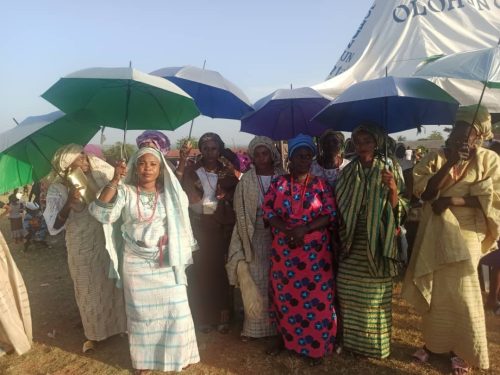
Like the Indonesians, the people of Shao town also have a day in which they give out their spinsters in marriage. This day is also known as “Awon festival” or “Awonga festival”, it is a day set aside for mass weddings in the ancient town. Awon Mass Wedding features the marriage of hundreds of young girls. This period is also the season when a number of traditional rites and rituals are carried out. During these festive occasions, investigations also reveal those female children are usually forced to be circumcised against their wishes and that of their parents. Women, especially wives of the traditional title holders were also coerced to take part in some rituals which could involve lives. Although many human rights activists had argued over the continued practice of some of the norms, some indigenous residents remain conservative and adamant, arguing that the culture must remain to preserve the glory of the ancestors.
Meanwhile, as the community prepares for the 2021 edition of its tradition, the Awonga Mass Wedding, billed to hold in October, the ancient town has begun to wear a new look – gloomy and nervous, the people of Shao are reluctant to celebrate and are ridden with anxiety because one of the most important positions within the community – the Chief Priest position, hasn’t been filled yet by the chosen one. But they intend to celebrate regardless, as they did last year.
A band of hunters who used to entertain the residents and visitors amid occasional fire from their Dane guns, during the occasion with their fanciful dance steps has begun rehearsal. The beautiful damsels to be married off have also prepared for the historic tradition that has been in existence for over two centuries.
It is a moment when the mammoth crowd gathers through the LGEA Primary School playground in the town to soak in the rich cultural heritage of the people.
The Awon Mass Wedding dating back to the early history of the community has become a rallying point for the people.
Historically, the festival is said to have emanated from a woman called Awon who mysteriously appeared to a hunter named Omo Olarele and claimed the ownership of a small stream from which he had been drinking water each time he went hunting. The one-breasted woman, who welcomed the hunter, only requested to be taken to the first Ohoro of Shao, Oba Olanibo, to which the hunter consented.
The Vacant stool, a threat to citizen’s right and fleeing woman
As beautiful or rich, some cultural enthusiasts may see the Shao festival, to a large majority of the citizens, especially the civilized ones, the culture poses a big threat to lives and in a serious conflict with modernity.
As the Awon Mass Wedding festival approaches with residents preparing to roll out drums for the celebration, it was learnt that efforts are on top gear to complete the initiation process of the newly chosen Chief priest, AbdulFatahi Baba. However, before he can be installed as the successor, his wife, son, and daughters must also take part in the cultural ritual as part of the rites. This woman, Rodhiya Abdulfatahi fled the community out of fear for the life-endangering ritual procedure her son and daughters will be subjected to. It was also mentioned that she had witchery tendencies and everyone within the community believes that she’s a lesbian and would influence her children with waywardness.
Narrating how the mother of six became the target and subject of emotional torture, a resident in the community, Mrs Silifa Olukoga, 54, told the story about how Rodhiya, whose location is unknown to the community, eventually fled the community because the whole town has insisted that she must succumb to the ritual rites required for her husband’s ascension.
She said: “Perhaps due to the low education level, women are subjected to all manner of abuses in this part of the world. It all happened when Rodhiya’s husband Mr AbdulFatahi was chosen as the successor of the Chief priest following the death of the late priest.
While many see the cultural practices of the ancient city as a rich heritage, to some citizens, particularly those in touch with modernity, the Shao traditional practices pose a great threat to their modern lifestyle.
Speaking with our correspondent, a traditional chief in the community, who simply identified himself as Akogun, confirmed the frantic search for the woman, saying, “It is an abomination for the woman and her children not to show up for the traditional rites. Once her husband has been chosen by the oracle to occupy the vacant stool, she must come forward for it, Akogun said.
Community acceptance of and compliance with annual ivermectin treatment in Shao were remarkably high.
The Awon Ceremonial
The Awon dance festival takes place two months after the mass wedding and every woman in Shao must take part in the dance.
On this day, every woman must stay at home to make bean cakes for Awon. Any woman that flouts this order and goes out will be chased back home by a masquerade called “Duo Dika”.
The dance commences in the afternoon with the women assembling in front of the Baba Alawon’s house. Drummers are also present to play at the event. The Awon Festival is one that the people of Shao look forward to with anticipation every year.
There is a lot of singing and dancing during the festival. At a time, the dancing becomes so rigorous and the masquerade makes an appearance again.
The masquerade proceeds to chase the women out of the dance arena and they run to their various homes. The festival day usually ends at about 6 o’clock in the evening.










NEWS
ZITDA Deploys Internet Connectivity at Gusau International Airport Ahead of October 1 Commercial Operations
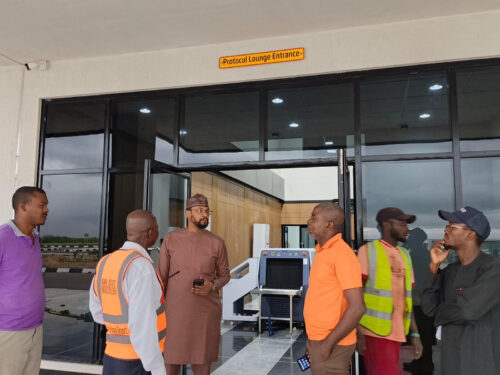
ZITDA team visited the airport to assess the facility ahead of the immediate deployment of the digital infrastructure.
The connectivity will cover critical areas of the airport, including the domestic and international departure and arrival terminals, protocol and VIP lounges, the control tower, the fire station and other operational facilities. Passengers will also have access to free internet from the moment they arrive at the airport.
Speaking on the initiative, ZITDA said its responsibility goes beyond providing internet access, describing the project as part of efforts to build the digital infrastructure required for modern government, seamless public services and a connected Zamfara.
The airport deployment is part of the broader digital infrastructure expansion programme of the Zamfara State Government, driven by Governor Dauda Lawal’s vision of a more digitally enabled, efficient and connected state.
The first phase of the expansion has already been completed and covers the Government House, the JB Yakubu Secretariat Complex, the State House of Assembly Complex, the State High Court Complex, Yariman Bakura Specialist Hospital, the School of Nursing Sciences and the Zamfara Internal Revenue Service.
ZITDA said that as the state prepares to welcome commercial flights to Gusau International Airport, it is equally preparing the digital infrastructure required to support a modern airport.
NEWS
[Photo News] Governor Dauda Lawal Joins VP Shettima at UNGA, Positions Zamfara as Investment Destination
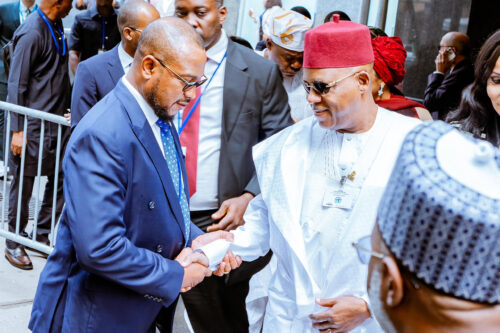
Governor Lawal, who is attending the global summit to engage world leaders on behalf of Zamfara State, remained visibly active at the Nigeria Corner and several side events, where he is projecting the state as a prime destination for investment in Nigeria, particularly within the agricultural and natural mineral value chain.
The Governor’s presence at UNGA signals Zamfara’s renewed push to attract foreign direct investment and reposition the state as an economically viable partner on the global stage, despite its recent security challenges.
More photos below:




The approval, which adopts the Federal Government’s Consolidated Health Salary Structure (CONHESS), is aimed at improving the welfare of health workers and strengthening healthcare delivery in the state.
The development follows an earlier increase by the state government to bring the salaries of medical personnel in Zamfara in line with those of their counterparts in the Federal Government.
With the new approval, a health worker currently earning ₦100,000 will now take home ₦195,000, while someone on ₦200,000 will earn ₦390,000. A worker on ₦300,000 will now receive ₦585,000, and those on ₦500,000 and ₦1,000,000 will earn ₦975,000 and ₦1,950,000, respectively.
In effect, the 95 percent increase means the existing salary of every affected health worker is almost doubled.
The approval is expected to boost morale, attract and retain qualified health professionals, and ultimately improve healthcare delivery across the state.
It also comes shortly after the state government recruited new health workers last week, with the newly engaged staff set to benefit from the new salary structure.
Health workers in the state have since expressed appreciation to Governor Lawal for the gesture, describing it as a major boost to the sector.
The governor reaffirmed his administration’s commitment to the welfare of workers and the delivery of quality healthcare services to the people of Zamfara State.



-

 BIG STORY5 days ago
Ogun 2027: Equity, Performance and The Road Ahead —– By Sola Fajobi
-

 BIG STORY5 days ago
Tinubu Demands Two Permanent UN Security Council Seats, Veto Power for Africa
-

 BIG STORY3 days ago
Tinubu to Nigerians: I’m Correcting Mistakes of Past Administrations, Allow Me to Finish The Work
-

 POLITICS4 days ago
Oyo 2027: Inside the Alli-Adedeji Ticket and the ‘2 for 1’ Strategy —- By Seun Oloketuyi
-

 NEWS2 days ago
ZITDA Deploys Internet Connectivity at Gusau International Airport Ahead of October 1 Commercial Operations
-

 BIG STORY4 days ago
Anyone Pushing for Return of Petrol Subsidy Doesn’t Mean Well for Nigeria —- Alex Otti
-

 BIG STORY2 days ago
Tinubu Hale and Hearty, He Will Return to Nigeria This Week —- Onanuga
-

 BIG STORY2 days ago
Newlywed Businessman Excretes 72 Wraps of Cocaine At Enugu Airport