Connect with us


BIG STORY

Lagos Monarch Counters Oba Of Benin, Says You’re Wrong, Aworis Are Lagos’ First Settlers

Published

on

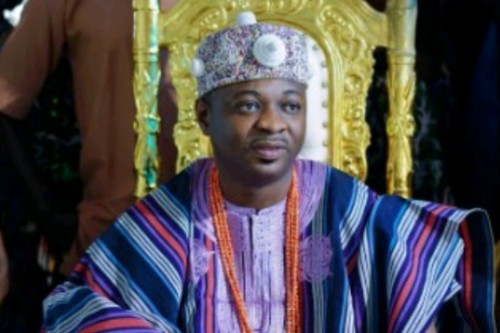
Oba Sulaimon Bamgbade, the Olofin of Isheri and Adimula of Awori Kingdom, on Thursday said the Aworis were the first settlers in Lagos.

Bamgbade urged the Oba of Benin, Oba Ewuare II, to retrace the origin of the Benin Kingdom to Ile Ife, like the Aworis have always done.

This is coming in response to a recent comment by Oba Ewuare II, who traced the origin of Lagos to the Benis.

The monarch’s comment has elicited opposition from a prominent Awori monarch, the Olota of Ota, Oba Adeyemi Obalanlege; some academics and a Lagos chief, among others.

Oba Ewuare II sparked controversy among Nigerians especially on social media during a visit to the Lagos State Governor, Babajide Sanwo-Olu, on Sunday, when the king said the Binis founded Lagos.

“It is in the history books that the Binis founded Lagos. When some people will hear it now, they will go haywire; what is the Oba saying there again? But it is true. Go and check the records. Maybe not all over Lagos as we know it now but certain areas in Lagos, maybe the nucleus of Lagos, were founded by my ancestors. The Oba of Lagos will say so,” Oba Ewuare said.

But reacting to the comment in a statement on Thursday, the Olofin said contrary to Oba Ewuare’s claim, Lagos was founded and established by Olofin Ogunfuminire, the progenitor of the Awori people.

He said, “Olofin Ogunfuminire left Ile-Ife to settle at Isheri before migrating with his wife, Ajaiye, to present-day Iddo in the heart of Lagos. It was at Iddo that Ajaiye was blessed with the fruits of the womb. Her offspring are the Idejo who are the actual traditional landowners of Lagos.

“The spatial region of the land owned by the Idejo spans from Lagos Mainland (Iddo) to Lagos Island and up to Eti-Osa which he allocated absolutely to his children and other descendants.

“In this regard, he assigned Iru to the Oniru, Ikate to the Elegushi, Lagos Island to Aromire, Iganmu to Ojora, Otto, and mainland to the Oloto (up to Odo–Iya Alaro). Isheri was the dispersal point where other Olofin Ogunfunminire descendants left to found other Awori towns. For instance, Akeredun left Isheri to establish Igbesa, Odoyi left Isheri to find Agboyi, Osolo and Eleidi Atalabi left Isheri to find Ota.

“These facts are firmly established and supported by extant literature written by foreign authors and researchers such as Kristin Mann who in his book titled ‘Slavery and Birth of an African City: Lagos 1760- 1900,” wrote and I quote: ‘Migrant fishing people first settled in Lagos and from the beginning water and canoes had a prominent role in the lives of its inhabitants. Prior to the sixteenth century, Aworis, the southernmost of the Yoruba-speaking people, dispersed from Isheri, a village twelve miles up the Ogun River. A group of them settled at what is now Ebute Metta, on the mainland.

“Until the need for greater security drove the community to a smaller island in the lagoon opposite Lagos Island. There, they established two settlements, Otto and Iddo, and soon attracted fresh immigrants. In time, people from Iddo moved to the northwestern corner of the larger Island opposite, which eventually became known as Lagos, looking for land to farm.

“The settlers recognised the paramount ruler called the Olofin, based in the more populous community of Iddo but tracing mythical descent from Isheri and via the founder of that village to Ile-ife, the cradle of Yoruba civilisation.”

Olofin added, “The Benin who later came to Lagos as mere traders met Olofin and his descendants on the island of Iddo and its neighbourhood where they, Benin settled down and were well received and hosted by the community. As time went by, a feud broke out between the Benin and their hosts. Facing imminent defeat, they called for reinforcements and assistance from the Oba of Benin.

“Olofin Ogunfunminire and his mentees vehemently and successfully repelled these attacks. As a compromise, and as part of the tolerant disposition which is the character of the typical Awori, the Benins were eventually relocated to live with Aromire on his pepper farm on Lagos Island at Iga Idungaran (Idungaran in Awori means pepper farm) where they after a while and probably due to the indifference of the original land owner, introduced a more structured organisation.

“The first settlers in present Lagos are Aworis and the dispersal point of Aworis is Isheri. As the Olofin of Isheri and Adimula of Awori Kingdoms, I implore The Oba of Benin to retrace the origin of the Benin Kingdom to Ile Ife, like the Aworis have always done.”

BIG STORY

We Will Get It Right With Security —- Obasa

Published

on

Speaker of the Lagos State House of Assembly, Rt. Hon Mudashiru Obasa has affirmed that with the support of all Nigerians, President Bola Ahmed Tinubu would get it right with his concerted reengineering of the nation’s security architecture.

Speaking at the APC Stakeholders and Progressives Governors Forum meeting held Saturday, December 6, at the Eko Hotel and Suites, Victoria Island, Lagos, Obasa said he did not doubt that President Tinubu and the All Progressives Congress, APC-led federal government, would do all that they can to ensure that they secure the life and property of every Nigerian.

According to Obasa, “We have seen the president in action and how he is innovating and working hard to resolve our many challenges, especially insecurity, and we believe he will get it done. He’s still the man who can do it. That is why we must do everything within our powers to ensure that he is returned in 2027.”

Speaker Obasa teed off with robust commendations for the governors for their shared dedication and commitment to helping President Tinubu resolve Nigeria’s insecurity problem.

He urged them to galvanise their people when they return to their various states to be a part of the solution to Nigeria’s security challenge, and not stay aloof.

Speaker Obasa added that security is not just about the governors, “It is about everybody. We must all be involved in fighting this problem. We must give the President all the support that we can so that he will succeed in his attempts to redirect the trajectory of Nigeria.”

The PGF had converged on Lagos between December 5 and 6 for a meeting convened by the Chairman of the Forum, Senator Hope Uzodimma, Governor of Imo State, and hosted by Governor Babajide Sanwo-Olu of Lagos State.

In a communique read by Governor Uzodinma, the governors passed a vote of confidence on President Tinubu’s administration, and pledged support for his Renewed Hope Agenda and re-election in 2027.

The Forum, according to Governor Uzodinma, reviewed the security situation across the country and expressed appreciation for the improved coordination between federal, state, and local security structures, as well as the courage and sacrifices of security agencies and community volunteers. They also resolved to strengthen local security architecture in all the states.

Governor Uzodinma said that their two-day engagement provided an opportunity to review the nation’s current trajectory, deepen coordination among the governors, and reaffirm their firm support for the Renewed Hope Agenda of President Tinubu. “The PGF commended President Bola Ahmed Tinubu for his steadfast commitment to stabilizing the economy, strengthening national security, and laying the foundations of sustainable growth through the Renewed Hope Agenda,” he said.

Continue Reading

BIG STORY

Nigerian Army Suspends Officer Retirements Amid National Security Emergency

Published

on

The Nigerian Army has suspended all statutory and voluntary retirements for certain categories of officers following the nationwide security emergency declared by President Bola Tinubu.

An internal memo dated December 3, signed by Maj. Gen. E. I. Okoro on behalf of the Chief of Army Staff, and sighted by our correspondent, stated that the suspension of retirements is aimed at retaining manpower, experience, and operational capacity as the Armed Forces expand in response to rising insecurity.

The document, referencing the Harmonized Terms and Conditions of Service Officers (HTACOS) 2024, noted that although officers are ordinarily expected to retire upon reaching their age limit, completing 35 years of service, or after repeated promotion or conversion failures, service extension is permissible under Paragraph 3.10(e) in the interest of the military.

The memo partly read: “Military service of a commissioned officer entails a period of unbroken service in the AFN from the date of enlistment or commissioning to the date of retirement. The period of service is determined by conditions enshrined in the HTACOS Officers 2024. These include attainment of age ceilings on various ranks, a maximum length of service of 35 years, and other criteria provided in Paragraphs 11.02(d) and 17.15, among extant regulations.

“Notwithstanding these provisions, Chapter 3.10(e) of HTACOS Officers 2024 allows for the extension of service to officers in the interest of the service.

“The President and Commander-in-Chief declared a nationwide security emergency on November 26, mandating the expansion of the AFN and other security agencies. In line with this, and to rapidly expand manpower, it has become expedient to temporarily suspend all statutory and voluntary retirements from the Nigerian Army with immediate effect.”

According to the circular, the temporary suspension applies to officers who fall into the following categories: officers who failed promotion examinations three times; officers passed over three times at promotion boards; officers who have reached the age ceiling for their ranks; officers who failed conversion boards three times; and officers who have attained 35 years of service.

“Officers in these categories who are not interested in an extension of service are to continue with the normal retirement procedure. Officers desirous of extension should note that upon extension, they are not eligible for career progression, including promotion, career courses, NA sponsorship, self-sponsored courses, secondment, or extra-regimental appointments,” the memo stated.

It directed all commanders to disseminate the directive and manage morale, adding that the policy would be reviewed as the security situation improves.

President Bola Tinubu, on November 26, 2025, declared a nationwide security emergency and directed the military, police, and intelligence agencies to expand recruitment and deploy thousands of additional personnel.

Continue Reading

BIG STORY

Senate Orders Nationwide Crackdown As Lead Poisoning Hits Ogijo Lagos

Published

on

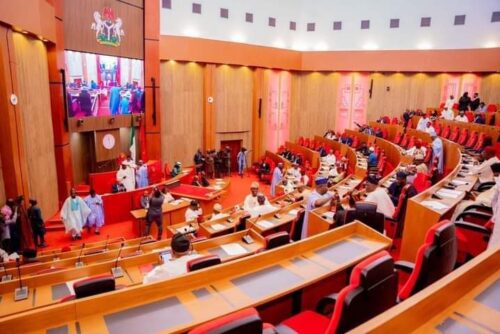
The Senate on Thursday expressed grave alarm over a fast-spreading lead-poisoning crisis in Ogijo, a densely populated community straddling the boundary between Ikorodu (Lagos) and Ogun East Senatorial District.

It described it as a full-blown environmental and public-health emergency that threatened thousands of lives.

The motion, jointly sponsored by Mukhail Adetokunbo Abiru (Lagos East) and Gbenga Daniel (Ogun East), was brought under Matters of Urgent Public Importance pursuant to Orders 41 and 51 of the Senate Standing Orders, 2023 (as amended).

Lawmakers cited scientifically verified reports of extreme lead contamination linked to a cluster of used lead-acid battery recycling factories operating in the area for years.

According to the Senate, the crisis had left residents battling persistent headaches, abdominal pain, memory loss, seizures, and developmental delays in children, symptoms strongly associated with chronic lead exposure.

The chamber noted with concern that the Federal Government had already begun clampdowns, with the Minister of State for Labour and Employment, Nkeiruka Onyejeocha, shutting down seven battery-recycling factories and ordering a temporary halt to lead-ingot exportation pending safety investigations.

Senators said they were “alarmed that residents have for several years complained of persistent headaches, abdominal pains, loss of memory, seizures, cognitive decline, and developmental delays in children, symptoms strongly associated with chronic lead exposure.”

Despite years of community protests, the smelters allegedly continued operating openly, releasing toxic fumes and particulate dust into surrounding homes, markets and playgrounds.

“It is regrettable that despite years of community outcry, smelter furnaces continued operating, discharging toxic fumes from melted batteries directly into surrounding neighbourhoods. We are concerned that while some factory operators deny wrongdoing, community exposure remains extreme.

“The Senate acknowledges and commends the proactive efforts of the Lagos and Ogun State Governments and their relevant ministries and agencies for conducting early inspections, raising community awareness and working with federal authorities to contain the exposure,” lawmakers said.

The chamber further cited disturbing findings by independent testing commissioned by The Examination and The New York Times, which revealed severe contamination in both residents’ blood samples and soil within the industrial cluster.

Some environmental samples, senators noted, showed lead levels “up to 186 times the global maximum safety threshold.”

A major dimension of the scandal, lawmakers said, was that lead processed in Ogijo had already been traced into international supply chains, reaching global battery and automobile manufacturers who either did not address the findings or relied solely on assurances from Nigerian suppliers.

The Senate lamented that while some factory operators deny wrongdoing, community exposure remains dangerously high amid weak accountability and gaps in Nigeria’s regulatory frameworks.

Senators nonetheless praised emergency actions taken by the Lagos and Ogun state governments, commending their early inspections, public-awareness campaigns and support for affected families.

Citing Sections 14(2)(b) and 20 of the 1999 Constitution, the Senate emphasised the government’s responsibility to safeguard citizens’ welfare and ensure a safe environment.

Following extensive deliberations, the Senate resolved to commend both the Federal Government and the Lagos and Ogun State Governments for their swift intervention in shutting down non-compliant lead-recycling factories.

Lawmakers urged continued enforcement, including factory closures, export suspensions, prosecution of violators, and strengthened industrial safety monitoring.

The chamber mandated the Federal Ministry of Health and the Nigeria Centre for Disease Control (NCDC) to deploy emergency medical teams to Ogijo to provide free toxicology screenings, blood-lead management, chelation therapy, and ongoing treatment for affected children and adults.

Simultaneously, the Federal Ministry of Environment and NESREA were directed to carry out comprehensive environmental remediation, mapping soil, groundwater, air, and household dust contamination.

The Senate also called on the Federal Ministry of Solid Minerals and relevant regulatory agencies to enforce strict compliance standards for battery-recycling and lead-processing operations nationwide.

Additionally, it recommended establishing a National Lead Poisoning Response and Remediation Task Force within NEMA and directed the Committee on Legislative Compliance to monitor progress and report back within six weeks.

The Senate described the Ogijo crisis as a preventable tragedy that must serve as a national wake-up call on industrial pollution, regulatory failure and the urgent need to protect vulnerable communities from hazardous waste.

 

Continue Reading


Join Us On Facebook

Most Popular


Warning: Undefined array key "slug" in /home/porsch10/public_html/wp-includes/class-wp-theme-json.php on line 2117

Warning: Undefined array key "slug" in /home/porsch10/public_html/wp-includes/class-wp-theme-json.php on line 2117

Warning: Undefined array key "slug" in /home/porsch10/public_html/wp-includes/class-wp-theme-json.php on line 2117