Connect with us


BIG STORY

Federal Government Plans Tax Overhaul To Access $750m World Bank Loan

Published

on

The Federal Government is pushing ahead with critical tax reforms to meet the requirements for a $750 million loan from the World Bank.

This loan is part of a broader $2.25 billion package approved by the World Bank to support Nigeria’s economic stability and vulnerable populations.

The disbursement of the $750 million loan is contingent on specific fiscal and governance conditions under the Accelerating Resource Mobilisation Reforms programme.

The ARMOR programme includes three main result areas: implementing tax and excise reforms to increase Value-Added Tax collections and excise rates on health and environmentally friendly products; strengthening tax and customs administrations to enhance VAT compliance and audit effectiveness; and safeguarding oil and gas revenues by increasing transparency and net revenue contributions.

The agreement document between Nigeria and the World Bank read in part, “The bank agrees to lend to the borrower the amount of $750,000,000 as such amount may be converted from time to time through a currency conversion (“Loan”), to assist in financing the programme described in Part 1 of Schedule 1 to this Agreement (“Programme”) and the project described in Part 2 of Schedule 1 to this Agreement (“Project”, and together with the Programme, hereinafter jointly referred to as the “Operation”).

“The borrower may withdraw the proceeds of the loan in accordance with Section IV of Schedule 2 to this Agreement. All withdrawals from the loan account shall be deposited by the Bank into an account specified by the Borrower and acceptable to the bank.”

According to the Disbursement Linked Indicators set out in the loan agreement, the loan will only be released upon achieving measurable progress in key areas.

These include raising VAT collection through improved regulations, increasing excise taxes on health and environmental products, and boosting corporate tax compliance through enhanced digital infrastructure.

Central to the ARMOR programme is the government’s plan to increase VAT rates and expand taxpayer compliance.

Some of the loan targets include increasing VAT collections to 1.8 per cent of non-oil Gross Domestic Product, unlocking $105m of the loan.

Also, there is a target to register 660,000 VAT filers, which will release $30m from the loan.

An e-invoicing system for VAT traders, once launched, will trigger $20m, with an additional $45m upon 30 percent trader adoption.

In an effort to boost VAT revenue, the Federal Government is considering a bill proposing an increase in the VAT from 7.5 per cent to 10 percent by 2025.

VAT refers to a consumption tax on goods and services levied at each stage of the supply chain where value is added.

In the executive bill seen by PUNCH Online, the legislature also intends to increase the VAT to 12.5 percent by 2026 through 2029.

“VAT shall be charged on the value of all taxable supplies at the following rates (a) 2025 year of assessment 10 per cent; (b) 2026, 2027 2028, and 2029 years of assessment 12.5 percent (c) 2030 year of assessment and thereafter 15 per cent,” the document reads.

Also, a copy of the Stakeholder Engagement Plan for Nigeria – Accelerating Resource Mobilisation Reforms programme dated March 2024 showed that the government is required to reintroduce the excises on telecom services, EMT levy on electronic money transfers through the Nigerian Banking System among other taxes.

It was also gathered that one of the tax bills at the National Assembly included this excise tax.

The Federal Government has proposed a five per cent excise duty on telecommunications services, gaming, and betting activities as part of a new bill to overhaul Nigeria’s tax framework.

The bill, titled “A Bill for an Act to Repeal Certain Acts on Taxation and Consolidate the Legal Frameworks relating to Taxation and Enact the Nigeria Tax Act to Provide for Taxation of Income, Transactions, and Instruments, and Related Matters,” was dated October 4, 2024.

An analysis of the proposed legislation showed that it seeks to introduce excise duties on services such as telecoms, gaming, gambling, lotteries, and betting provided in Nigeria.

Also, the program outlines specific allocations for technical assistance, with $5m each going to the Federal Inland Revenue Service and the Nigeria Customs Service to support their capacity to implement these new measures effectively.

This includes the development of systems for better data sharing, risk-based audits, and compliance processes, as well as substantial investments in program management and capacity building.

There will also be $10m for project management, tax policy capacity-building and other expenses.

In total, the amount makes the $20m investment financing before the release of $730m in line with fiscal targets met.

The FIRS will receive $5m to develop and implement critical initiatives aimed at enhancing its operations and revenue collection capabilities.

This funding will support the development and implementation of a robust third-party data sharing platform, along with administrative control programs to streamline operations and enhance efficiency.

Also, the FIRS will develop a VAT lottery system and an e-invoicing system, both of which rely heavily on advanced software and extensive communication planning. These systems are designed to boost VAT collections and improve compliance among taxpayers.

The funding will facilitate the creation of a risk-based audit assessment program for VAT and Corporate Income Tax, aimed at enhancing the effectiveness and efficiency of audit processes within the agency.

Similarly, the NCS will receive $5m to enhance its administrative processes and improve compliance.

This funding will be used to design and implement new administrative processes, including the establishment of sanctions for non-compliance with excise rules.

The NCS will also develop centralised control room systems equipped with backup and disaster recovery capabilities, ensuring operational continuity and resilience in case of emergencies.

Moreover, the funding will support capacity-building initiatives, enabling the NCS to effectively manage and implement these new systems and processes, ultimately leading to improved compliance and operational efficiency.

The loan also focuses on customs reforms to improve trade compliance and increase revenue.

Directing 15 percent of cargo through the Green Channel will unlock $35m, while a compliant trader programme under the Authorized Economic Operator framework is linked to $15m.

Other loan-linked targets include reducing tax expenditures by eliminating corporate bond interest exemptions and rationalising the Pioneer Status Industry Tax Incentive scheme by the end of 2024, each unlocking $10m.

Also, excise taxes on health-related products and environmentally harmful goods will increase. A presidential order to introduce these excises will trigger $10m, with an additional $30m if revenue from green taxes reaches 0.2 percent of non-oil GDP.

The Federal Government recently inaugurated a Joint Committee of staff of the Nigerian Investment Promotion Commission and FIRS to review the current guidelines for the administration of the PSI, validate the cost of the incentive to Nigeria, and recommend changes to the qualification and administration.

The Taiwo Oyedele-led Presidential Committee on Fiscal Policy and Tax Reforms plans to replace the abused pioneer status with priority sector incentives, rewarding companies based on their investments in the economy.

Also, in one of the executive bills, the Federal Government plans to introduce an Economic Development Incentive Certificate as a tax incentive for companies investing in capital projects.

As outlined in the bill, firms seeking the certificate must submit their applications through the Nigerian Investment Promotion Commission, accompanied by a non-refundable fee of 0.1 per cent of the capital expenditure, capped at N5m.

The NIPC will review and recommend the applications to the Minister for approval, after which the Minister may forward the recommendation to the President.

A part of the bill read, “The application shall be accompanied by a non-refundable fee of 0.1% of the qualifying capital expenditure incurred or to be incurred, subject to a maximum of N5,000,000.00 and no further fee shall be payable in respect of such application.

“The NIPC shall recommend the application to the Minister, for approval or otherwise, including the projected tax expenditure impact report in its recommendation.”

The tax bill noted that approval from the President is mandatory before the certificate is issued.

Once granted, the NIPC is required to submit an annual report detailing the sectors and companies that benefited from the scheme to the Minister, who must present the report to the President and the National Economic Council within 30 days.

BIG STORY

Petrol Price War Turns Dirty As Dangote Accuses NMDPRA Boss Farouk Ahmed Of Paying $5m For His Children Secondary School Fees In Switzerland

Published

on

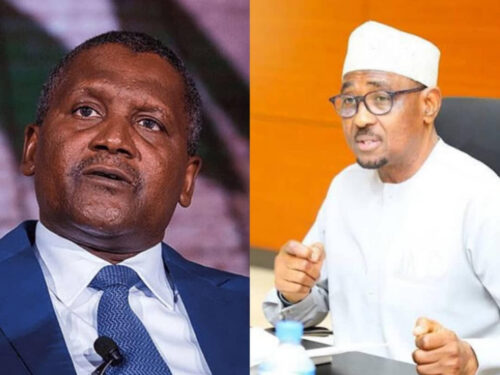
The President and Chief Executive of Dangote Industries Limited, Aliko Dangote, has called for an investigation and prosecution of the Chief Executive Officer of the Nigerian Midstream and Downstream Petroleum Regulatory Authority (NMDPRA), Engr Farouk Ahmed, saying he pays as much as $5 million in school fees for his children in Switzerland.

Speaking at a press conference at the Dangote Petroleum Refinery on Sunday, Dangote accused the leadership of the NMDPRA of colluding with international traders and oil importers to frustrate local refining through the continued issuance of import licences for petroleum products.

Dangote alleged that Ahmed was living beyond his legitimate means, claiming that four of his children attend secondary schools in Switzerland at costs running into several million dollars.

He said such expenditure raised serious questions about potential conflicts of interest and the integrity of regulatory oversight in the downstream petroleum sector.

The Dangote Group chairman assured Nigerians that the pump price of Premium Motor Spirit (PMS) would fall further, stating that petrol would sell at no more than N740 per litre from Tuesday, beginning in Lagos, due to his refinery’s reduction of the gantry price to N699 per litre.

He said MRS filling stations would be the first to reflect the new pricing.

Expressing concern over the state of the downstream sector, Dangote said Nigeria’s continued reliance on fuel imports was harming local production and discouraging investment in domestic refining.

He disclosed that import licences covering approximately 7.5 billion litres of PMS had reportedly been issued for the first quarter of 2026, despite the availability of significant domestic refining capacity.

According to him, modular refineries are already struggling under the current policy environment and on the brink of extinction, while the persistent issuance of import permits further weakens the sector.

Dangote said: “I am not calling for his removal, but for a proper investigation.

“He should be required to account for his actions and demonstrate that he has not compromised his position to the detriment of Nigerians.

“What is happening amounts to economic sabotage.”

Dangote alleged that Farouk pays as much as $5 million in tuition fees for his children’s secondary education in Switzerland.

He questioned how many Nigerians could afford such costs.

He added: “The Code of Conduct Bureau, or any other body deemed appropriate by the government, can investigate the matter.

“If he denies it, I will not only publish the tuition he paid at those secondary schools, but I will also take legal steps to compel the schools to disclose the payments made by Farouk.

“I sent my own children to secondary schools here in Nigeria.

“How many Nigerians can afford to pay $5 million for secondary school tuition, not university education?

“In his home state of Sokoto, many parents are struggling to pay as little as N10,000 in school fees.”

Dangote described the downstream petroleum sector as being under severe strain, alleging the presence of entrenched interests that profit from fuel imports at the expense of national development.

He added: “There are powerful interests in the oil sector.

“It is troubling that African countries continue to import refined products despite long-standing calls for value addition and domestic refining.

“The volume of imports being allowed into the country is unethical and does a disservice to Nigeria.”

Dangote stressed the need for a clear separation between regulatory oversight and commercial interests, warning that allowing traders to influence regulation would undermine the integrity of the sector.

He said: “The downstream sector must not be destroyed by personal interests.

“A trader should never be a regulator.

“Forty-seven licences have been issued, yet no new refineries are being built because the environment is not conducive.”

Dangote maintained that Nigerians would ultimately benefit from local refining, even as fuel importers incur losses.

He said he would not relent in ensuring that Nigerians enjoy the benefits of domestic refining, noting that the company was working around the clock to ensure that recent reductions in the gantry price were fully reflected at the retail level.

From Tuesday, he said, all MRS filling stations would begin selling PMS at prices not exceeding N740 per litre, starting in Lagos.

He added that the refinery had reduced its minimum purchase requirement from two million litres to 500,000 litres to enable more marketers, including members of the Independent Petroleum Marketers Association of Nigeria (IPMAN), to participate.

“So if you come to the refinery today, you will get PMS at N699 per litre,” he said.

Dangote disclosed that despite frustration and sabotage, the refinery would deploy its Compressed Natural Gas (CNG) trucks in the coming days and was prepared to procure additional units beyond the initial 4,000 if required to sustain affordable pricing nationwide.

Responding to complaints from oil importers that the recent price reduction would result in losses, Dangote said the refinery was established primarily for the benefit of Nigerians.

“Anyone who chooses to continue importing despite the availability of locally refined products should be prepared to face the consequences,” he said.

He also highlighted quality differences, noting that products supplied through MRS and other offtakers from the refinery were straight-run fuels, unlike blended products imported from overseas markets.

“Nigerians have a choice to buy better quality fuel at a more affordable price or to buy blended PMS at a higher rate. Importers can continue to lose, so long as Nigerians benefit,” he added.

Dangote said the refinery was driven more by legacy than profit, noting that he could have invested the $20 billion elsewhere if financial gain were his sole objective.

He revealed plans to list the refinery on the Nigerian Exchange to allow Nigerians to own shares in the facility.

He said: “We want every living Nigerian to have the opportunity to benefit, no matter how small their holding.

“If the market takes 55 percent and I retain 45 percent, I am satisfied.”

Dangote disclosed that discussions were ongoing with the Securities and Exchange Commission (SEC) to enable Nigerians to purchase shares in naira while receiving dividends in dollars.

He accused the NMDPRA of misrepresenting the refinery’s capacity by publishing offtake figures rather than actual production levels.

He said: “We have the capacity to meet local demand, and we have sufficient refined products in stock.

“But to keep prices high, imports are deliberately encouraged.”

He said attempts were being made to push the refinery into exporting products only for them to be re-imported into Nigeria at higher prices, adding: “This refinery is for Nigerians first, and I am not giving up.”

Dangote also disclosed that the refinery imports an average of 100 million barrels of crude oil annually from the United States, a figure expected to rise to 200 million barrels following expansion, due to insufficient domestic crude supply.

He added that the refinery also sources crude from Ghana and other countries, while exporting jet fuel and gasoline to the United States.

He further alleged that domestic refiners are forced to buy Nigerian crude at premiums of up to $4 per barrel from the trading arms of international oil companies, placing them at a competitive disadvantage.

He called on the government to ensure crude oil taxes are assessed based on actual transaction values, warning that the current system allows under-declaration and revenue losses.

Continue Reading

BIG STORY

EFCC Not Weaponized, Don’t Trivialize Anti-Graft War —— Presidency To Opposition Leaders

Published

on

The presidency has rejected claims of the weaponization of anti-corruption agencies as put forward by opposition politicians.

On Sunday, a coalition of opposition leaders accused the federal government of deploying the Economic and Financial Crimes Commission (EFCC) to intimidate and weaken political opponents, warning that the trend poses a serious threat to Nigeria’s multiparty democracy.

In a statement, Bayo Onanuga, special adviser to the president on information and strategy, described the opposition as failed politicians seeking scapegoats for their shortcomings.

He said claims that democracy is under threat because politicians are joining the All Progressives Congress (APC) are unfounded.

“Our constitution guarantees freedom of association and affords our people the right to change their political leanings at any time of their choosing,” the statement reads.

“None of the people who joined the governing APC was pressured to do so. They all did so of their own free will. They are being motivated by the noticeable gains of President Bola Tinubu’s reform programme.”

He asked whether Nigeria’s democracy was imperiled when politicians defected in droves to the Peoples Democratic Party (PDP) between 2000 and 2015.

Onanuga said ongoing investigations by the EFCC have exposed politicians who need to account for their stewardship in office.

He said those under investigation are now accusing Tinubu of weaponizing the EFCC for political purposes.

“While the Presidency does not speak for the EFCC and believes the agency can speak for itself, we must reiterate that the EFCC is an independent institution established by law and empowered to carry out its statutory responsibilities without interference or favour,” Onanuga said.

“The agency’s mandate is to investigate and prosecute financial crimes, irrespective of the personalities involved, their political affiliations, or their positions in society.

“We find it curious that the same people who claimed they want to rescue Nigeria are now the ones waging a war of attrition against accountability and probity.

“Those who have cases to answer before EFCC should be bold and brave enough to defend themselves if they are clean.

“The agency’s mandate is to investigate and prosecute financial crimes, irrespective of the personalities involved, their political affiliations, or their positions in society.”

Onanuga said Tinubu does not issue directives to any anti-corruption agency on whom to investigate, arrest, or prosecute.

He said the president is focused on addressing national challenges rather than engaging in political targeting.

Onanuga said prosecution is carried out by the courts and not through political manipulation. He said those found not guilty will be cleared by the judicial process.

Onanuga described allegations of EFCC weaponization as distractions by politicians running short of campaign issues.

He said no one is above the law and that political affiliation should not shield anyone from accountability.

“We have taken cognisance of the signatories to the statement. It is instructive that some of them were previously investigated and prosecuted by the EFCC even before President Tinubu took office in 2023,” he added.

“Some of these politicians have also been indicted in international financial probes for money laundering, with some of their accomplices jailed in foreign lands.”

Continue Reading

BIG STORY

Dangote Names N739 As New Petrol Pump Price

Published

on

Barring any last-minute change, MRS and other partners of the Dangote Petroleum Refinery are set to begin selling petrol at N739 per litre.

This comes two days after the refinery slashed its petrol gantry price from N828 to N699 per litre. Speaking at a press briefing at the Lekki refinery on Sunday, the President of the Dangote Group, Alhaji Aliko Dangote, said he was aware that despite lower gantry prices, some filling stations often choose to keep pump prices high, thereby sabotaging his efforts.

According to him, MRS would commence the sale of petrol at N739 per litre from Tuesday, while other partners would follow. Dangote alleged that some officials had met with certain marketers and encouraged them to keep prices high in order to frustrate the price reduction, stressing that he would fight to enforce the new price regime.

“I was told that the marketers have met with (some officials) and were told to make sure that the price is maintained high. But this price we are going to introduce, we are going to start with MRS stations most likely on Tuesday in Lagos; that N970 per litre, you won’t see it again. We have also asked members of IPMAN to come now.

We have asked anybody who can buy 10 trucks to come and buy 10 trucks at N699.

“We are going to use whatever resources that we have to make sure that we crash the price down. We will get these sales; maybe it will take us a week to 10 days. But first of all, within a week to 10 days, we will be able to deliver. For this December and January, we don’t want people to sell petrol for more than N740 nationwide. Those who want to keep the price to sabotage the government, we will fight as much as we can to make sure that these prices are down. That’s not the price. If you have money to come and buy, you can pick up petrol at N699,” he said.

Dangote said transporting petrol from the refinery costs no more than N15 per litre, questioning why pump prices would rise as high as N900 per litre. He also accused the Nigerian Midstream and Downstream Petroleum Regulatory Authority of issuing 47 import licences to bring in more than seven billion litres of petrol in the first quarter of 2026, a move he said was killing local investments.

“Freight within Lagos is N10 or N15, maximum. So if it’s N10 to N15, everything is going to cost you N715. Why do you want to sell at N900? People should get the real price. I cannot come now and take the hit. Did we make money? No, we didn’t make money. But as we speak now, even our tanks are full because the NMDPRA has issued reckless licences. And we have to now go and complain to the government.

“They normally issue licences in the middle of the month. So, they are now ready to issue licences for about 7.5 billion litres for the first quarter of 2026, despite the fact that we have guaranteed to supply enough quantity.

“If you are talking about monopoly, did we stop anybody? They issued 47 licences. Let those people come and put up a refinery here, or let them go and buy even NNPC’s and operate them. If it’s profitable, they should go and do that now. NNPC was the only business that was bringing in fuel before.

“Now, we are the only one and one of the few modular refineries that are producing. Those modular refineries, I can tell you for nothing that they are almost on the verge of collapse. None of them is making a dime,” he added.

The billionaire businessman assured Nigerians that the N739 per litre price would be enforced, beginning with MRS stations on Tuesday. “Starting from Tuesday, MRS will start selling petrol at N739/litre. Definitely, we will enforce that low price. We will make sure that it’s implemented. If you have your truck, you can come here and buy it. We are selling at N699. The N699 includes the percentage of NMDPRA. So what actually comes out to us is about N389 or so,” he stated.

Contacted for his reaction, the NMDPRA spokesman, George Ene-Ita, said, “For now, no comment.”

Continue Reading


Join Us On Facebook

Most Popular


Warning: Undefined array key "slug" in /home/porsch10/public_html/wp-includes/class-wp-theme-json.php on line 2117

Warning: Undefined array key "slug" in /home/porsch10/public_html/wp-includes/class-wp-theme-json.php on line 2117

Warning: Undefined array key "slug" in /home/porsch10/public_html/wp-includes/class-wp-theme-json.php on line 2117