Warning: Undefined array key "slug" in /home/porsch10/public_html/wp-includes/class-wp-theme-json.php on line 2102

Warning: Undefined array key "slug" in /home/porsch10/public_html/wp-includes/class-wp-theme-json.php on line 2102

Warning: Undefined array key "slug" in /home/porsch10/public_html/wp-includes/class-wp-theme-json.php on line 2102
BREAKING: Suspected Herdsmem Slaughter Two Parish Priests, Others In Benue State
Connect with us


Fathers Joseph Gor and Felix Tyolaha have been confirmed dead in the deadly attack by herdsmen early today on Mbalom village of St. Ignatius Quasi Parish Ukpor-Mbalom. In their classic style they burn down homes, destroy food items and kill.

The police seem to know nothing of the attacks which have been going on in other villages within Benue State since the Anti Open Grazing Law came into effect last year. Many people are asking why the International community has remained silent over the massacre of Benue citizens?

The answer is simple: It has been the goal of the jihadists to conquer Benue and Tiv people who resisted their advance into the middle belt since 1804; the people who rejected Islam and fought for the unification of Nigeria in the civil war of 1967 – 1970.

The people of the East therefore have little sympathy for Benue people and the Muslim North is enjoying a sweet revenge overshadowed by an insensitive regime. There were over 170.000 internally displaced persons before the Naka invasion and surely with the current situation in Mbalom Benue will be flooded with thousands more.

What cannot be said at this point is the consequences of the death of missionaries in the silent killings that have been siloed by the government for over a year. The diocese has been active in providing relief materials including education and skills acquisition lessons. To go for the priests means total destruction of everything we stand for and believe in.

Fr. Moses IORAPUU Director of Communications Catholic Diocese of Makurdi.

BIG STORY

Festive Season: Dangote Refinery To Supply 1.5bn Litres of Petrol Monthly

Published

on

Dangote Petroleum Refinery has announced plans to supply one billion five hundred million litres of Premium Motor Spirit (PMS) monthly to the Nigerian market in December 2025 and January 2026, a move aimed at ensuring uninterrupted nationwide fuel availability through the festive season and into the New Year.

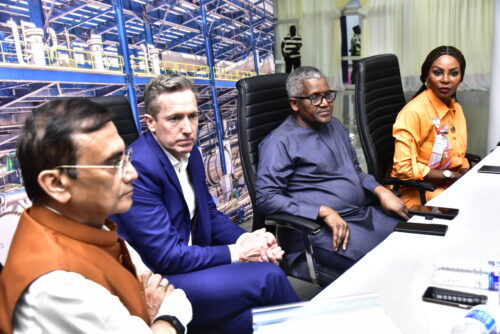
President and Chief Executive of Dangote Industries Limited, Aliko Dangote, disclosed the plans at the weekend, noting that the refinery will make available 50 million litres of PMS daily beginning December 1.

“In line with our commitment to national well-being, and consistent with our track record of ensuring a holiday season free of fuel scarcity, the Dangote Petroleum Refinery will supply 1.5 billion litres of PMS to the Nigerian market this month. This represents 50 million litres per day. We are formally notifying the Nigerian Midstream and Downstream Petroleum Regulatory Authority (NMDPRA) of this commitment. We will supply another 1.5 billion litres in January and increase to 1.7 billion litres in February, which translates to about 60 million litres per day,” Dangote said.

Speaking during a visit by the South-South Development Commission (SSDC) to the refinery and the Dangote Fertilizer complex, he stated that the facility currently has adequate stock and is producing between 40 and 45 million litres of PMS daily. He added that the daily supply of 50 million litres should dispel long-standing claims that domestic refineries lack the capacity to meet national demand.

Dangote also revealed ongoing engagement with petroleum marketers to strengthen distribution systems, including expanding the use of CNG-powered haulage.

“Our priority is to ensure Nigeria receives the products it needs. This is not driven by profit motives; it is about guaranteeing the availability of essential energy products. It is similar to the transformation we delivered in the cement sector,” he added.

He further noted that the refinery is progressing with its expansion plan to reach a capacity of 1.4 million barrels per day. More than 100,000 workers are expected to be involved in the expansion of both the refinery and the fertilizer complex. Dangote emphasized that the Group remains committed to its vision, driven by the strong public support for the company’s role in shaping Nigeria’s economic development.

During the visit, the Managing Director of SSDC, Usoro Offiong Akpabio, commended Dangote’s leadership and his continued contribution to strengthening Nigeria’s industrial capability, national energy security and long-term economic competitiveness.

She described the South-South region as Nigeria’s natural energy corridor, with vast crude oil reserves, gas infrastructure, maritime assets, agro-industrial activity and emerging industrial clusters. She noted that deeper collaboration between the region and the Dangote Group could unlock opportunities in product distribution, CNG infrastructure, petrochemicals, agriculture, and employment creation.

Akpabio added that such partnerships would advance the Federal Government’s energy stability agenda and position the South-South as a strategic growth hub for the Dangote Group.

“As the statutory development body for the South-South, SSDC is mandated to drive regional economic development, infrastructure integration, human capital advancement, and private-sector-led–led growth. In this regard, we stand prepared to support State-level policy and regulatory support for Ease-of-doing-business across our six states. Enabling environments for Dangote Group’s expansion into strategic sectors such as gas processing, agro-industrial value chains, renewable energy, logistics, and export-oriented manufacturing,” she said.

In a letter from the refinery’s Managing Director, David Bird, to the Authority Chief Executive of the NMDPRA, the company reaffirmed its readiness to host NMDPRA officials onsite at the refinery from December 1st to verify and publish its daily supply volumes. The refinery also sought the Authority’s support to ensure unhindered importation of crude, feedstocks and blending components, as well as smooth vessel loading for product evacuation.

“In the spirit of full transparency to the public we are willing to publish our daily production and stock volumes (online and print media),” Bird stated. “We seek the full support of NMDPRA to allow Dangote refinery to import our crude, feedstocks and blending components unhindered as well as support the lifting of our products by vessel. We continue to experience delays in vessel clearance which impacts not only the refinery operations but also our customers, adding unnecessary costs and inefficiencies”.


Continue Reading

BIG STORY

FG Proposes 40% Salary Increase For Lecturers As ASUU Prepares For Fresh Negotiations

Published

on

The Federal Government has reportedly proposed a 40 per cent salary increase for lecturers under the Academic Staff Union of Universities, sources familiar with the development told our correspondent in Abuja.

The proposal comes as ASUU leadership prepares to return to the negotiation table with the Federal Government delegation headed by Yayale Ahmed.

The union’s decision follows a consensus reached at the National Executive Council meeting held in Abuja on Sunday.

Branch leaders who attended the meeting are expected to communicate the development to their members nationwide.

Speaking at the end of the NEC meeting, a member who preferred anonymity due to restrictions on media engagement during negotiations, said the union would continue discussions with the government.

“They made a proposal of a 40% salary increment. Branch leaders will go back and update members on the situation. As it stands, negotiations continue with the government next week,” the source said.

ASUU’s one-month ultimatum to the Federal Government ended last Saturday, heightening tension within the academic community of Nigerian public universities.

In a last-minute move to avert a potential strike, the government had summoned ASUU leadership to a meeting in Abuja on Monday, which lasted until Tuesday.

Both parties declined to make the discussions public due to strict rules governing the negotiation process.

The union had threatened a full-scale strike, citing the government’s “nonchalant” attitude toward its demands.

Key issues include the review of the 2009 ASUU-Federal Government agreement, payment of outstanding salaries and earned allowances, and the disbursement of the university revitalisation fund.

The Minister of Education, Dr. Tunji Alausa, who is currently out of the country, insisted that the government had met the union’s demands.

Speaking to State House correspondents two weeks ago, Alausa reiterated President Bola Tinubu’s directive that there should be no strike in public universities, emphasising ongoing negotiations to keep students in school.

“As I told you, the President has mandated us that he doesn’t want ASUU to go on strike, and we’re doing everything humanly possible to ensure that our students stay in school. The last strike they went on for about six days was not really needed. We’ve met literally all their requirements and are back at the negotiation table. We will resolve this,” the minister said.

Meanwhile, the Nigeria Labour Congress, the umbrella body of labour unions in the country, has expressed support for ASUU and vowed to advocate for the academic community if the government fails to meet its demands.


Continue Reading

BIG STORY

‘Terrorism Took Root On Your Watch’, Presidency Replies Obasanjo

Published

on

The Presidency has responded to former President Olusegun Obasanjo, asserting that he lacks the credibility to criticize President Bola Tinubu over the worsening security situation in the country.

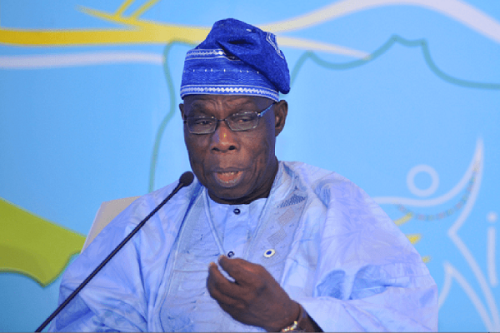
Speaking at an event in Jos, Plateau State, on Friday, Obasanjo expressed his deep concern over the escalating insecurity in the country. He suggested that Nigerians have a right to seek foreign intervention, given what he described as the government’s failure to protect its citizens adequately.

However, the government alleged that terrorism began to take root under Obasanjo’s administration, suggesting that the current security challenges are a legacy of his time in office.

The Presidency also condemned Obasanjo for suggesting that President Tinubu should seek help from foreign countries if he fails to address Nigeria’s security problems.

It called such a proposal an abdication of responsibility, emphasizing that advocating for external intervention in the nation’s internal affairs is not a sign of true leadership.

These remarks were shared in a post by the Special Adviser to the President on Media and Public Communication, Sunday Dare, on his verified X account.

Taking aim at Obasanjo, the Presidency stated that before recommending the surrender of Nigeria’s sovereignty to foreign nations, the former President should reconsider his failure to act when terrorism began to take hold during his time in office.

“Recent comments by a former President and a few habitual presidential aspirants attempting to paint the Tinubu administration as ‘unable to protect Nigerians’ are not merely hypocritical but ignoble. They ignore the hard truth: Nigeria is facing terrorists. All of them. By every definition, be they international, regional, or local.

“Yet the very individuals who looked away when these threats first sprouted now want to sit in judgment. Nigerians know better.

“The suggestion that Nigeria should effectively subcontract its internal security to foreign governments is not statesmanship; it is capitulation. Before recommending surrender, the former President should reflect on what he failed to do when these terrorists first began organising under his watch,” the statement said.

The Presidency emphasized that it is an undeniable reality that the country is under attack by terrorists, and no euphemism can alter this harsh truth.

“The people killing Nigerians, raiding villages, kidnapping innocents, blowing up infrastructure and challenging state authority are terrorists — whether they fly a foreign flag or none at all.

“Nigeria today confronts a multilayered terrorist ecosystem that includes: Internationally designated terror organisations; ISIS-linked and al-Qaeda-linked franchises across the Sahel; Local violent extremist groups masquerading as bandits; Cross-border terrorist cells exploiting porous frontiers; Ideological insurgents and criminal-terror hybrids operating in ungoverned spaces.

“These actors collaborate. They share money, ideology, weapons, intelligence and logistics. Their goal is the same: to break the Nigerian state and subjugate its people. Let’s call them what they all are: terrorists,” The Presidency stated.

It accused Obasanjo’s administration of allowing terrorism to take root by failing to take early action.

It stated, “It is a historical fact that the ideological seeds and early cells of Boko Haram were nurtured during Obasanjo’s civilian presidency. As they recruited, indoctrinated, established camps, and openly challenged authority, the state failed to act with the necessary urgency.”

“What began as a preventable extremist sect transformed into: A violent insurgency; A cross-border terrorist franchise; A regional menace aligned with global jihadist movements.

“For the leader under whom the first seeds of terrorism were allowed to germinate to now issue public lectures is not just ironic, it is reckless.”

The Presidency also made it clear that while Nigeria is open to international cooperation in addressing its security challenges, it will not outsource its security or surrender its sovereignty.

“Nigeria will cooperate internationally, yes, but it will not raise a white flag because someone who once had the chance lost his nerve,” the statement asserted.

The government emphasized the importance of global partnerships, particularly with the United States and other allied nations, in tackling the transnational nature of the threat.

“Nigeria needs the support and understanding of the United States, and that cooperation is already underway,” the Presidency added.

“Of course, the collaboration of other allied nations is also crucial. The crime at hand is transnational, and every ungoverned space must come under scrutiny.”


Continue Reading

Most Popular