Connect with us


BIG STORY

BREAKING: FG Shuts Kara Bridge Along Lagos-Ibadan Expressway

Published

on

Sequel to a tanker accident that claimed lives on Kara Bridge, Lagos-Ibadan Expressway, on Sunday, the Federal Ministry of Works has said the road will be shut for integrity tests.

A letter addressed to the Lagos State Government and signed by the Deputy Director, Highways, Federal Ministry of Works, K.Y. Ibrahim, solicited the support of the state for the success of the job.

Ibrahim said the contractor handling that section of the expressway requested that the bridge be shut from Friday to Sunday in order to ascertain the bridge’s “serviceability state after the fire incident”.

“We now request the support of the Lagos State Government in terms of handling the expected high traffic volume that may be generated along the axis during the work and also to help evacuate the wreckage of the accident still on site,” the letter said.

BIG STORY

From Harvard With Love: Why Ijebuland Is Blessed With A Strong Choice

Published

on

Education has long been one of the defining strengths of the Awùjalẹ̀ institution in Ijebuland. The immediate past Awùjalẹ̀, Oba Sikiru Kayode Adetona, was widely respected not only for the length of his reign but also for his intellectual depth, discipline, and exposure.
His solid formal education and broad worldview shaped a reign marked by courage, clarity, and principled leadership. Under him, Ijebuland benefited from a ruler who could engage confidently with governments, institutions, and global audiences while remaining firmly rooted in tradition. It is therefore unsurprising that education remains a central consideration as conversations continue about the next Awùjalẹ̀.
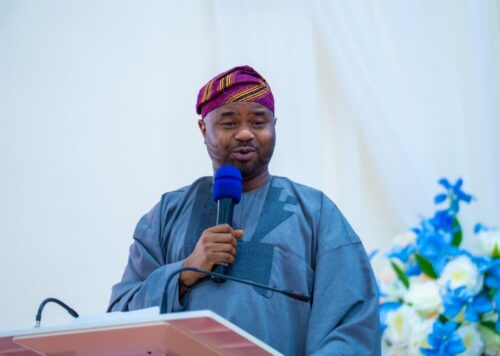
Within this context, Omoọba Abímbọ́lá Onabanjo’s educational background has drawn considerable attention. He holds a Bachelor of Science Honours degree in Banking and Finance from Lagos State University, a discipline that provided him with strong foundations in economics, financial systems, and organizational discipline.
Beyond this, he pursued advanced executive education at some of the world’s most respected institutions, including Harvard Business School, the Wharton School, and Columbia Business School, where he refined his understanding of leadership, international strategy, corporate governance, and global capital markets. This level of exposure places him firmly within the long-standing tradition of educated Ijebu leadership.
Since discussions about the possible choice of Omoọba Abímbọ́lá Onabanjo began, many people have asked further questions about his pedigree and readiness. His people and those who know him well, including Mr. Rabiu Oliyide and Mrs. Olowolayemo Kowoti, consistently affirm that he is well qualified, not only on paper, but in conduct and character.
Omoọba Abímbọ́lá Onabanjo is deeply rooted in Ijebu royal heritage. His lineage carries a clear understanding that the Awùjalẹ̀ stool is not ornamental but sacred, an institution built on discipline, restraint, and lifelong service to the people. Those close to him often speak of his respect for tradition and his belief that kingship demands humility and moral authority. At a time when traditional institutions must consciously preserve their relevance, many see in him someone who understands both the weight of history and the responsibility of the future.
Age and maturity have also featured prominently in discussions. While leadership is not defined by age alone, Omoọba Abímbọ́lá Onabanjo is widely regarded as being at a stage of life marked by emotional balance, perspective, and readiness for responsibility. He represents a generation able to listen to elders while also understanding the realities of younger Ijebu sons and daughters, many of whom live and work beyond Nigeria’s borders. This balance is increasingly important for a kingdom whose influence now extends far beyond its geographical boundaries.
Beyond heritage and education, his record of leadership is already well established. As Chairman and Founder of Kleensteps Holdings, he oversees a diversified group operating across luxury services, security solutions, and strategic infrastructure development. His leadership philosophy emphasizes disciplined growth, strong governance, and sustainability, principles that align closely with the demands of traditional authority in a modern world.
Perhaps most compelling to many people in Ijebuland is his long history of quiet service. Long before his name was ever associated with the Awùjalẹ̀ stool, he had supported students struggling to remain in school, assisted widows and elderly people facing hardship, and contributed to community and youth initiatives. These acts were carried out without publicity or political ambition, reflecting a genuine commitment to the welfare of others.
Support for Omoọba Abímbọ́lá Onabanjo has not been driven by noise or lobbying. It has grown organically through shared experiences and long observation of his conduct. In him, many see a blend of sound education, echoing the intellectual tradition of past Awùjalẹ̀s, strong heritage, maturity, and compassion.
At this important moment in Ijebu history, it is understandable why so many believe Ijebuland is blessed to have such a thoughtful and well-prepared choice before it.


Continue Reading

BIG STORY

The Taxman: Dr. Zacch Adedeji At 48, His Revolution For Nigerian Taxes —- By Seun Oloketuyi

Published

on

At 48, Dr. Zacch Adedeji stands at the centre of one of the most consequential reforms in Nigeria’s economic history. Calm, methodical, and unapologetically reform-minded, Adedeji has earned the moniker “The Taxman” not through rhetoric, but through action — by leading a sweeping transformation of Nigeria’s tax system designed to make it fairer, broader, more efficient, and fit for a modern economy.

In a country long dependent on oil revenues and burdened by a fragmented tax structure, Adedeji’s work represents a decisive break from the past.

Rewriting the Architecture of Taxation

Under President Bola Ahmed Tinubu’s administration, Nigeria enacted a landmark set of tax reform laws that fundamentally altered the nation’s revenue framework. Central to this reform was the replacement of the Federal Inland Revenue Service (FIRS) with the Nigeria Revenue Service (NRS), not merely a change of name, but a redefinition of mandate, structure, and philosophy.

The reforms harmonized previously overlapping tax laws, streamlined administration across federal and sub-national levels, and created a single, modern revenue authority with clearer powers and stronger accountability. For decades, Nigeria’s tax system had been characterized by complexity, inefficiency, and duplication. Adedeji’s reforms sought to eliminate these bottlenecks and build a system capable of supporting long-term national development.

From Tax Burden to Tax Fairness

A defining feature of Adedeji’s revolution is its emphasis on fair taxation. Rather than increasing tax rates, the reforms focused on correcting structural injustice within the system.

One of the most significant interventions was the removal of VAT from essential goods and services, including food, healthcare, education, and accommodation. This move directly addressed the cost-of-living pressures faced by ordinary Nigerians and signalled a shift from revenue extraction to social sensitivity.

At the same time, multiple nuisance taxes and overlapping levies were eliminated, reducing the burden on businesses especially small and medium-scale enterprises that form the backbone of the Nigerian economy. By broadening the tax base instead of raising rates, the reforms aimed to ensure that more people participate in the system without punishing productivity.

Digitalizing Revenue, Blocking Leakages

Adedeji’s tax revolution is also a technology-driven one. Under his leadership, Nigeria’s revenue administration has embraced digital transformation as a tool for transparency, efficiency, and enforcement.

New systems for e-invoicing, improved taxpayer identification, data integration, and intelligence-led compliance have strengthened the government’s ability to track revenue and curb evasion. These measures have reduced human interference, limited corruption opportunities, and improved the ease of compliance for taxpayers.

International partnerships, including technical cooperation with advanced tax authorities, have further strengthened institutional capacity, positioning Nigeria’s tax administration among the most forward-looking in Africa.

People-Centred Reform, Not Just Numbers

Unlike traditional fiscal reforms focused solely on revenue figures, Adedeji’s approach places the citizen at the centre. Low-income earners have been shielded through personal income tax exemptions, while simplified payment channels, including digital and mobile platforms, have made compliance more accessible.

For small businesses, artisans, and informal sector participants, the reforms represent a shift from fear and harassment to clarity and inclusion. The message is clear: taxation should be understandable, predictable, and fair, not punitive.

A Long-Term Vision for National Stability

Adedeji has consistently emphasized that tax reform is not an overnight fix. The full stabilization and optimization of the new system, he argues, will take years of disciplined implementation. This long-term outlook reflects a commitment to sustainability rather than short-term political wins.

If successfully executed, the reforms are expected to significantly improve Nigeria’s tax-to-GDP ratio, reduce dependence on volatile oil revenues, and provide the government with predictable funding for infrastructure, healthcare, education, and social services.

A Legacy Taking Shape

At 48, Dr. Zacch Adedeji is not merely administering taxes; he is redefining Nigeria’s fiscal future. By transforming revenue collection from a fragmented, mistrusted system into a unified, modern institution, he has laid the groundwork for a more resilient and inclusive economy.

History will judge the full impact of these reforms in the years to come. But already, one fact is undeniable: Nigeria’s tax conversation has changed. And at the heart of that change stands The Taxman, a reformer whose revolution is reshaping how a nation funds its future.

Continue Reading

BIG STORY

JUST IN: Five Feared Dead As Bandits Attack National Park In Oyo

Published

on

Suspected bandits on Tuesday night attacked personnel of the National Park Service (NPS) in Oloka village, Orire Local Government Area (LGA), Oyo State.

Report says the attack occurred around 9:00 pm on January 6, 2026, catching the NPS personnel by surprise. Several officers were reportedly killed or injured during the incident.

Further details, including the exact number of casualties, are yet to be confirmed.

The state Police Public Relations Officer, Olayinka Ayanlade, was said to have confirmed the incident.

He said, “Yes, there was an attack by yet to be identified men against the men of the National Park. The Commissioner of Police and other service chiefs are currently on their way to the location.

“Meanwhile, the CP Femi Haruna has deployed tactical teams, Mobile Police Force officers of the NPF, and EOD to the affected area to prevent further breakdown of law and order,” he explained.


Continue Reading


Join Us On Facebook

Most Popular


Warning: Undefined array key "slug" in /home/porsch10/public_html/wp-includes/class-wp-theme-json.php on line 2117

Warning: Undefined array key "slug" in /home/porsch10/public_html/wp-includes/class-wp-theme-json.php on line 2117

Warning: Undefined array key "slug" in /home/porsch10/public_html/wp-includes/class-wp-theme-json.php on line 2117