Connect with us


BIG STORY

Wema Bank Empowers 100,000 MSMEs In Ekiti State

Published

on

  • Launches Ekiti-Wema MSME Empowerment Programme for Youth and Businesses


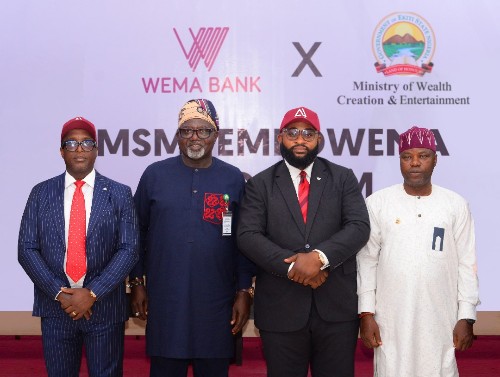
Wema Bank, Nigeria’s foremost innovative bank and pioneer of Africa’s first fully digital bank, ALAT, has partnered with the Ekiti State Government through the Ministry of Wealth Creation and Employment to launch the Ekiti-Wema MSME Empowerment Programme for youth and businesses in Ekiti State.

Launched on Monday, August 5th, 2024, the Ekiti-Wema MSME Empowerment Programme is an initiative designed to train and empower 100,000 youth and Micro, Small and Medium Enterprises (MSMEs) operating within Ekiti State with business management, digital empowerment and finance management skills for success.

Leveraging the immense potential of Nigerian youth and the economic opportunities presented by MSMEs, the Ekiti-Wema MSME Empowerment Programme is strategically curated to help the youth of Ekiti State maximise their potential while equipping businesses for sustainable growth and productivity, towards boosting the state’s macroeconomic conditions.

The Ekiti-Wema MSME Empowerment Programme is set to be executed through virtual and physical training sessions cutting across business management, digitalisation, and financial management, additionally providing access to mentorship support from experienced and successful entrepreneurs from within and outside Nigeria.

These participants will also receive a certificate of participation upon completion of their training course. Beyond the trainings, participants will also gain access to market and assistance in securing finances to put their learnings to practice and scale their operations.

This comprehensive approach ensures that the Programme not only enhances the capabilities of youth and MSMEs in Ekiti State but also facilitates their sustained growth and contribution to the economic development of Ekiti State.

Reiterating the Bank’s commitment to pioneering solutions, initiatives and partnerships for the growth and success of Nigerians, Wema Bank’s Executive Director of Retail and Digital Business, Tunde Mabawonku, encouraged youth and businesses in Ekiti State to seize this unique opportunity for their success. “As Nigeria’s most innovative bank, we have committed to concerting efforts, pooling resources where ideal and going the extra mile in developing solutions that address the needs of our people and ultimately empower them to thrive.

Our robust portfolio attests to this deep-rooted commitment and with the Ekiti-Wema MSME Empowerment Programme, we are extending the reach of our positive impact, positively enhancing the lives and businesses of the Ekiti State people and empowering them with the skills, knowledge, and expertise needed to thrive in today’s competitive market.

Our approach is granular yet comprehensive, bringing tailored solutions for growth to the youth and businesses of Ekiti State right within their vicinity.

We hope that through this initiative, Ekiti State will become a hub of productivity and economic buoyance, and the domino effect of this economic boost will translate on the national scale, improving our nation’s macroeconomic indicators for the best”, Mabawonku said.

The Ekiti State Honourable Commissioner for Wealth Creation and Employment, Otunba Kayode Fasae, added, “Our goal with this partnership with Wema Bank is to implement a two-pronged approach that contains two missing key ingredients of wealth creation and employment generation, which are skill development and finance. Wema Bank has been extremely supportive in working with the Ekiti State Government for the success of our people.

You would recall that in 2020, the Bank collaborated with the State to sponsor the training of 2500 youth under the Central Bank of Nigeria’s AgriBusiness Small Medium Enterprise Investment Scheme (AGSMEIS) and now, four years later, we are proud to announce the birth of yet another groundbreaking partnership with the Bank, the Ekiti-Wema MSME Empowerment Programme.

We reiterate our unwavering commitment to maximise the deliverables of this Programme to serve as a veritable intervention platform for skill development and panacea for employment and wealth creation”.

Wema Bank continues to expand its network, partnering with reputable individuals, institutions, and entities on state and federal levels to provide viable solutions for Nigerians across the world, empowering them to thrive in both personal and professional endeavours. With the Ekiti-Wema MSME Empowerment Programme, Wema Bank is set to transform 100,000 lives and businesses across Ekiti State.

Interested Youth and Businesses in Ekiti State are to visit https://wema-ekitisme.alat.ng/register to register for the Ekiti-Wema MSME Empowerment Programme.

BIG STORY

Nigeria’s Inflation Rate Drops For 8th Consecutive Month, Now 14%

Published

on

The National Bureau of Statistics (NBS) reports that Nigeria’s headline inflation rate decreased to 14.45% in November 2025.

The NBS announced the decrease in its consumer price index (CPI) report on Monday, marking the eighth consecutive drop in 2025 — surpassing President Bola Tinubu’s 15 percent target.

According to the Bureau, the November headline inflation rate is lower relative to the 16.05 percent recorded in October 2025.

The latest rate is the lowest in five years, signalling a return to the COVID-19 pandemic level when headline inflation reached the 14 percent range in October 2020, according to data from the Central Bank of Nigeria (CBN).

The NBS said the current inflation rate, on a year-on-year basis, was “20.15% lower than the rate recorded in November 2024 (34.60%)”.

“This shows that the Headline inflation rate (year-on-year basis) decreased in November 2025 compared to the same month in the preceding year (i.e., November 2024),” the agency said.

“On a month-on-month basis, the Headline inflation rate in November 2025 was 1.22%, which was 0.29% higher than the rate recorded in October 2025 (0.93%).

“This means that in November 2025, the rate of increase in the average price level was higher than the rate of increase in the average price level in October 2025.”


Continue Reading

BIG STORY

Petrol Price War Turns Dirty As Dangote Accuses NMDPRA Boss Farouk Ahmed Of Paying $5m For His Children Secondary School Fees In Switzerland

Published

on

The President and Chief Executive of Dangote Industries Limited, Aliko Dangote, has called for an investigation and prosecution of the Chief Executive Officer of the Nigerian Midstream and Downstream Petroleum Regulatory Authority (NMDPRA), Engr Farouk Ahmed, saying he pays as much as $5 million in school fees for his children in Switzerland.

Speaking at a press conference at the Dangote Petroleum Refinery on Sunday, Dangote accused the leadership of the NMDPRA of colluding with international traders and oil importers to frustrate local refining through the continued issuance of import licences for petroleum products.

Dangote alleged that Ahmed was living beyond his legitimate means, claiming that four of his children attend secondary schools in Switzerland at costs running into several million dollars.

He said such expenditure raised serious questions about potential conflicts of interest and the integrity of regulatory oversight in the downstream petroleum sector.

The Dangote Group chairman assured Nigerians that the pump price of Premium Motor Spirit (PMS) would fall further, stating that petrol would sell at no more than N740 per litre from Tuesday, beginning in Lagos, due to his refinery’s reduction of the gantry price to N699 per litre.

He said MRS filling stations would be the first to reflect the new pricing.

Expressing concern over the state of the downstream sector, Dangote said Nigeria’s continued reliance on fuel imports was harming local production and discouraging investment in domestic refining.

He disclosed that import licences covering approximately 7.5 billion litres of PMS had reportedly been issued for the first quarter of 2026, despite the availability of significant domestic refining capacity.

According to him, modular refineries are already struggling under the current policy environment and on the brink of extinction, while the persistent issuance of import permits further weakens the sector.

Dangote said: “I am not calling for his removal, but for a proper investigation.

“He should be required to account for his actions and demonstrate that he has not compromised his position to the detriment of Nigerians.

“What is happening amounts to economic sabotage.”

Dangote alleged that Farouk pays as much as $5 million in tuition fees for his children’s secondary education in Switzerland.

He questioned how many Nigerians could afford such costs.

He added: “The Code of Conduct Bureau, or any other body deemed appropriate by the government, can investigate the matter.

“If he denies it, I will not only publish the tuition he paid at those secondary schools, but I will also take legal steps to compel the schools to disclose the payments made by Farouk.

“I sent my own children to secondary schools here in Nigeria.

“How many Nigerians can afford to pay $5 million for secondary school tuition, not university education?

“In his home state of Sokoto, many parents are struggling to pay as little as N10,000 in school fees.”

Dangote described the downstream petroleum sector as being under severe strain, alleging the presence of entrenched interests that profit from fuel imports at the expense of national development.

He added: “There are powerful interests in the oil sector.

“It is troubling that African countries continue to import refined products despite long-standing calls for value addition and domestic refining.

“The volume of imports being allowed into the country is unethical and does a disservice to Nigeria.”

Dangote stressed the need for a clear separation between regulatory oversight and commercial interests, warning that allowing traders to influence regulation would undermine the integrity of the sector.

He said: “The downstream sector must not be destroyed by personal interests.

“A trader should never be a regulator.

“Forty-seven licences have been issued, yet no new refineries are being built because the environment is not conducive.”

Dangote maintained that Nigerians would ultimately benefit from local refining, even as fuel importers incur losses.

He said he would not relent in ensuring that Nigerians enjoy the benefits of domestic refining, noting that the company was working around the clock to ensure that recent reductions in the gantry price were fully reflected at the retail level.

From Tuesday, he said, all MRS filling stations would begin selling PMS at prices not exceeding N740 per litre, starting in Lagos.

He added that the refinery had reduced its minimum purchase requirement from two million litres to 500,000 litres to enable more marketers, including members of the Independent Petroleum Marketers Association of Nigeria (IPMAN), to participate.

“So if you come to the refinery today, you will get PMS at N699 per litre,” he said.

Dangote disclosed that despite frustration and sabotage, the refinery would deploy its Compressed Natural Gas (CNG) trucks in the coming days and was prepared to procure additional units beyond the initial 4,000 if required to sustain affordable pricing nationwide.

Responding to complaints from oil importers that the recent price reduction would result in losses, Dangote said the refinery was established primarily for the benefit of Nigerians.

“Anyone who chooses to continue importing despite the availability of locally refined products should be prepared to face the consequences,” he said.

He also highlighted quality differences, noting that products supplied through MRS and other offtakers from the refinery were straight-run fuels, unlike blended products imported from overseas markets.

“Nigerians have a choice to buy better quality fuel at a more affordable price or to buy blended PMS at a higher rate. Importers can continue to lose, so long as Nigerians benefit,” he added.

Dangote said the refinery was driven more by legacy than profit, noting that he could have invested the $20 billion elsewhere if financial gain were his sole objective.

He revealed plans to list the refinery on the Nigerian Exchange to allow Nigerians to own shares in the facility.

He said: “We want every living Nigerian to have the opportunity to benefit, no matter how small their holding.

“If the market takes 55 percent and I retain 45 percent, I am satisfied.”

Dangote disclosed that discussions were ongoing with the Securities and Exchange Commission (SEC) to enable Nigerians to purchase shares in naira while receiving dividends in dollars.

He accused the NMDPRA of misrepresenting the refinery’s capacity by publishing offtake figures rather than actual production levels.

He said: “We have the capacity to meet local demand, and we have sufficient refined products in stock.

“But to keep prices high, imports are deliberately encouraged.”

He said attempts were being made to push the refinery into exporting products only for them to be re-imported into Nigeria at higher prices, adding: “This refinery is for Nigerians first, and I am not giving up.”

Dangote also disclosed that the refinery imports an average of 100 million barrels of crude oil annually from the United States, a figure expected to rise to 200 million barrels following expansion, due to insufficient domestic crude supply.

He added that the refinery also sources crude from Ghana and other countries, while exporting jet fuel and gasoline to the United States.

He further alleged that domestic refiners are forced to buy Nigerian crude at premiums of up to $4 per barrel from the trading arms of international oil companies, placing them at a competitive disadvantage.

He called on the government to ensure crude oil taxes are assessed based on actual transaction values, warning that the current system allows under-declaration and revenue losses.

Continue Reading

BIG STORY

EFCC Not Weaponized, Don’t Trivialize Anti-Graft War —— Presidency To Opposition Leaders

Published

on

The presidency has rejected claims of the weaponization of anti-corruption agencies as put forward by opposition politicians.

On Sunday, a coalition of opposition leaders accused the federal government of deploying the Economic and Financial Crimes Commission (EFCC) to intimidate and weaken political opponents, warning that the trend poses a serious threat to Nigeria’s multiparty democracy.

In a statement, Bayo Onanuga, special adviser to the president on information and strategy, described the opposition as failed politicians seeking scapegoats for their shortcomings.

He said claims that democracy is under threat because politicians are joining the All Progressives Congress (APC) are unfounded.

“Our constitution guarantees freedom of association and affords our people the right to change their political leanings at any time of their choosing,” the statement reads.

“None of the people who joined the governing APC was pressured to do so. They all did so of their own free will. They are being motivated by the noticeable gains of President Bola Tinubu’s reform programme.”

He asked whether Nigeria’s democracy was imperiled when politicians defected in droves to the Peoples Democratic Party (PDP) between 2000 and 2015.

Onanuga said ongoing investigations by the EFCC have exposed politicians who need to account for their stewardship in office.

He said those under investigation are now accusing Tinubu of weaponizing the EFCC for political purposes.

“While the Presidency does not speak for the EFCC and believes the agency can speak for itself, we must reiterate that the EFCC is an independent institution established by law and empowered to carry out its statutory responsibilities without interference or favour,” Onanuga said.

“The agency’s mandate is to investigate and prosecute financial crimes, irrespective of the personalities involved, their political affiliations, or their positions in society.

“We find it curious that the same people who claimed they want to rescue Nigeria are now the ones waging a war of attrition against accountability and probity.

“Those who have cases to answer before EFCC should be bold and brave enough to defend themselves if they are clean.

“The agency’s mandate is to investigate and prosecute financial crimes, irrespective of the personalities involved, their political affiliations, or their positions in society.”

Onanuga said Tinubu does not issue directives to any anti-corruption agency on whom to investigate, arrest, or prosecute.

He said the president is focused on addressing national challenges rather than engaging in political targeting.

Onanuga said prosecution is carried out by the courts and not through political manipulation. He said those found not guilty will be cleared by the judicial process.

Onanuga described allegations of EFCC weaponization as distractions by politicians running short of campaign issues.

He said no one is above the law and that political affiliation should not shield anyone from accountability.

“We have taken cognisance of the signatories to the statement. It is instructive that some of them were previously investigated and prosecuted by the EFCC even before President Tinubu took office in 2023,” he added.

“Some of these politicians have also been indicted in international financial probes for money laundering, with some of their accomplices jailed in foreign lands.”

Continue Reading


Join Us On Facebook

Most Popular


Warning: Undefined array key "slug" in /home/porsch10/public_html/wp-includes/class-wp-theme-json.php on line 2117

Warning: Undefined array key "slug" in /home/porsch10/public_html/wp-includes/class-wp-theme-json.php on line 2117

Warning: Undefined array key "slug" in /home/porsch10/public_html/wp-includes/class-wp-theme-json.php on line 2117