Connect with us


BIG STORY

Lagos Announces Eight-Month Partial Closure Of Lekki-Ajah Road For Major Rehabilitation Works

Published

on

The Lagos State Government has announced that parts of the Lekki–Ajah corridor will undergo partial closure for eight months to allow major rehabilitation and improvement works aimed at easing traffic congestion along the busy route.

In a statement issued on Wednesday, the Commissioner for Transportation, Mr. Oluwaseun Osiyemi, confirmed that the project is designed to enhance road quality and ensure smoother traffic flow for commuters.

“The Lagos State Government has announced road rehabilitation works on Lekki-Ajah corridor commencing from Saturday 15th November, 2025 to Wednesday 15th July, 2026, a period of 8 months,” the statement shared on his X handle read.

Osiyemi explained that the project would be carried out in two phases to reduce inconvenience to motorists and residents. Preliminary work, he added, is already underway ahead of the full commencement.

According to him, the first phase of the rehabilitation will be implemented in seven sections. During this period, one lane will remain open while the other is closed for construction. Once work on the closed lane is completed, repairs will shift to the opposite side.

“Motorists heading toward Lekki and Ajah will continue to have access throughout the construction,” he stated.

For the second phase, vehicles moving from Ajah toward Lekki will be restricted to one lane while the other undergoes rehabilitation.

“When the first lane is completed, work will shift to the second. At all times, movement toward Ajah will remain open,” Osiyemi assured.

The commissioner further noted that certain sections of the corridor would experience partial closures throughout the duration of the project.

He appealed for patience and cooperation from road users, stressing that adherence to traffic directions and diversions would ensure safety and minimal disruption.

“We urge road users to obey traffic officers and follow diversion signs as directed. These repairs are part of the Lagos State Government’s commitment to improving road infrastructure and ensuring safer, smoother journeys for everyone,” Osiyemi added.

BIG STORY

Senate Orders Nationwide Crackdown As Lead Poisoning Hits Ogijo Lagos

Published

on

The Senate on Thursday expressed grave alarm over a fast-spreading lead-poisoning crisis in Ogijo, a densely populated community straddling the boundary between Ikorodu (Lagos) and Ogun East Senatorial District.

It described it as a full-blown environmental and public-health emergency that threatened thousands of lives.

The motion, jointly sponsored by Mukhail Adetokunbo Abiru (Lagos East) and Gbenga Daniel (Ogun East), was brought under Matters of Urgent Public Importance pursuant to Orders 41 and 51 of the Senate Standing Orders, 2023 (as amended).

Lawmakers cited scientifically verified reports of extreme lead contamination linked to a cluster of used lead-acid battery recycling factories operating in the area for years.

According to the Senate, the crisis had left residents battling persistent headaches, abdominal pain, memory loss, seizures, and developmental delays in children, symptoms strongly associated with chronic lead exposure.

The chamber noted with concern that the Federal Government had already begun clampdowns, with the Minister of State for Labour and Employment, Nkeiruka Onyejeocha, shutting down seven battery-recycling factories and ordering a temporary halt to lead-ingot exportation pending safety investigations.

Senators said they were “alarmed that residents have for several years complained of persistent headaches, abdominal pains, loss of memory, seizures, cognitive decline, and developmental delays in children, symptoms strongly associated with chronic lead exposure.”

Despite years of community protests, the smelters allegedly continued operating openly, releasing toxic fumes and particulate dust into surrounding homes, markets and playgrounds.

“It is regrettable that despite years of community outcry, smelter furnaces continued operating, discharging toxic fumes from melted batteries directly into surrounding neighbourhoods. We are concerned that while some factory operators deny wrongdoing, community exposure remains extreme.

“The Senate acknowledges and commends the proactive efforts of the Lagos and Ogun State Governments and their relevant ministries and agencies for conducting early inspections, raising community awareness and working with federal authorities to contain the exposure,” lawmakers said.

The chamber further cited disturbing findings by independent testing commissioned by The Examination and The New York Times, which revealed severe contamination in both residents’ blood samples and soil within the industrial cluster.

Some environmental samples, senators noted, showed lead levels “up to 186 times the global maximum safety threshold.”

A major dimension of the scandal, lawmakers said, was that lead processed in Ogijo had already been traced into international supply chains, reaching global battery and automobile manufacturers who either did not address the findings or relied solely on assurances from Nigerian suppliers.

The Senate lamented that while some factory operators deny wrongdoing, community exposure remains dangerously high amid weak accountability and gaps in Nigeria’s regulatory frameworks.

Senators nonetheless praised emergency actions taken by the Lagos and Ogun state governments, commending their early inspections, public-awareness campaigns and support for affected families.

Citing Sections 14(2)(b) and 20 of the 1999 Constitution, the Senate emphasised the government’s responsibility to safeguard citizens’ welfare and ensure a safe environment.

Following extensive deliberations, the Senate resolved to commend both the Federal Government and the Lagos and Ogun State Governments for their swift intervention in shutting down non-compliant lead-recycling factories.

Lawmakers urged continued enforcement, including factory closures, export suspensions, prosecution of violators, and strengthened industrial safety monitoring.

The chamber mandated the Federal Ministry of Health and the Nigeria Centre for Disease Control (NCDC) to deploy emergency medical teams to Ogijo to provide free toxicology screenings, blood-lead management, chelation therapy, and ongoing treatment for affected children and adults.

Simultaneously, the Federal Ministry of Environment and NESREA were directed to carry out comprehensive environmental remediation, mapping soil, groundwater, air, and household dust contamination.

The Senate also called on the Federal Ministry of Solid Minerals and relevant regulatory agencies to enforce strict compliance standards for battery-recycling and lead-processing operations nationwide.

Additionally, it recommended establishing a National Lead Poisoning Response and Remediation Task Force within NEMA and directed the Committee on Legislative Compliance to monitor progress and report back within six weeks.

The Senate described the Ogijo crisis as a preventable tragedy that must serve as a national wake-up call on industrial pollution, regulatory failure and the urgent need to protect vulnerable communities from hazardous waste.

 

Continue Reading

BIG STORY

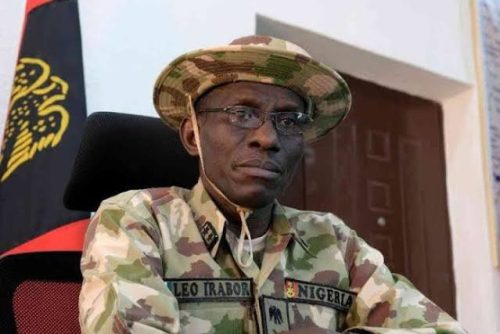
Some Politicians Funding Terrorism In Nigeria, Says Ex-CDS Lucky Irabor

Published

on

Lucky Irabor, ex-chief of defence staff (CDS), says some political actors are involved in terrorism financing in Nigeria.

On November 30, Daniel Bwala, Special Adviser to President Bola Tinubu on policy communication, said the federal government would soon reveal the identities of terrorism sponsors.

Bwala said the government is “making far-reaching decisions”, adding that the outcome would be noticeable shortly.

The presidential aide said terrorism is a global problem, adding that “the demand is now on the world governments to see how they can cooperate with Nigeria”.

Speaking on ‘Politics Today’, a Channels Television programme, on Monday, Irabor said certain politicians exploit insecurity for personal advantage.

Asked directly if politicians fund terror networks, he replied with “some politicians”.

Irabor said some party chieftains capitalize on instability to create an impression that they can offer better leadership.

“Some politicians have now taken advantage of the state of under-governance, as it were, to perhaps gain some form of leverage to give the impression that they can do better,” he said.

“Others perhaps want to give an impression they can do better, to score the point that there is poor governance… they could also instigate a certain crisis one way or the other.

“Those who believe that it’s purely political, maybe, have their argument from that angle. For me, it will be wrong.”

Irabor also addressed criticisms of the federal government’s refusal to publish names of alleged terror financiers.

Continue Reading

BIG STORY

JUST IN: Tinubu Nominates Ex-CDS Christopher Musa As Defence Minister

Published

on

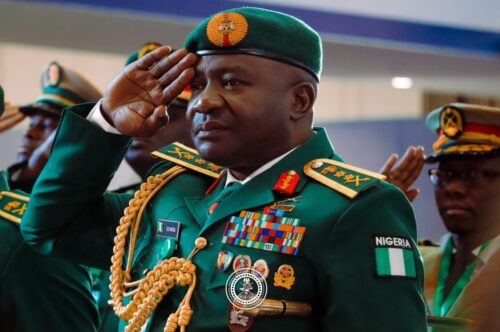
President Bola Tinubu has nominated a former Chief of Defence Staff, General Christopher Musa, as the new Minister of Defence.

The nomination was contained in a letter sent to Senate President Godswill Akpabio on Tuesday, announcing Musa as the replacement for Alhaji Mohammed Badaru, who resigned from the position on Monday due to health reasons.

In his letter to the Senate, the President expressed confidence in Musa’s capacity to lead the Defence Ministry and strengthen Nigeria’s security framework.

The nomination was confirmed in a statement issued by the President’s Special Adviser on Information and Strategy, Bayo Onanuga.

The statement added, “General Musa, 58, on December 25, is a distinguished soldier who served as Chief of Defence Staff from 2023 until October 2025. He won the Colin Powell Award for Soldiering in 2012.

“Born in Sokoto in 1967, General Musa received his primary and secondary education there before attending the College of Advanced Studies in Zaria. He graduated in 1986 and enrolled at the Nigerian Defence Academy the same year, earning a Bachelor of Science degree upon graduation in 1991.

“General Musa was commissioned into the Nigerian Army as a Second Lieutenant in 1991 and has since had a distinguished career. His appointments include General Staff Officer 1, Training/Operations at HQ 81 Division; Commanding Officer, 73 Battalion; Assistant Director, Operational Requirements, Department of Army Policy and Plans; and Infantry Representative/Member, Training Team, HQ Nigerian Army Armour Corps.

“In 2019, he served as Deputy Chief of Staff, Training/Operations, Headquarters Infantry Centre and Corps; Commander, Sector 3, Operation Lafiya Dole; and Commander, Sector 3 Multinational Joint Task Force in the Lake Chad Region.

“In 2021, General Musa was appointed Theatre Commander, Operation Hadin Kai. He later became Commander of the Nigerian Army Infantry Corps before being appointed Chief of Defence Staff by President Tinubu in 2023.”

Continue Reading


Join Us On Facebook

Most Popular


Warning: Undefined array key "slug" in /home/porsch10/public_html/wp-includes/class-wp-theme-json.php on line 2117

Warning: Undefined array key "slug" in /home/porsch10/public_html/wp-includes/class-wp-theme-json.php on line 2117

Warning: Undefined array key "slug" in /home/porsch10/public_html/wp-includes/class-wp-theme-json.php on line 2117