Warning: Undefined array key "slug" in /home/porsch10/public_html/wp-includes/class-wp-theme-json.php on line 2102

Warning: Undefined array key "slug" in /home/porsch10/public_html/wp-includes/class-wp-theme-json.php on line 2102

Warning: Undefined array key "slug" in /home/porsch10/public_html/wp-includes/class-wp-theme-json.php on line 2102
EFCC Nabs Soldier Involved In Internet Fraud 'Yahoo-Yahoo' In Lagos [PHOTOS]
Connect with us


BIG STORY

EFCC Nabs Soldier Involved In Internet Fraud ‘Yahoo-Yahoo’ In Lagos [PHOTOS]

Published

on

Operatives of the Economic and Financial Crimes Commission (EFCC) have arrested Ajayi Kayode, a soldier, for alleged internet fraud.

In a statement, Dele Oyewale, EFCC spokesman, said Kayode, with service number NAF18/34732, was arrested during an early morning raid at 6B, Fatai Idowu Arobike, Lekki Phase 1, Lagos, on Saturday.

He said the arrest was made following intelligence received about the soldier’s alleged involvement in criminal activities.

Oyewale said the soldier was arrested alongside 26 other suspects.

“Kayode, the lance corporal, was arrested alongside Kalu Emmanue; Hassan Sunday; Odinaka David Okem; Victor Ochiabuito; Christopher Prince; Victor Ologhu; Alex Aka; Miracle Onyekwere; Habeeb Ayomide; Olakunle Ajeigbu, Rasheed Olanrewaju, and Salam Hakeem,” the statement read.

“Others are Adeniran Nurudeen; Opeyemi Ojo Chris; Derrick Moris; Shehu Oluoti; Fuad Akinbayo; Babatunde Idowu; Uzo Igwe Nathaniel; Debowale Adedoyin; Shegun Emmanuel; Godswill Maduchem; Samson Kazeem; Oluwatobi Oluwatoba, Olaitan Ajao, and Oyindamola Kareem.”

The soldier reportedly confessed that the “big shot yahoo-yahoo boys” in whose company he was arrested, were his friends and that they had been teaching him how to make quick money through cybercrime.

The anti-graft agency said while the “boys” are members of Organised Cyber Criminal Syndicate Network, OCCSN, the ladies arrested with them confirmed the involvement of their “boyfriends” in internet fraud.

Items recovered from the suspects include diamond jewelry, exotic cars, and expensive phones.

The anti-graft agency said the suspects will be charged to court soon.

BIG STORY

Some Politicians Funding Terrorism In Nigeria, Says Ex-CDS Lucky Irabor

Published

on

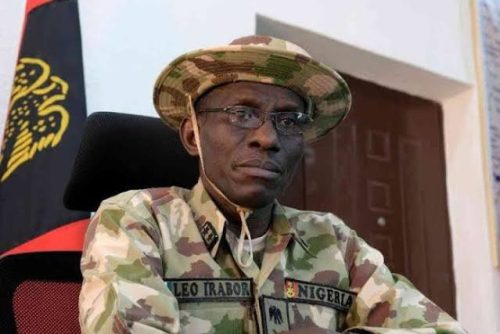
Lucky Irabor, ex-chief of defence staff (CDS), says some political actors are involved in terrorism financing in Nigeria.

On November 30, Daniel Bwala, Special Adviser to President Bola Tinubu on policy communication, said the federal government would soon reveal the identities of terrorism sponsors.

Bwala said the government is “making far-reaching decisions”, adding that the outcome would be noticeable shortly.

The presidential aide said terrorism is a global problem, adding that “the demand is now on the world governments to see how they can cooperate with Nigeria”.

Speaking on ‘Politics Today’, a Channels Television programme, on Monday, Irabor said certain politicians exploit insecurity for personal advantage.

Asked directly if politicians fund terror networks, he replied with “some politicians”.

Irabor said some party chieftains capitalize on instability to create an impression that they can offer better leadership.

“Some politicians have now taken advantage of the state of under-governance, as it were, to perhaps gain some form of leverage to give the impression that they can do better,” he said.

“Others perhaps want to give an impression they can do better, to score the point that there is poor governance… they could also instigate a certain crisis one way or the other.

“Those who believe that it’s purely political, maybe, have their argument from that angle. For me, it will be wrong.”

Irabor also addressed criticisms of the federal government’s refusal to publish names of alleged terror financiers.

Continue Reading

BIG STORY

JUST IN: Tinubu Nominates Ex-CDS Christopher Musa As Defence Minister

Published

on

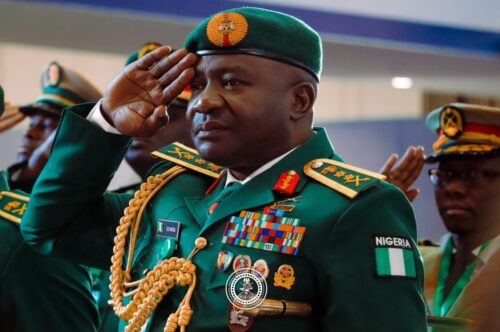
President Bola Tinubu has nominated a former Chief of Defence Staff, General Christopher Musa, as the new Minister of Defence.

The nomination was contained in a letter sent to Senate President Godswill Akpabio on Tuesday, announcing Musa as the replacement for Alhaji Mohammed Badaru, who resigned from the position on Monday due to health reasons.

In his letter to the Senate, the President expressed confidence in Musa’s capacity to lead the Defence Ministry and strengthen Nigeria’s security framework.

The nomination was confirmed in a statement issued by the President’s Special Adviser on Information and Strategy, Bayo Onanuga.

The statement added, “General Musa, 58, on December 25, is a distinguished soldier who served as Chief of Defence Staff from 2023 until October 2025. He won the Colin Powell Award for Soldiering in 2012.

“Born in Sokoto in 1967, General Musa received his primary and secondary education there before attending the College of Advanced Studies in Zaria. He graduated in 1986 and enrolled at the Nigerian Defence Academy the same year, earning a Bachelor of Science degree upon graduation in 1991.

“General Musa was commissioned into the Nigerian Army as a Second Lieutenant in 1991 and has since had a distinguished career. His appointments include General Staff Officer 1, Training/Operations at HQ 81 Division; Commanding Officer, 73 Battalion; Assistant Director, Operational Requirements, Department of Army Policy and Plans; and Infantry Representative/Member, Training Team, HQ Nigerian Army Armour Corps.

“In 2019, he served as Deputy Chief of Staff, Training/Operations, Headquarters Infantry Centre and Corps; Commander, Sector 3, Operation Lafiya Dole; and Commander, Sector 3 Multinational Joint Task Force in the Lake Chad Region.

“In 2021, General Musa was appointed Theatre Commander, Operation Hadin Kai. He later became Commander of the Nigerian Army Infantry Corps before being appointed Chief of Defence Staff by President Tinubu in 2023.”

Continue Reading

BIG STORY

South Africa Begins Use Of Groundbreaking HIV Prevention Drug

Published

on

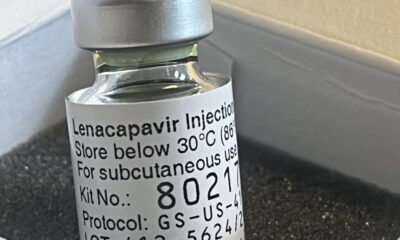
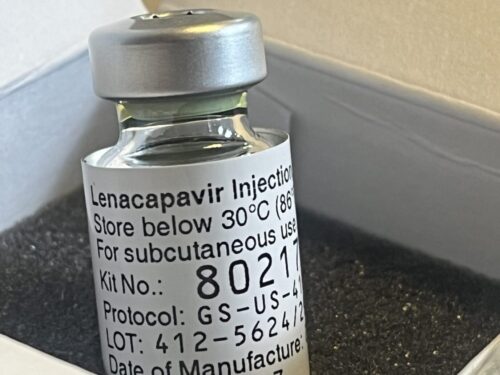
South Africa has begun administering lenacapavir, a long-acting HIV prevention drug, to selected individuals as part of a new study led by Wits RHI at the University of the Witwatersrand and funded by Unitaid.

The move comes just five months after the US Food and Drug Administration granted its first approval for the drug’s use in HIV prevention.

Lenacapavir has shown remarkable results in clinical trials, offering near-complete protection against HIV and outperforming existing pre-exposure prophylaxis (PrEP) options.

The injectable drug is taken twice a year and was initially projected to cost about $28,000 per user annually.

However, a pricing deal brokered by the Clinton Health Access Initiative (CHAI), working alongside Dr Reddy’s Laboratories, Unitaid, the Gates Foundation, and Wits RHI, has slashed the cost to about $40 — a reduction aimed at making the drug affordable in low- and middle-income countries.

In a statement on Monday, Unitaid said the study will provide the Department of Health with the evidence they need to adapt quickly and in real time as they integrate lenacapavir into existing HIV prevention programs.

“These early learnings on real-world use will also apply to other countries adopting lenacapavir,” the statement reads.

“Making new medicines widely available in low- and middle-income countries can take up to a decade or longer as regulatory approvals must be obtained, manufacturing must be secured, and prices must come down.

“Global momentum behind lenacapavir has set the drug on a rapid trajectory: South Africa registered the drug in record time in late October, followed by Zambia in November, and the first doses have already been delivered in Zambia and Eswatini through The Global Fund and PEPFAR. Broader rollout in early adopter countries is expected in early 2026.”

Aaron Motsoaledi, South Africa’s minister of health, said the country is working with relevant stakeholders to make lenacapavir available to the most vulnerable populations who are at higher risk of HIV infections.

“These early efforts from Unitaid and Wits RHI will help us fine-tune how lenacapavir is delivered through our health system so we can reach as many people as possible with this new Pre-Exposure Prophylaxis (PrEP) option, especially adolescent girls, young women, and pregnant and breastfeeding women,” he said.

In Brazil, a similar study led by Fiocruz is also underway.

Insights and tools from the Fiocruz study in Brazil will help guide rollout strategies within the country and across Latin America.

Continue Reading


M


Join Us On Facebook

Most Popular