



NEWS
Dauda Lawal’s Infrastructure Agenda for Zamfara State —- By Karen Ibrahim


- /home/porsch10/public_html/wp-content/plugins/mvp-social-buttons/mvp-social-buttons.php on line 27
https://porscheclassy.com/wp-content/uploads/2026/09/Karen-Ibrahim-858x600.jpg&description=Dauda Lawal’s Infrastructure Agenda for Zamfara State —- By Karen Ibrahim', 'pinterestShare', 'width=750,height=350'); return false;" title="Pin This Post">
- Share
- Tweet /home/porsch10/public_html/wp-content/plugins/mvp-social-buttons/mvp-social-buttons.php on line 69
https://porscheclassy.com/wp-content/uploads/2026/09/Karen-Ibrahim-858x600.jpg&description=Dauda Lawal’s Infrastructure Agenda for Zamfara State —- By Karen Ibrahim', 'pinterestShare', 'width=750,height=350'); return false;" title="Pin This Post">
That emphasis is very significant in a state such as Zamfara State, where the infrastructure deficit has for years been a major constraint that has hampered development. Poor and inadequate road networks have left many communities poorly connected, limited access to markets, schools, healthcare facilities, and other essential services. The deficit extends beyond roads to electricity, potable water, housing, healthcare and other basic public infrastructure. Indeed, the Zamfara State Government has acknowledged that the deterioration of infrastructure and inadequate water supply were among the problems inherited by the administration.
For a largely agrarian state, terrible road networks mean that farmers will struggle to move their produce to market; for a rural population, greater difficulty getting to a hospital or school; and for businesses, it can translate into higher costs of doing business and fewer investment opportunities. This explains why the Dauda Lawal’s administration is frontally addressing the infrastructure deficit.
It is against this background that Governor Lawal’s infrastructure agenda deserves commendation. From the construction and rehabilitation of roads linking towns and rural communities to investments in healthcare, education, water supply, housing and urban development, the administration has approached infrastructure as part of a broader strategy to reconnect communities, stimulate economic activity and create the foundation for sustainable growth. The task is substantial, but so too is the logic behind it: before Zamfara State can fully realise its agricultural, commercial and human-capital potential, it must first close the infrastructure gap that has constrained that potential for years.
The financial commitments provide an indication of the seriousness attached to the agenda by Governor Lawal.
In 2024, about N109 billion was allocated to Infrastructure and Urban Development out of a capital budget of N308.2 billion. In 2025, the Ministry of Works and Infrastructure received N108.81 billion, including N106.24 billion for capital expenditure. By 2026, the Citizens’ Budget put the allocation to infrastructure at about N195.58 billion. While the numbers matter, what matters more is what the spending is intended to achieve.
Road construction has naturally occupied the centre of the infrastructure agenda because roads remain the most immediate link between communities, markets and economic opportunities in the predominantly agrarian state.
Several of the projects are therefore significant not simply because of their length, but because of the various communities they connect. The 94-kilometre Yandoton Daji–Doka–Yan Waren Daji–Hayin Alhaji–Bedi–Yankuzo/Tsafe Road, for instance, is intended to improve connectivity across communities whose economic activities depend heavily on agriculture and local commerce.
Similarly, the 53-kilometre Jauri–Dogon Kade–Nassarawa Mai Layi–Nassarawa Godal Road opens another important corridor between the various communities. Other projects include the Birnin Zauma–Gummi/Bukkuyyum Road, Maradun–Makera Road, Zurmi–Rukudawa Road and the Lambar Asako–Asako Road, including the Asako Bridge.
The administration has also committed N5 billion to emergency road construction in each of the three senatorial zones. Taken together, these projects show that it is not confined to the state capital. There is a deliberate attempt to address the connectivity gap between urban centres and rural communities.
A farmer experiences the benefits of good roads in the cost of taking his produce to the market, the reduction in time spent travelling, and the ease with which farm inputs can reach his community. That is why rural roads have economic significance.
The state capital, Gusau, has been the focus of township road construction, drainage and traffic infrastructure, alongside the development of a central motor park and beautification projects. The objective goes beyond making the city look better.
As the administrative and commercial centre of the state, Gusau accommodates a growing population and increasing commercial activity that entails the movement of people and goods from across the state. An urban infrastructure system that cannot keep pace with that volume of growth will eventually become a constraint on the economy itself.
Governor Lawal is not just constructing roads. He understands that roads without drainage will deteriorate faster, and that traffic congestion reduces productivity. This is why the Gusau urban renewal programme has been comprehensive.
The infrastructure agenda extends beyond roads.
The newly constructed international airport is perhaps the most ambitious expression of the administration’s desire to improve connectivity to the state. For a highly religious state such as Zamfara, however, the significance of the airport goes beyond economics and infrastructure. The sight and sound of pilgrims taking off from, and returning through, an airport within their own state carries a psychological and emotional significance that is difficult to quantify. For many residents, the airport represents the possibility of embarking on one of Islam’s most sacred journeys from their own doorstep rather than travelling to another state before beginning the journey. Beyond that symbolism, the airport is expected to improve access for investors and businesses, facilitate faster movement of people, strengthen Zamfara’s connection to national and international markets, and create better logistics for agriculture, livestock and other economic activities.
The same logic applies to water infrastructure. With more than N25 billion earmarked for the sector in the 2026 budget, the administration recognises that the development of towns and communities cannot be separated from access to reliable water supplies. Water infrastructure may not be as visible as a major road, but its importance to households, public health, agriculture and urban development is difficult to overstate. As Zamfara’s towns expand and population pressures increase, investment in the sector is therefore not merely about meeting today’s needs but about preparing the state for the demands of tomorrow.
Most often, discussions about infrastructure are treated as though it were separate from agriculture, commerce, security, or social development. In reality, the sectors are interconnected. Infrastructure does not and will not solve every problem by itself. But without it, solving them becomes considerably harder.
This is the philosophy behind Lawal’s approach. His administration has described the infrastructure programme not merely as construction activity but as part of an effort to create a conducive environment for businesses to thrive, improve security and establish the conditions for sustainable development.
Governor Dauda Lawal’s infrastructure agenda is therefore best understood not just as the construction of roads, bridges, drainage projects, water schemes and an airport, but as an attempt to lay the foundation upon which a more productive Zamfara State will stand. That is the significance of the governor’s description of infrastructure as a “development imperative”. It captures the central idea behind the programme: that economic growth cannot be sustained where communities remain disconnected, cities lack basic infrastructure, and the movement of people, goods and services is constrained.
Taken together, these projects suggest that the administration’s infrastructure agenda is not simply about building physical structures. It is about changing the conditions that have constrained Zamfara’s development for decades. A good road network will connect farmers to markets, reliable water will improve the quality of life in communities, modern public facilities can strengthen essential services, while the international airport has opened the state to greater movement of people, investment, and opportunity.
The scale of the infrastructure deficit means that the Lawal administration still has a considerable distance to cover, and that is not a problem considering his commitment to the project. But the significance of the current intervention lies in its direction and breadth. By committing substantial resources to infrastructure while linking those investments to agriculture, commerce, human capital and social development, the government is building not just projects, but the foundation upon which a more productive and connected Zamfara will emerge.
For a state that has spent years confronting the combined burdens of insecurity, poverty and underdevelopment, infrastructural development has changed the story. Roads that connect communities, water that reaches households, facilities that serve the people, and an airport that connects Zamfara to the wider world are more than symbols of government activity. They are investments in the possibility of a different future. That is the foundation of Dauda Lawal’s infrastructure agenda for Zamfara State.


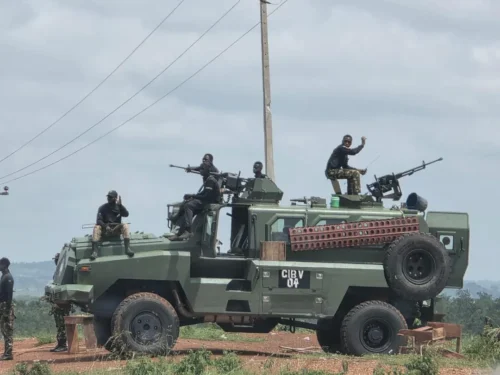
A suspected terrorist collaborator has been arrested in Kaduna State by the troops of the Joint Task Force North West, Operation Fansan Yamma.
The troops also destroyed three improvised explosive devices (IEDs) in Zamfara State and recovered 73 livestock abandoned by fleeing terrorists.
According to a statement issued on Friday by the Media Information Officer of Operation Fansan Yamma, Lieutenant Colonel Aliyu Danja, the two operations were conducted on Thursday.
Danja said troops of Sector 1, acting on credible intelligence, arrested a suspect, Yusuf Adamu, at Kuyello in Birnin Gwari Local Government Area of Kaduna State.
He said preliminary interrogation indicated that the suspect allegedly participated in terrorist activities, including recording a video of a female kidnap victim who was allegedly sexually assaulted by terrorists to facilitate a ransom demand.
“During preliminary interrogation, the suspect reportedly admitted to involvement in terrorist activities, including recording a video of a female kidnap victim who was allegedly sexually assaulted by terrorists to facilitate a ransom demand,” the statement said.
According to Danja, the suspect further alleged that the victim was subsequently killed after the ransom was delivered and that he received ₦50,000 for his role in the operation.
The military spokesman said investigations were ongoing to apprehend the alleged principal suspect, identified as Yusuf Iliya Sani, and other collaborators.
In a related development, troops of Sector 2, working alongside personnel of the Nigeria Police Explosive Ordnance Disposal team, destroyed three IEDs planted by terrorists along the Magami–Dansadau road in Zamfara State.
Danja said the explosives were located and destroyed during a joint operation conducted on Thursday.
He added that the successful clearance operation had elicited positive reactions from residents and road users, who were expected to benefit from improved safety and freedom of movement along the route.
In another operation, troops recovered 73 livestock allegedly rustled by terrorists between Kombo and Gurusu villages in Zamfara State.
The operation followed intelligence reports about the movement of terrorists with rustled animals in the area.
According to the statement, troops swiftly deployed to the location and engaged the suspected terrorists, forcing them to flee and abandon the livestock.
“The recovered animals comprised 14 camels, 19 cows and 40 sheep,” Danja said.
He added that the troops, working alongside local vigilantes, moved the recovered animals to a secure location for further action.
The military said the operations demonstrated its commitment to dismantling terrorist support networks, eliminating explosive threats and protecting lives and property across the North-West.
It urged residents to continue providing credible and timely information about suspicious persons, movements and objects to the nearest security formation to support ongoing military operations.

A traffic warden and two State Civil Guard Corps personnel have been arrested by the Imo State Police Command over the alleged harassment and extortion of a motorist in Owerri.
A viral video recorded by a car occupant captured the operatives allegedly harassing and extorting a driver over the absence of a driver’s licence.
The Police Public Relations Officer in the state, Henry Okoye, said the three operatives had been identified and arrested.
They were identified as Inspector Chinewe Ejiogu, attached to the Shell Camp Divisional Police Headquarters, and two State Civil Guard Corps personnel, Kelechi Nzediagwu and Onyedikachi Chibuike. They are currently detained at the State Criminal Investigation Department.
The command condemned their alleged conduct, describing it as unacceptable and contrary to the discipline and integrity expected of law enforcement personnel.
The Commissioner of Police, Audu Bosso, has directed the command’s Complaint Response Unit to investigate the incident.
The police urged the affected motorist to report to the unit and provide relevant information to aid the investigation, adding that appropriate disciplinary action would follow its conclusion.
The Police spokesperson for Imo State Command, Henry Okoye, disclosed this in a statement.
Okoye said, “The Imo State Police Command is aware of a viral video in which a police traffic warden and two personnel of the State Civil Guard Corps were captured harassing and extorting a motorist allegedly driving without a driver’s licence in Owerri on October 8.
“The Command strongly condemns the conduct depicted in the video, describing it as unacceptable and contrary to the standards of discipline and integrity expected of law enforcement personnel.
“The police officer involved has been identified as Inspector Chinewe Ejiogu, attached to the Shell Camp Divisional Police Headquarters, while the two State Civil Guard Corps personnel have been identified as Mr Kelechi Nzediagwu and Mr Onyedikachi Chibuike. They are currently detained at the State Criminal Investigation Department (SCID).
“Consequently, the Commissioner of Police, Imo State Command, CP Audu Garba Bosso, psc(+), mnips, has directed the Command’s Complaint Response (CRU) Unit to investigate the incident. The affected motorist is urged to report to the unit and provide relevant information to assist the investigation. Appropriate disciplinary action will follow upon its conclusion.
“The Command reiterates that no traffic violation justifies extortion, harassment, or abuse of office. All personnel have been warned to discharge their duties in accordance with the law and treat members of the public with respect.
“The Command urges members of the public to report incidents of police misconduct through the appropriate channels and assures them that allegations of misconduct will be treated seriously.”

A truck has reportedly crushed a Vehicle Inspection Officer (VIO) to death opposite Mega Primary School, along Hospital Road, Akure, the Ondo State capital.
Residents were seen shouting in a video shared by Akure-based radio station, Crest FM on Friday.
According to eyewitnesses, the officer tried to intercept the truck, which was already in the fast lane, but couldn’t stop it before the incident.
The officer was reportedly trapped beneath the trailer after the truck struck him, leaving residents at the scene in distress.
The video also showed some of the officer’s colleagues panicking as they watched the incident unfold. Residents could be heard shouting while people gathered around the scene.
The circumstances surrounding the incident, including the events that led to the officer’s attempt to stop the truck, were not immediately clear.



-

 BIG STORY3 days ago
NAF Releases Names of 25 Personnel Killed in Ondo Crash
-

 BIG STORY4 days ago
Anambra Govt Warns: ‘A Vote for Obi Will Kill APGA’ — Resist Him and NDC
-

 BIG STORY4 days ago
JUST IN: Many Feared Dead as Helicopter Crashes into River in Ondo
-

 NEWS2 days ago
WAEC Revises Subject Combinations For WASSCE Students Ahead Of 2026/2027 Exams
-

 BIG STORY2 days ago
BREAKING: Security Agencies Rescue 20 Kidnapped Prospective NYSC Members In Imo
-

 BIG STORY4 days ago
How Subsidy Removal Funded $500m Lagos Airport Reconstruction — Keyamo
-
 BIG STORY3 days ago
Dangote Stops Petrol Sales to Importing Marketers Over Fuel Blending
-

 BIG STORY4 days ago
‘He’ll Harvest Votes’ — Umahi Predicts Tinubu Will Sweep All South-East States