Lagos does not forgive complacency. Its floods do not negotiate, its aquifers do not replenish themselves, and its waste, left unattended, grows into black mountains that burn for weeks. For most of the past three decades, the Lagos State Ministry of Environment and Water Resources responded to these realities with the tools and tempo it inherited: slow, under-funded, and too often deferential to powerful interests. Then came 2025, and with it a commissioner, Tokunbo Wahab, who treated the portfolio like an emergency that had already lasted thirty years. The result was the most consequential single year any Lagos environment ministry has ever recorded. This is an unsparing account of what was achieved, agency by agency, what remains stubbornly unfinished, and what it cost, in political capital, in bruised relationships, and in sheer human exertion, to move a megacity even a few metres closer to liveability.
The Man Who Refused to Manage the Crisis
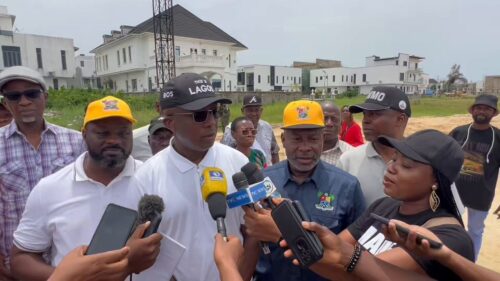
Tokunbo Philip Wahab is a lawyer who speaks like a prosecutor and inspects sites like a detective who already knows where the body is buried. By the end of 2025, he had personally led several field operations, he is on X at odd hours, answering queries about why a pump station promised in March was still a hole in the ground in October, or why a drainage channel cleared in July was already blocked again in September. Ministry staff learned quickly that “I will get back to you” was no longer an acceptable answer. Decisions that once crawled through ten committees were taken in the site offices on short notice. You can call it “governance by adrenaline.” It has continued to produce results, but it has also produced friction that will echo into 2026 and beyond.
Lagos Water Corporation (LWC): The First Real Progress in a Generation
Water is the most intimate of Lagos’s daily humiliations. Successive governments have announced grand master plans, only to deliver a few additional million gallons while demand raced ahead by tens of millions. In 2025, the Lagos Water Corporation finally broke that cycle.
The flagship project was Adiyan Phase II. On 24 October, the final length of 1,200 mm ductile iron pipe – pipe number 944 was lowered into place along the 8 km transmission corridor from the new intake on the Ogun River to the treatment plant at Adiyan. When fully commissioned in the first quarter of 2026, the plant will add 70 million gallons per day (MGD) of treated water, raising total state production from roughly 210 MGD at the start of the year to approximately 280 MGD. It is the first major waterworks in Lagos to be completed within the original timeline in fifteen years.
But 2025 was about more than one plant. In April, the state signed a $180 million financing package with the Belstar Capital–ENKA consortium, insured by the U.S. Development Finance Corporation, to rehabilitate the decaying Iju (45 MGD) and Ishashi (4 MGD) plants and to construct two new 35 MGD green-field mini-works at Akute and Otta-Iyana. Work began immediately. By December, the Iju rehabilitation was 68% complete, and the first new mini-plant had reached foundation level.
Older, forgotten assets were resurrected. The Mosan-Okunola Waterworks in Alimosho, abandoned since 1999, was recommissioned in May after a nine-month overhaul. It now supplies 2.5 MGD to a local government that had never known public piped water. Across the state LWC replaced 127 km of tertiary distribution pipes and established 42 district meter areas. In the pilot zones non-revenue water fell from 64 % to 41 % still scandalously high by global standards, but a measurable improvement.
By November 2025, total production stood at 252 MGD, the highest figure Lagos has ever recorded in a single year. It is still less than a third of the estimated demand, and millions continue to buy expensive, sometimes contaminated water from tankers and sachets. Yet for the first time since 1999, the gap narrowed rather than widened.
Office of Drainage Services & Emergency Flood Abatement Gangs: Turning the Tide, Literally
Lagos floods for two reasons: it rains hard, and people have spent decades blocking the paths the water once took. In 2025, the Office of Drainage Services (ODS) and its rapid-response unit, the Emergency Flood Abatement Gangs (EFAG), attacked both problems simultaneously.
Between January and October, the gangs cleaned 666 linear kilometres of tertiary and secondary drains, more than in the previous four years combined. They removed 412,000 cubic metres of solid waste and silt. Forty-two new high-capacity pumps were installed in systemic flood spots: Idimu, Iyana-Ipaja, Ajegunle phases I and II, Okota, and parts of Lekki Phase I. In September, the state took the unprecedented step of suspending all ongoing reclamation and sand-filling activities across the state. Forty-seven sites were sealed, eleven were partially demolished, and the message was unambiguous: wetlands and flood plains are no longer negotiable real estate.
The results showed during the October rains. Areas that routinely went underwater for days, Osborne Foreshore Phase II, parts of Ikate-Elegushi, System 1E drainage basin on the Lekki-Epe axis, experienced flooding measured in hours rather than days. It was not perfect; Agiliti, Ketu, and parts of Ikorodu still suffered badly, but the reduction in duration and extent was the clearest evidence yet that preventive cleaning and reclamation control actually work.
Lagos Waste Management Authority (LAWMA): From Crisis Management to Circular Ambition
For years, LAWMA’s public image oscillated between heroic and helpless. In 2025, it was allowed, for the first time, to behave like a modern solid-waste utility.
The fleet renewal was massive: 1,050 new compactor trucks, most running on compressed natural gas, replaced vehicles that should have been scrapped a decade earlier. Domestic collection coverage in residential areas rose from 61 % to 78 %. Forty thousand jobs, sweepers, loaders, sorters, were formalised through audited Private Sector Participants (PSPs). The Styrofoam and single-use plastics ban finally acquired enforcement muscle: 123 metric tonnes of banned items were confiscated, 1,800 traders fined, and 41 supermarkets sealed until they complied.
But the real leap forward came at the 11th Lagos International Climate Change Summit in November, where LAWMA and the ministry signed four transformative MoUs:
- HAK Waste Nigeria Ltd – State-wide deposit-refund system for PET bottles and cans, targeting 60 % recovery by 2028, modelled on successful schemes in Rwanda and South Africa.
- Haggai Logistics Ltd – Construction of a 100-tonne-per-day tyre recycling plant in Epe that will produce crumb rubber and pyrolysis oil.
- Mondo 4 Africa – A plastic-to-diesel pyrolysis facility in Ikorodu capable of processing 50 tonnes daily, with fuel off-take agreements already signed with two transport unions.
- Harvest Waste Consortium (Dutch/Nigerian) – Definitive agreement for a 60–80 MW waste-to-energy plant at the Epe landfill, with financial close expected in March 2026 and construction starting immediately thereafter.
These are not letters of intent; they are binding contracts with performance bonds. For the first time, Lagos has a realistic pathway to close its three ageing landfills: Olusosun, Solous 2 & 3 within the next decade.
Lagos State Environmental Protection Agency (LASEPA): From Noise Nuisance to Full-Spectrum Regulator
LASEPA used to be known primarily for midnight raids on loud churches. It has since grown up.
Twelve new continuous ambient air-quality monitoring stations were commissioned, bringing the network to eighteen and allowing the agency to launch Lagos’s first public air-quality index dashboard. Real-time PM2.5, NO₂, SO₂, and ozone readings are now available on the LASEPA website and the Partner, AirQo mobile app. On days when Dangote Refinery flares heavily or when harmattan dust mixes with generator exhaust, Lagosians can see exactly why their throats hurt.
Industrial enforcement was systematic: 312 contravention notices, 89 seals, and the first-ever requirement that large emitters install continuous emission monitoring systems linked directly to LASEPA servers. Noise regulation remained muscular; several religious houses and over 87 nightclubs served abatement notices, but it was no longer the agency’s only story.
The criticism that enforcement is selective has not disappeared. A handful of five-star hotels on Victoria Island appear to receive gentler treatment than Pentecostal churches in Ajegunle. LASEPA insists the difference is procedural compliance, not status, but perception matters, and the perception has not been fully dispelled. However, a lot of wins have been recorded.
Lagos State Waterways Authority (LASWA): Making the Lagoon Work for Commuters
Eighteen per cent of Lagos is water, yet until 2025, the state treated it mostly as scenery. LASWA changed that with the Omi Eko initiative launched on 17 October.
Fifteen new commercial ferry routes were activated, thirty-eight jetties upgraded or newly built, and 140 km of navigable channels dredged and marked with solar-powered buoys. A firm order was placed for seventy-five fully electric ferries; the first twenty-five will arrive in 2026. Boat licensing and compulsory third-party insurance became non-negotiable; accidents fell 31 % year-on-year.
Commuters from Ikorodu to Victoria Island can now make the journey in forty-five minutes for less than the cost of fuel on the expressway, when the boats run on schedule, which they increasingly do. Tariff increases were introduced during the year, but the direction is unmistakable: Lagos is finally building a water-borne mass transit system worthy of a coastal megacity.
Lagos State Wastewater Management Office (LSWMO): The Quiet Crisis That Refused to Stay Quiet
Only 8 % of Lagos households are connected to centralised sewerage. The rest rely on septic tanks whose soakaways leach into the shallow aquifer that millions still use for drinking water. In 2025, LSWMO began the long war against this invisible poisoning.
One hundred and eighty properties, mostly hotels, factories, and large estates, were sealed for discharging raw sewage directly into storm drains. The first phase of the Lagos Wastewater Management Master Plan 2025–2035 was adopted in September, identifying eleven new treatment plants and 1,200 km of interceptor sewers needed over the next decade. Two hundred modular public toilets were added to the network, bringing the total to 1,910.
Progress is glacial compared to the scale of the problem, but for the first time, the state has a funded plan and an agency willing to use its enforcement powers.
Lagos is not yet the city its residents deserve, but it is demonstrably further along the path than it was in January. More people have piped water than at any time in the past twenty years. The streets are cleaner. The drains flow faster. The lagoon carries commuters instead of only effluent. The air is monitored, the waste is beginning to be converted into energy, and the state finally has a climate plan that international investors treat as bankable.
Much of this happened because one man decided that managing decline was no longer an acceptable job description. Whether the institutions he has shaken awake can maintain the pace after he eventually leaves is the question that will define the next decade. For now, the evidence is visible from the Third Mainland Bridge at dawn: new water pipes glinting in the sun, ferries cutting white wakes across the lagoon, and, in the distance, the smoke from Olusosun landfill burning a little less thickly than it did last year.
It is not enough. It is, however, a beginning.




















 BIG STORY4 days ago
 BIG STORY2 days ago
 BIG STORY2 days ago
 BIG STORY8 hours ago
 BIG STORY9 hours ago
 BIG STORY9 hours ago
 BIG STORY21 hours ago
 BIG STORY8 hours ago